TANZANIAINVEST has been interviewing Mr. Ali Khalil Mirza, Marketing Director of the Zanzibar Commission for Tourism (ZCT), to learn about the current Zanzibar tourism sector situation and outlook.
TI: How did Zanzibar tourism first begin?
Ali Khalil – Zanzibar Commission for Tourism: Tourism started over 30 years ago.

Tourism has existed in Zanzibar since the 60s.
However, in those days it existed in a different manner, where we used to have only 3 hotels that were under the government organisation.
In those days tourists came out of the curiosity, rather than [because of] specific marketing strategies, of people mainly going to Kenya with very few of them flying form Kenya to Zanzibar.
Also, Zanzibar and Tanzania maintained a very good relationship with the so-called eastern European block so we used to have people from east Germany, Russia and alike that were invited by government officials to come and visit our island and, therefore, tourism was mainly for friendship purposes.
Mostly people would be here on invitation and very few would come to Zanzibar on their own.
TI: When did Zanzibar tourism properly take off and why?

AK: In 1985 or 1986, the Government of Tanzania started to change the economic meridian from socialism to an open economy and, therefore, an investment Act was promulgated in 1986 and was later amended in 1989 to cater for all local and foreign investments in Tanzania.
From 1989, the Government initially thought there would be investment in all sectors of the economy, but it was tourism afterwards that responded more than any other sector.
Therefore, in 1991 we had to prepare a master plan and this is when our institution, and many others, took place- like ZIPA (Zanzibar Investment Promotion Agency) to cater for investment activities in Zanzibar that mostly would be towards the tourism sector.
TI: From 1991 until today, who has been developing the tourism industry in Zanzibar, the private or the public sector? What has been the level that has been achieved thus far?
AK: I would say initially the government of Zanzibar fired the first shot by welcoming investment activities by providing a conducive investment environment, such as lend being accessible. {xtypo_quote_left}The government of Zanzibar fired the first shot by welcoming investment activities by providing a conducive investment environment.{/xtypo_quote_left}
Secondly, providing main roads and other infrastructures that were not there before.
Subsequently, Italian investors that were already present in tourism in Mombasa and Malindi in Kenya were the first ones to respond very quickly to such new environment by setting up hotels in Zanzibar.
Because of historical reasons, Zanzibar and Mombasa had a very good relationship and Italians showed [themselves] to be risk takers.
It was easy for them to then extend from Kenya to Zanzibar.
At the same time, the Government started promoting the island throughout the world and explaining the destination.
TI: Who are the main competitors to your destination and what are your competitive advantages?
AK: Our main competitors are our neighbours Kenya, Mauritius, Reunion and South East Asia.{xtypo_quote_right}Our advantage is first that we are a new destination, not full exploited, with an undestroyed culture.{/xtypo_quote_right}
Our advantage is first that we are a new destination, not full exploited, with an undestroyed culture which is still very strong with a unique cosmopolitan atmosphere and tolerance.
Our culture, inheritance and heritage represent our main competitive advantages.
We are a blending of interrelationships [because of] many years of various races, cultures and religions.
On top of that, we have an unspoiled marine and terrestrial environment, together with nice climate, nice weather with a constant 27 [degrees] Celsius and not very cold waters.
Finally, we have security where you can walk around without being annoyed by anybody.
Zanzibar Tourism Outlook
TI: How significant is the current presence of tourism in Zanzibar and how are you looking to further develop it?
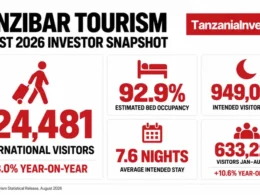
AK: We receive almost 100,000 tourists per year, but this year we should definitely exceed such a cap with about 120,000 arrivals.
We already have 173 hotel establishments, out of which 55 are categorized as hotels of medium and higher level standards.
What we want now is to promote Zanzibar as a higher standard, low volume-high yield type of tourism destination, within the coming 5 years. {xtypo_quote_left}What we want now is to promote Zanzibar as a higher standard, low volume-high yield type of tourism destination.{/xtypo_quote_left}
We are trying to increase the quality and the quantity of tourists because we know that good hotels keep on improving their facilities and will, hence, attract higher income tourists.
At the same, time we do not want those small establishments to die out immediately and, therefore, we will continue to promote the island on both levels: quality and quantity.
We want our figures to double.
We want our resources to be sustainable.
If we manage to check our volume of tourism while increasing the revenues, we shall get away with something such as environmental disruption, because of our very good marine (coralline barrier) and terrestrial environment, which is still the best [compared to] many parts of Africa.
Secondly, there is the whole issue of social and culture.
Having high-income tourists who are more inclined to follow all the norms of the country without polluting the local culture is what we are striving for.
We have this so-called balanced approach by which we want tourists and we want resources but we do not want to spoil our society and our culture because there is where our strength is.
TI: Why is Stonetown currently the primary destination for tourism in Zanzibar?
AK: Stonetown shows and portrays many of the cultural blends that have been accumulated over many centuries.
This is why I think reaching our goal of high yield 300,000 is a good number.
TI: How do you plan to reach such a target?
AK: Originally, Zanzibar tourism development was very much geared by seasonality because we have a rainy season that commences in March [and lasts] until the end of May and then a short rainy season at the end of the year.{xtypo_quote_right}We are looking at extending our seasonality [and] at extending the permanence of visitors.{/xtypo_quote_right}
Initially, many hotels and tour operators would not like to risk bringing tourists during this period, but as we have been going on diversifying the product the season now has extended.
We have between 9 and 10 months of a season, except for the rainy season from March until May.
Our high season used to commence in the mid-July, but beginning from this year, the season has now started to begin in June and it would be ending by, say, the end of September.
The season will recommence again in mid-November until February, with December and January as the highest peak, as well as August and September, of course.
We are looking at extending our seasonality.
We are also looking at extending the permanence of visitors where, formally, we would have people for 3 nights 4 days, now it is 6 nights-7 days and, with package tours, we reach 2 weeks.
We aim to do so by including cultural events to go along with tourism activities.
TI: What are the challenges to ensuring the success of such a plan?
AK: Our main challenge on the island is still to improve our infrastructure, our roads network, our airports and ports and, more in general, all type of services.
We need to improve accessibility via air and improve our facility at the airport and that is being tackled thanks to a World Bank programme under the coordination of the Ministry of Communications and Transport of Zanzibar.
Now there is also a port program with the EU [that is] underway for $43 million.
Both improvements should be finished within a couple of years.
Secondly, we need to diversify our markets, where still our main markets are in Western Europe such as Italy, UK, France and Spain.
We have now a very fast growing market from South Africa.
Therefore, the infrastructures I mentioned should be included.
We have already started digging in South-East Asia, targeting China and the former Eastern European block and all other emerging markets.
Also, we are promoting domestic, national and regional tourism.
Locally, we are already informing the people on the island about the facilities available here so during low season we could reduce our rate to welcome locals.
Nationally, we are aiming at [people in] Tanzania with good income, mainly in Dar es Salaam, who traditionally would travel outside the country.
Then, in the spirit of the previous East African Community, we are also talking of the regional markets whereby our offer could cover the East Africans that are travelling in the region and to Tanzania.
Therefore, tourism could be tied with trade, whereby many people come here to buy goods.
Strengthening our domestic markets plus diversifying our market is a main challenge in making sure our industry is sustainable.
After having witnessed the drop in tourism after 9/11, we do not want to depend too much on the world market.
Thirdly, there is the issue of capacity building: we have the facilities, we have the working opportunities that have been created by the hotels, but now we don’t have the capacity for local stuff, for Zanzibarians to capture such opportunities.
This is why we are tidying up, with the help of EU and the French government, our training school so as to produce students of medium and high calibre.
Want to know more about Tourism in Tanzania? Our free overview of the Tanzania Business and Investment Guide 2026 covers Tourism, plus key sectors and investment opportunities. The complete 141-page edition includes policies, taxation, key regulations, full macroeconomic data, and sources, and is also available at no cost upon completion of a short form.
Download Free OverviewGet the Full Edition for Free