
Zanzibar
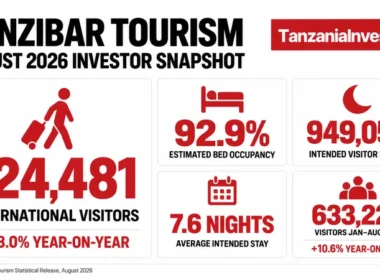
Zanzibar is a semi-autonomous archipelago of the United Republic of Tanzania that welcomed 917,000 tourists in 2025 and generated a GDP of about USD 1.4 billion in 2021 at 2015 constant prices.
The archipelago united with Tanganyika in 1964 to form the United Republic of Tanzania and today operates its own executive, legislative, and judiciary institutions under the Revolutionary Government of Zanzibar, with President Dr Hussein Ali Mwinyi as Head of Government[3].
Zanzibar's House of Representatives passed the 2026/2027 government budget in June 2026, reflecting the archipelago's fiscal autonomy for non-union matters within the Tanzanian federation[2].
Contents
Zanzibar Within the Union with Mainland Tanzania
Zanzibar joined Tanganyika in 1964 to form the present-day United Republic of Tanzania, and the archipelago retains a semi-autonomous status within that Union structure.
The Revolutionary Government of Zanzibar, headed by President Dr Hussein Ali Mwinyi and the Revolutionary Council, is fully responsible for all non-union matters, including its own budget, taxation, and investment framework[3].
The Zanzibar House of Representatives (Baraza la Wawakilishi) is the archipelago's legislature, with the Speaker Hon. Zubeir Ali Maulid presiding over sessions that debate and pass Zanzibar-specific legislation such as the Zanzibar Newspapers Corporation Act 2026 and the Fisheries Development and Marine Conservation Authority Bill 2026[2].
Union matters, including foreign affairs, defence, and monetary policy, remain the competence of the United Republic, while Zanzibar handles its own trade promotion, tourism, land, and fiscal matters.
Political Reconciliation and Governance
On 9 July 2026, President Hussein Ali Mwinyi witnessed the signing of the Joint Declaration on Political Reconciliation (Muafaka) between Chama Cha Mapinduzi (CCM) and ACT-Wazalendo at Ikulu Zanzibar, formalising an agreed agenda between the two parties[3].
The reconciliation is intended to unite citizens, strengthen national cohesion, and enable joint efforts to advance development in the archipelago[3].
Zanzibar operates a multiparty democracy in which the 1984 constitution provides for the inclusion of the opposition in a Government of National Unity, an arrangement that shapes the archipelago's political stability and investment climate.
Zanzibar Government Budget 2026/2027
The Zanzibar House of Representatives passed the main government budget for the 2026/2027 financial year on 19 June 2026, following its presentation by the Minister of Finance and Planning[2].
Ministerial budgets covered by the same session included Finance and Planning; Youth, Employment and Empowerment; Arts, Culture and Sports; and Lands and Housing Development, alongside the President's Office (State House) estimates presented by Minister of State Dr Saada Mkuya Salum on 8 May 2026[2][3].
Standing committees of the House, including the Budget Committee, the Public Accounts Committee (PAC), and the Communications, Land and Energy Committee, tabled reports for the 2024/2025 fiscal year that fed into the deliberations[2].
Zanzibar Economy: Tourism, Spices, and Ports
Zanzibar's economy is dominated by services, driven by a tourism sector whose arrivals climbed to 917,000 in 2025[1].
The archipelago's main industries are spices, raffia, and tourism, with clove, nutmeg, cinnamon, coconut, and black pepper the principal spice crops that historically earned the islands the name "Spice Islands" together with Tanzania's Mafia Archipelago[1].
Zanzibar is served by five ports and by Abeid Amani Karume International Airport, which can handle up to 1.5 million passengers per year, providing the logistical backbone for both tourism and trade[1].
The archipelago's marine ecosystem underpins fishing and algaculture and, in 2026, the House of Representatives advanced the Fisheries Development and Marine Conservation Authority Bill to institutionalise governance of the blue economy[2].
Geography and Population
Zanzibar lies 25 to 50 kilometres off the Tanzania mainland and consists of two large islands, Unguja and Pemba, plus more than 50 islets[1].
The capital, Zanzibar City, is located on Unguja, and its historic centre, Stone Town, is a UNESCO World Heritage Site[1].
The archipelago has long been part of the Swahili maritime world of the East African coast, with its level of engagement with the sea, through fishing, sailing technology, and port facilities, deepening significantly in the second millennium C.E.[6].
Investment Opportunities in Zanzibar
Tourism and upmarket hospitality remain the largest opportunity, supported by tourist arrivals reaching 917,000 in 2025 and airport capacity of up to 1.5 million passengers per year[1].
The blue economy offers scope for fisheries, aquaculture, and algaculture investment, further supported by the 2026 legislative push to establish a Fisheries Development and Marine Conservation Authority[2].
Spice value chains, including clove, nutmeg, cinnamon, coconut, and black pepper, provide additional avenues for processing and export-oriented investment[1].
Port and airport-linked logistics, given five operational ports and an international airport, complete the archipelago's opportunity set for investors targeting the Indian Ocean rim[1].
Last Update: July 2026