





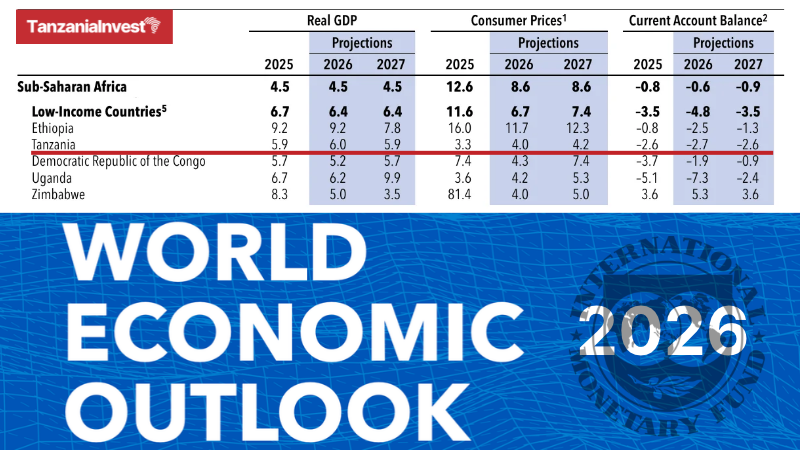
The International Monetary Fund (IMF) projects Tanzania’s real GDP to grow by 6.0% in 2026 and 5.9% in 2027, with inflation at 4.0% and 4.2%, in its World Economic Outlook October 2026.
The report, titled “Resilience Under Strain, Urgent Choices”, was released on 13 October 2026 during the IMF and World Bank Annual Meetings in Bangkok, Thailand.
Global Economic Growth and Inflation in 2026 and 2027
Global growth is projected at 3.1% in 2026 and 3.4% in 2027, unchanged for 2026 and revised moderately upward for 2027 compared with the April 2026 World Economic Outlook.

According to the IMF, activity held up better than expected in the first half of 2026 despite the war in the Middle East and continuing trade tensions, supported by strong investment in artificial intelligence.
Advanced economies are projected to grow by 2.1% in 2026 and 1.8% in 2027, while emerging market and developing economies slow to 3.7% in 2026 before recovering to 4.4% in 2027.
Global headline inflation is projected to rise to 4.7% in 2026 from 4.1% in 2025, before easing back to 4.1% in 2027, driven mainly by higher energy and food prices.
The IMF’s baseline assumes crude oil prices 41% higher and natural gas prices 48% higher in 2026 than in 2025, and it sees risks to the outlook as tilted to the downside.
Africa Economic Growth and Inflation in 2026 and 2027
Growth in sub-Saharan Africa is projected to remain stable at 4.5% in 2026 and 2027, although the IMF noted substantial divergence across countries depending on policy space, commodity exposure, climate shocks, and access to external financing.

Inflation in sub-Saharan Africa is projected to ease to 8.6% in 2026 and 2027 from 12.6% in 2025, with consumer prices in 2026 rising 15.6% in Nigeria and 4.4% in South Africa.
Among the continent’s largest economies, the IMF projects 2026 growth of 4.2% for Nigeria, 1.0% for South Africa, and 9.2% for Ethiopia, one of the fastest rates in Africa.
Low-income countries in sub-Saharan Africa are projected to grow by 6.4% in 2026, compared with 3.3% for middle-income countries and 4.2% for oil exporters in the region.
In North Africa, which the IMF groups with the Middle East and Central Asia, growth in 2026 is projected at 5.1% for Egypt, 4.5% for Morocco, and 3.8% for Algeria.
The report noted that oil-importing economies without major natural resources are more affected by higher energy and food prices, while declining official development assistance is a headwind across the region.
East Africa Economic Growth and Inflation in 2026 and 2027
Among Tanzania’s East African Community partners, the IMF projects 2026 growth of 10.5% for South Sudan, 7.4% for Rwanda, 6.2% for Uganda, 5.2% for the Democratic Republic of the Congo, 4.5% for Kenya, 3.6% for Burundi, and 2.3% for Somalia.
Uganda’s growth is projected to accelerate to 9.9% in 2027 from 6.2% in 2026, the highest rate expected among East African Community members that year.
Inflation across East Africa varies widely in 2026, from 4.2% in Uganda, 4.3% in the Democratic Republic of the Congo, and 6.0% in Kenya to 10.5% in Burundi, 12.3% in Rwanda, and 27.6% in South Sudan.
Outside the bloc, Ethiopia is projected to grow by 9.2% in 2026 and 7.8% in 2027, with inflation easing to 11.7% in 2026 from 16.0% in 2025.
Among Tanzania’s southern neighbours, growth in 2026 is projected at 5.6% for Zambia, 2.6% for Malawi, and 1.0% for Mozambique.
Tanzania Economic Growth and Inflation in 2026 and 2027
Tanzania’s real GDP growth is projected to accelerate to 6.0% in 2026 from an estimated 5.9% in 2025, before settling at 5.9% in 2027, well above the sub-Saharan Africa average of 4.5%.
Consumer price inflation in Tanzania is projected at 4.0% in 2026 and 4.2% in 2027, up from 3.3% in 2025, the lowest rate among East African Community members and less than half the sub-Saharan Africa average of 8.6% in 2026.
Tanzania’s current account deficit is projected at 2.7% of GDP in 2026 and 2.6% in 2027, compared with 2.6% in 2025.
In its chapter on corporate income taxation, the IMF cited Tanzania, together with Guinea and Mali, among commodity exporters relying on foreign mining companies that have recently strengthened their frameworks against tax avoidance.
Want to know more about the Economy in Tanzania? Our free overview of the Tanzania Business and Investment Guide 2026 covers the Economy, plus key sectors and investment opportunities. The complete 141-page edition includes policies, taxation, key regulations, full macroeconomic data, and sources, and is also available at no cost upon completion of a short form.
Download Free OverviewGet the Full Edition for Free


