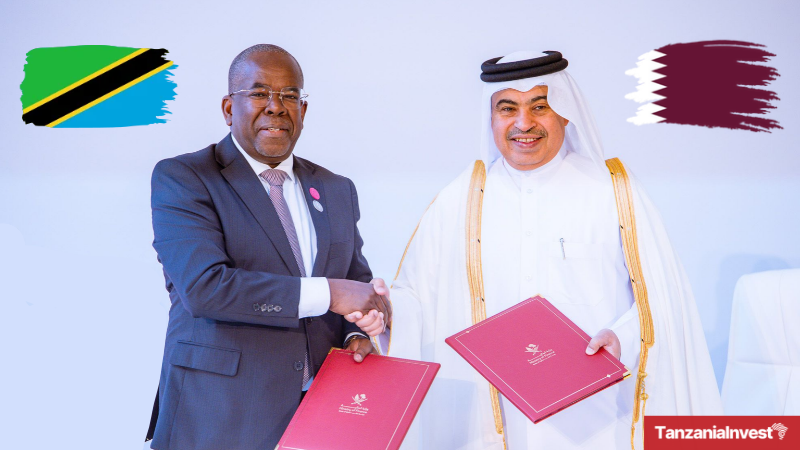
Tanzania and Qatar signed a Double Taxation Agreement on 29 September 2026 to boost bilateral trade and investment.
The Minister of Finance, Amb. Khamis Mussa Omar, and Qatar’s Minister of Finance, Ali Bin Ahmed Al Kuwari, signed the agreement on the sidelines of the Asian Infrastructure Investment Bank’s (AIIB) 11th Annual Meeting of the Board of Governors in Doha, Qatar.
“This agreement reflects the strong friendship between our two nations, together with our ambition to build a modern, equitable system that attracts investors and aligns with international standards,” Omar said.

“By eliminating double taxation, this agreement will boost international trade, investment and business activities, and build a more transparent and predictable environment for investors,” Omar said.
He said the agreement strengthens cooperation between the two countries’ tax authorities and supports international efforts against tax evasion and avoidance while protecting each country’s tax interests.
Omar named infrastructure, energy, tourism, transport and logistics, agriculture and financial services as sectors where Tanzania expects the agreement to attract new investment.
“Tanzania views this agreement as an opportunity to attract new investment across various sectors,” Omar added.
For his part, Qatar’s Minister of Finance, Ali Bin Ahmed Al Kuwari, said Tanzania is an important economic partner for Qatar and that removing double taxation on cross-border business income will attract more investment and capital from Qatar.

Al Kuwari pointed to the Qatar Investment Authority (QIA) and the Qatar Fund for Development (QFFD) as already participating in various projects in Tanzania, and said Qatar is ready to exchange knowledge and expertise with Tanzania rather than simply transfer it one way.
Tanzania has separately invited Qatari investors, including Thirty-Five Investment Holding, to invest in livestock and fisheries, from meat production to the completed Kilwa Masoko Fishing Port.
Tanzania’s meat exports have risen from about 1,000 metric tonnes in 2021 to nearly 15,000 tonnes, with a government target of at least 50,000 tonnes a year.
Tanzania has double taxation treaties in force with nine countries: Canada, Denmark, Finland, India, Italy, Norway, South Africa, Sweden, and Zambia.
The country has also signed agreements–not yet in force–with the United Arab Emirates in 2022, Oman in 2024, Türkiye in May 2026, and Singapore in June 2026.
Want to know more about the Economy in Tanzania? Our free overview of the Tanzania Business and Investment Guide 2026 covers the Economy, plus key sectors and investment opportunities. The complete 141-page edition includes policies, taxation, key regulations, full macroeconomic data, and sources, and is also available at no cost upon completion of a short form.
Download Free OverviewGet the Full Edition for Free