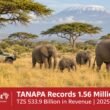


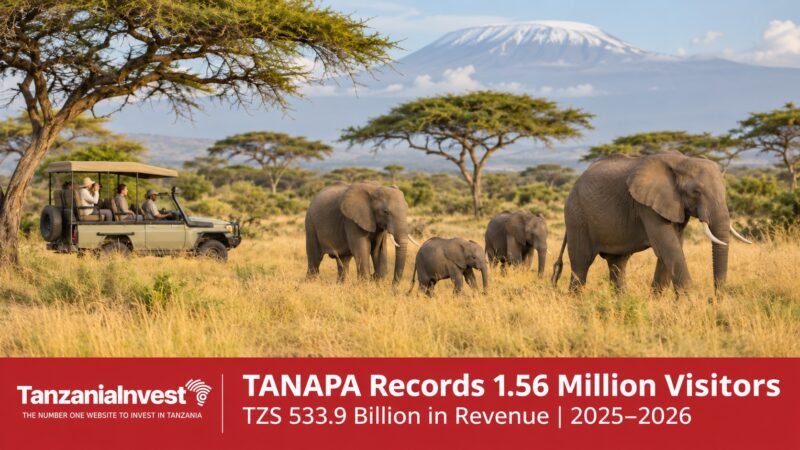
On 10th November 2026, the Tanzania National Parks Authority (TANAPA) released its results for the 2025-2026 financial year, reporting 1,559,441 visitors across its 21 national parks and TZS 533.9 billion (± USD 201.5 million) in revenue.
The information was shared during a meeting organized by the Office of the Treasury Registrar (OTR) to strengthen relations between OTR, TANAPA and editors, provide a platform for exchanging views and experiences, clarify issues concerning TANAPA, and promote a shared understanding of the Authority’s activities and responsibilities.
Tourists & Revenue Growth
Visitors to TANAPA’s parks increased from 788,940 in the 2021-2022 financial year to 1,559,441 in 2025-2026, representing an average annual growth of approximately 24%.

Revenue generated by the parks increased from TZS 174.7 billion to TZS 533.9 billion over the same period, equivalent to an average annual growth of approximately 40%.
The Authority attributed the growth in international tourist arrivals partly to the Royal Tour documentary featuring Tanzania’s President Samia Suluhu Hassan, which promoted Tanzania as a tourism destination.
TANAPA has also diversified its tourism products beyond conventional wildlife safaris to attract different visitor segments. These include hot-air balloon safaris in Serengeti and Tarangire national parks, exclusive black rhino viewing in Serengeti and Mkomazi national parks, horseback safaris in Arusha National Park, and catch-and-release sport fishing in Nyerere, Ruaha and Katavi national parks.
Other products include hot springs tourism in Ruaha National Park, night stargazing and astronomy experiences in Kilimanjaro, Arusha and Lake Manyara national parks, and helicopter tours over Mount Kilimanjaro.
The Authority is also developing sports tourism through an 18-hole golf course in the Fort Ikoma area of Serengeti National Park, alongside events such as the Great Ruaha, Serengeti Safari, Serengeti Migration, Kitulo and Arusha marathons.

Wildlife Conservation and Anti-Poaching Operations
TANAPA reported progress in protecting endangered wildlife over the past five years, including the recovery of black rhinos and chimpanzees.
Black rhino numbers increased from 128 in 2021 to 170 in 2026. Tanzania’s national black rhino population had fallen to only three animals between 1980 and 1985.
Chimpanzee numbers increased from 196 in 2021 to 288 in 2026 across Gombe, Mahale Mountains and Rubondo Island national parks, through forest habitat protection and measures to prevent the transmission of human respiratory diseases.
The Authority has also established a captive-breeding and rewilding programme for African wild dogs in Mkomazi National Park to rebuild populations threatened by human-wildlife conflict.
In a separate operation, approximately 400 elephants were relocated from Kitengule Ranch in Kagera Region to Burigi-Chato National Park using helicopters, drones and satellite tracking, to reduce damage to sugarcane and banana farms.
On anti-poaching, TANAPA reported arresting 35,559 suspects, confiscating 105 weapons, recovering 6,860 illegally grazed livestock and dismantling 10,971 wire snares.
The Authority also reported adapting to changing poaching tactics, with offenders increasingly using motorcycles and machetes rather than relying mainly on traditional wire snares and firearms.
Technology and Conservation Infrastructure
TANAPA has expanded the use of technology to improve wildlife monitoring, park security and tourism management.
The Authority has deployed 40 drones for aerial surveillance, boundary monitoring, wildlife tracking and rapid ranger deployment, and plans to increase the fleet to 100 drones over the next five to ten years.
Other investments include GPS satellite collars for tracking key herd leaders, sniffer dogs, patrol aircraft and three modern command and control centres: one in Serengeti National Park and two in Mkomazi National Park.
TANAPA has also built 10 radio communication towers across Serengeti, Lake Manyara, Tarangire, Mkomazi and Nyerere national parks, alongside radio communication systems in Burigi-Chato and Ugalla River national parks.
A digital tracking system is being developed to monitor safari vehicles in Serengeti National Park, addressing speeding, unauthorized off-road driving and emergencies involving stranded vehicles.
Habitat Restoration and Community Development
Beyond wildlife protection, TANAPA has undertaken ecosystem restoration programmes to improve biodiversity and maintain natural habitats.
The Authority removed invasive plant species across 440.22 hectares in 15 parks and cleared 1,546 hectares of dense bush in Lake Manyara National Park to restore grazing areas.
It also restored the Katavi-Mahale wildlife corridor with support from the German government, enabling communities in surrounding villages to generate income through carbon credit sales.
The Speke Gulf wildlife corridor, connecting Serengeti to Lake Victoria, was also reconnected through the compensation and peaceful relocation of residents, restoring access to permanent water sources for migrating wildebeest and elephants.
To improve water availability for wildlife, TANAPA drilled eight solar-powered deep wells (six in Mikumi National Park and two in Mkomazi National Park), built six water dams in Nyerere, Serengeti, Katavi and Mikumi national parks, desilted 19 existing dams and unblocked seven natural water channels, including the Katuma River.
On human-wildlife conflict, the Authority responded to 294 reported incidents across 260 villages, conducted 1,403 wildlife chasing and herding patrols, and held 500 community education meetings reaching 47,947 people.
TANAPA also trained 410 young people at VETA Sekou Toure in Mtumbo to serve as Village Game Scouts across 40 villages, with funding secured to train another 150.
Additional community investments included classrooms, teachers’ houses, dispensaries, doctors’ accommodation, rural roads supporting agricultural transport, livestock water ponds and the distribution of 590 beehives to local groups.
TANAPA also emphasized that national parks protect more than wildlife and tourism assets, as their forests and ecosystems safeguard water sources supporting agricultural irrigation and major hydropower stations, including Mtera, Kidatu, Kihansi and the Julius Nyerere Hydropower Dam.
The parks also absorb carbon emissions, help mitigate climate change, and preserve historical and cultural heritage sites such as ancient cave paintings, traditional ritual sites and historical graves.
Tourism Investment and Infrastructure Expansion
To accommodate growing visitor numbers, TANAPA has expanded accommodation, park access infrastructure and investment opportunities for private tourism operators.
Bed capacity across hostels, rest houses, permanent camps and lodges increased from 575 in 2021 to 1,294 in 2026.
The Authority has also allocated 130 investment sites for new lodges and camps, with a focus on the Southern, Eastern and Western tourism circuits.
Six new entrance gates have been built: Marmorile in Tarangire National Park, one in Ibanda-Kyerwa National Park, Machochwe in Serengeti National Park, Mtemere in Nyerere National Park, and Kikwaraza and Doma in Mikumi National Park.
Through the REGROW project, TANAPA built four paved airstrips, one at Mtemere in Nyerere National Park, two in Ruaha National Park and one in Udzungwa Mountains National Park, alongside visitor information centres.
Digital marketing has been expanded through the TANAGO application, TANAPA’s website and a global podcast reported to reach more than 120 million people.
The Authority’s five-to-ten-year development plans include a 6.69-kilometre tarmac road from Minjingu/Kibaoni to the Tarangire National Park gate, and Lake Victoria water tourism linking Serengeti’s Speke Gulf with Saanane Island, Rubondo Island and Burigi-Chato national parks.
TANAPA is also preparing specialized safari packages for AFCON 2027 and plans to host the World Best National Park Awards in Serengeti National Park on 12th December 2026.
Speaking at the event, TANAPA’s Conservation Commissioner, Massana Gibril Mwishawa, said: “Remove the notion that tourism is only for foreigners or wealthy people. Tourism is for everyone, and for Tanzanians, it is their right to visit these national parks. We as Tanzanians should change and not view ourselves as too disadvantaged to enjoy our own resources.”
Commissioner Mwishawa added: “The cost is not high. Entry fees for Tanzanians fall into two categories: TZS 10,800 to TZS 11,800 for the northern parks like Serengeti, Tarangire, Manyara, Kilimanjaro, Arusha, and Nyerere, and TZS 5,000 to TZS 4,400 for standard parks. These natural resources belong to all Tanzanians; we have only been given the authority to manage them.”
Tanzania’s Tourism Sector and National Parks
Tourism is Tanzania’s second-largest export earner after gold, with receipts of USD 4,565.8 million in the year ending September 2026, up 4.1%, and the sector accounts for 17.2% of GDP and 25% of foreign exchange earnings.
The country recorded 5,935,561 tourists in 2025, up 10.7% from 5,360,247 in 2024. These comprised 2,294,495 international arrivals, up 7.1% from 2,141,895, and 3,641,066 domestic tourists, up 13.1% from 3,218,352.
From January to June 2026, international arrivals were 993,771, down 0.3% from 996,787 in the same period of 2025. The Government targets 8 million tourists by 2030.
Wildlife safaris were the main activity for 49.4% of international visitors in 2025. Safari visitors spent USD 452 per person per night, against an overall average of USD 289.
TANAPA manages Tanzania’s 21 national parks, but not all protected areas. The Ngorongoro Conservation Area is managed by the Ngorongoro Conservation Area Authority (NCAA), and 29 game reserves and 23 game-controlled areas by the Tanzania Wildlife Management Authority (TAWA).
TANAPA is the largest of these institutions. From January to June 2026, it received 55.3% of international visitors to Ministry-managed attractions and collected 53.5% of their tourism revenue, ahead of NCAA (33.1%) and TAWA (12.8%).
Demand remains concentrated in the northern circuit, with Serengeti (13.1% of visits) and Tarangire (9.0%) among the most visited attractions. Southern parks such as Mikumi (2.6%), Udzungwa Mountains (0.7%) and Ruaha (0.6%) receive a small share.
TANAPA’s revenue target for 2026-2027 is TZS 720.3 billion, up from TZS 600.1 billion for 2025-2026.
Want to know more about Tourism in Tanzania? Our free overview of the Tanzania Business and Investment Guide 2026 covers Tourism, plus key sectors and investment opportunities. The complete 141-page edition includes policies, taxation, key regulations, full macroeconomic data, and sources, and is also available at no cost upon completion of a short form.
Download Free OverviewGet the Full Edition for Free