


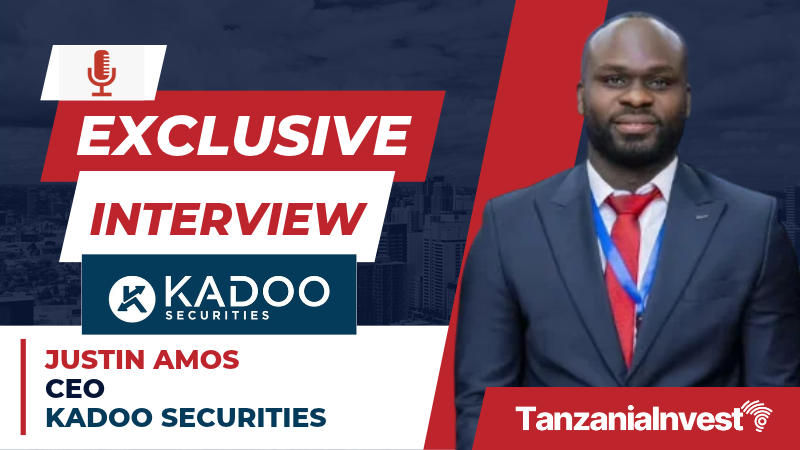
In this exclusive interview with TanzaniaInvest, Justin Amos, CEO of KADOO Securities, a Dar es Salaam Stock Exchange dealing member offering securities brokerage, fund management and investment advisory services, discusses the strong expansion of Tanzania’s capital markets and the opportunities available to investors.
The interview examines what has driven increased trading and investor participation, the opportunities available across shares, bonds, ETFs, Sukuk and collective investment schemes, and the prospects for new products and company listings.
Amos also discusses investor protection and taxation, and explains how to choose a licensed intermediary and how KADOO helps clients open accounts and start investing through its digital platform.

The interview will also feature in the upcoming free Tanzania Capital Markets Report & Guide, being prepared by TanzaniaInvest with the endorsement of the Dar es Salaam Stock Exchange.
Recent Market Developments and Performance
TanzaniaInvest: Tanzania’s capital markets recorded strong growth in 2025 and H1 2026. The Dar es Salaam Stock Exchange (DSE) total market capitalization increased by 34.3% in 2025 to TZS 24.0 trillion and by a further 46.6% in H1 2026 to TZS 35.18 trillion, while the DSE All Share Index rose by 29.1% in 2025 and 46.6% in H1 2026. The broader market also saw increased activity in bonds, collective investment schemes, and new products such as Exchange-Traded Funds (ETFs). What factors have driven this growth, and how do you assess the current stage of development of Tanzania’s capital markets?
Justin Amos: The democratization of the whole investing process, from onboarding and account opening to investing in capital markets via Mobile Apps like the KADOO Securities App, has attracted a massive influx of retail investors, especially young people, to the market. This is further catalyzed by the provision of financial literacy by Certified Financial Educators via social media outlets.
“The democratization of the whole investing process has attracted a massive influx of retail investors, especially young people, to the market.”
Again, the deliberate decision by both the DSE and the Capital Markets and Securities Authority (CMSA) to amend the DSE trading rules starting from June 2025 has unlocked liquidity and price recovery, which explains the rally observed in the stock market recently.
Our capital markets industry is 30 years young. There’s a big room for growth to finance businesses and build wealth for households.

Investment Products and Market Opportunities
Investors can access listed equities, Treasury bills and bonds (recently opened to all nationalities), corporate bonds, collective investment schemes and ETFs. How do you assess these different products in terms of return, risk, liquidity, advantages and disadvantages, and which types of investors are they best suited for?
Corporate and treasury bonds are low-risk investments suitable for periodic income and portfolio diversification. From January to 21st August 2026, government bond turnover in the secondary market was around USD 1.46 billion.
ETF turnover for the same period was around USD 43 million. As of now, there are 2 listed ETFs which are focused on equities, so they’re high-risk, high-return. [A 3rd ETF was launched in August 2026, though it is not yet listed].
Equities recorded USD 612 million in turnover in the same period. The DSE All Share Index had a 70% USD return between 10th Sep 2025 and 10th Sep 2026.
Tanzania has also seen growing activity in Sukuk (Islamic equivalent to conventional bonds ) and Sharia-compliant collective investment schemes.
How do these compare with conventional bonds and investment products?
Sukuk listed on the DSE offer highly competitive returns in line with conventional bonds. The return ranges from 10.25% to 12% a year, with maturities varying from 3 years to 7 years from the date of issue.
There are also 2 Ethical Mutual Funds; both deliver slightly higher returns compared to conventional mutual funds.
Investor Protection and Taxation
In Q2 2026, the primary market was unusually active, with the CMSA approving four issuances and a clear oversubscription trend. However, these included unsecured bonds not backed by underlying assets. How protected is an investor’s capital if a corporate bond issuer defaults or if a fund manager, broker, or other intermediary fails?
The DSE has set up the Fidelity Fund as a compensation scheme for investors who incur losses due to a stockbroker’s fault.
“The DSE has set up the Fidelity Fund as a compensation scheme for investors who incur losses due to a stockbroker’s fault.”
Before a firm issues a bond, CMSA measures the ability of the firm to finance its interest obligations timely to protect investors. Moreover, the DSE Trading Rules of 2022 have in place a capital test to determine the ability of an issuer to honor its debt obligations before admitting the bond to the List.
What are the main tax incentives currently available on both sides of the market, for investors purchasing capital-market products and for companies raising capital?
Dividends from listed companies are charged only 5% as Withholding Tax (WHT), compared to 10% charged on unlisted ones. Income distribution from Collective Investment Schemes (CIS) and capital gains from bonds are tax-free. Capital gains from sales of shares in the DSE where shareholding is less than 25% are exempt from tax.
“Capital gain from sales of shares in DSE where shareholding is less than 25% is exempt from tax.”
Interest earned from Treasury Bonds with a tenure above 3 years is also exempt from tax, whereas interest income from Treasury Securities of maturity less than 3 years is charged a 10% WHT.
Interest income from Corporate or Municipal Bonds issued and listed on the DSE with effect from 1st July 2022 is also tax exempt.
For newly listed companies with at least 30% of shares issued to the public, a 25% corporate tax rate is applicable for three years instead of the usual 30%.
Tanzania Capital Markets Outlook
Tanzania’s capital markets are increasingly expanding in size, participation, and range of products. How do you expect them to evolve over the short and medium term, and which trends, products, listings, and other developments do you expect?
In the near future, we expect to see more products, such as corporate bonds, ETFs, mutual funds, commercial papers, REITs, new equity listings, and index funds, coming to the market from brokers, the state, and private issuers. Capital is there, looking for where to be invested. We’re optimistic that these new issuances will raise the capital they seek.
“In the near future, we expect to see more products, such as corporate bonds, ETFs, mutual funds, commercial papers, REITs, new equity listings, and index funds, coming to the market from brokers, the state, and private issuers.”
As the Government keeps raising the efficiency and self-sufficiency of state-owned enterprises (SOEs), a number of equity listings are expected from this side. Again, the DSE engages various private companies on benefits and opportunities to obtain funding from Capital Markets. So, we may have new listings from this side too. Banking, telecom, and mining stocks are good candidates.
Given the vibrancy of our market, we are optimistic about the issuance of more innovative products like ETFs and REITs in years to come.
Getting Started
What are the practical steps a new investor needs to take to start investing in Tanzania’s capital markets, and what should they consider when choosing a broker, fund manager, or other intermediary? And why should investors choose KADOO Securities?
Before choosing any market intermediary, we advise an investor to check the DSE, CMSA, and Bank of Tanzania (BOT) websites to identify licensed actors. Accessibility and customer service excellence are non-negotiable in choosing a broker.
Customer service excellence is our number one strategic priority and differentiator. We offer dedicated and personalized assistance to our clients – both retail and institutional. We’re not satisfied until you’re.
We offer equities and fixed-income trading, fund management, and transaction advisory services. Our digital platform also allows investors to open and manage Central Depository System (CDS) accounts, buy and sell shares, monitor their portfolios, and access market information.
The KADOO Securities App seamlessly enables both local and foreign individual investors to onboard, complete KYC, and open Central Depository System (CDS) accounts digitally – no paperwork needed.
“The KADOO Securities App seamlessly enables both local and foreign individual investors to onboard, complete KYC, and open Central Depository System (CDS) accounts digitally – no paperwork needed. “
Subsequently, investors can purchase or sell listed shares. Via the App, an investor can buy and sell shares and treasury bonds on the secondary market, monitor their portfolios, and access market information.
What is your message to investors considering Tanzania today, and why should they choose KADOO Securities as their investment partner?
Being one of the fast-growing economies in Sub-Saharan Africa, Tanzania presents a clear and compelling investment case. A GDP growing at 6% annually, political stability, a population with a median age of 18 years, and its strategic location position Tanzania as Africa’s next growth frontier.
KARIBUNI SANA! [WELCOME TO TANZANIA!]
Want to know more about Capital Markets in Tanzania? Our upcoming Capital Markets Guide covers the Dar es Salaam Stock Exchange (DSE), listed companies, bonds, and private equity, plus the regulatory framework for investing in Tanzania’s capital markets.
Learn MoreWant to know more about the Capital Markets in Tanzania? Our free overview of the Tanzania Business and Investment Guide 2026 covers the Capital Markets, plus key sectors and investment opportunities. The complete 141-page edition includes policies, taxation, key regulations, full macroeconomic data, and sources, and is also available at no cost upon completion of a short form.
Download Free OverviewGet the Full Edition for Free