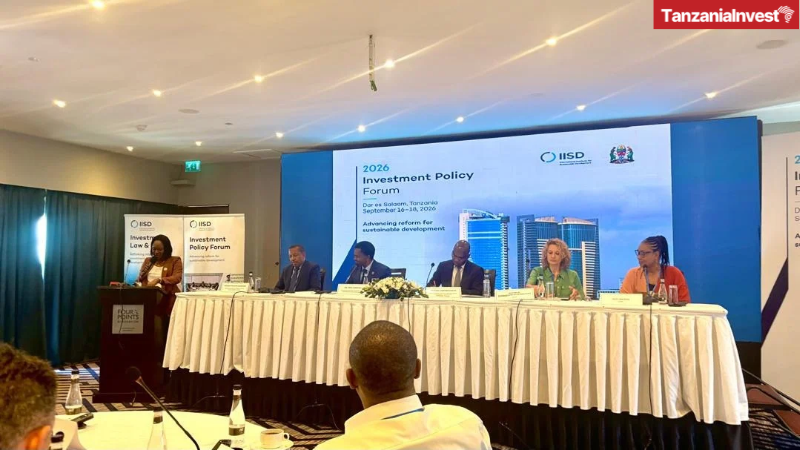
The 17th Investment Policy Forum was held in Dar es Salaam from 16 to 18 September 2026, focusing on how investment policies can generate jobs, skills, technology, stronger supply chains and domestic value addition.
The three-day Forum brought together government officials, investment policymakers, negotiators, international institutions and regional bodies from Africa, Asia, Latin America and the Caribbean.
Discussions focused on strengthening coherence across international, regional and national levels of investment governance and ensuring that investment policies support sustainable development.
The Forum also addressed how investment governance can respond to geopolitical shifts, technological advancement, climate change and evolving international trade and investment rules.
Speaking at the opening ceremony, Tanzania’s Deputy Minister of State for Planning and Investment, Pius Stephen Chaya, said: “This Forum under our ministry provides an important platform for policymakers, practitioners and experts to exchange experiences and strengthen investment governance.”
“This Forum comes at a very important time when the global investment landscape is undergoing major transformation. This is driven by geographical shifts, technological advancement, climate change and also evolving trade and investment rules,” Chaya said.
Chaya also outlined Tanzania’s investment institutional reforms, including the establishment of the Tanzania Investment and Special Economic Zones Authority (TISEZA) as the principal institution responsible for coordinating, promoting, facilitating and enabling investment.
He stated that investment governance should focus not only on attracting capital but also on the wider economic benefits generated by investment.
For her part, IISD Vice-President for Global Strategies Dr. Nathalie Bernasconi said: “We are moving from a world shaped predominantly by one economic superpower to one increasingly shaped by strategic competition between two countries.”
“I would argue that disruption also creates opportunity. The ideological foundations of trade and investment rules that often constrained developing countries are no longer firmly entrenched. That creates space to rethink the rules and to shape new ones around today’s development priorities,” Dr. Bernasconi said.
“This is an opportunity for countries to develop strategies that ensure investment creates domestic value, meaning jobs, skills, technology, global industries, stronger supply chains and greater value addition at home,” she added.
About the IISD Investment Policy Forum
The International Institute for Sustainable Development (IISD) provides governments with research, advisory support and policy tools covering sustainable development, investment policy and governance.
IISD established the Investment Policy Forum as a platform for officials from developing and emerging economies to exchange experiences and develop approaches to investment governance.
Initially known as the Annual Forum of Developing Country Investment Negotiators, the Forum was first held in Singapore in 2007 and now takes place every two years.
Its work includes investment treaties, policy reforms and investor–state dispute settlement, including coordination related to ISDS reform at the United Nations Commission on International Trade Law and negotiations at the World Trade Organization.
Want to know more about the Economy in Tanzania? Our free overview of the Tanzania Business and Investment Guide 2026 covers the Economy, plus key sectors and investment opportunities. The complete 141-page edition includes policies, taxation, key regulations, full macroeconomic data, and sources, and is also available at no cost upon completion of a short form.
Download Free OverviewGet the Full Edition for Free