
FDI
Foreign Direct Investment (FDI) inflows to Tanzania rose to USD 1.718 billion in 2024, a 28.3% increase from USD 1.339 billion in 2023.[4]
FDI has become a central pillar of Tanzania's growth model, anchoring the country's strategy to finance industrialisation, infrastructure, and value-added investment under the Sovereign Pragmatism doctrine unveiled in January 2026.
Inflows have been increasing in the past five years after the slowdown in 2020 caused by the COVID pandemic, reflecting targeted investment facilitation, infrastructure PPPs, and ongoing reforms to improve the business environment and investment climate.
FDI Inflows and Recent Performance
FDI inflows to Tanzania rose from USD 1.339 billion in 2023 to USD 1.718 billion in 2024, an increase of 28.3%.[4]
The upward trajectory reflects targeted investment facilitation, Public-Private Partnerships in infrastructure and services, and continued digitalisation of public services and processes.
Tanzania's broader macroeconomic backdrop has supported this momentum, with the economy reaching USD 79 billion in 2024[1] and estimated to have grown by 5.9% in 2025.[2]
The IMF projects GDP growth to accelerate to 6.3% in 2026 and 6.5% in 2027,[3] positioning Tanzania among the fastest-growing economies in Africa and reinforcing investor confidence.
Sectoral Composition of FDI
In 2023, large FDI inflows were recorded in mining and quarrying, manufacturing, finance and insurance, and information and communication activities, which together contributed 82.4% of total FDI.[6]
With the exception of manufacturing, these were among the top five fastest-growing economic activities of the year.
Inflows to information and communication more than doubled to USD 198 million, driven by the growing demand for internet services and mobile money transfers.
In 2025, the manufacturing sector continued to dominate in terms of both the number of projects and the amount of capital investment, reflecting its significant contribution to industrial growth and employment generation.
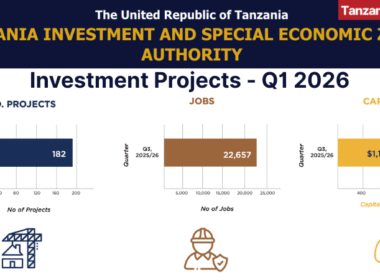
During the first quarter of fiscal year 2025/26 (July to September), the sectors that attracted the highest number of investment projects were manufacturing, commercial buildings, transportation, tourism, and agriculture.[8]
Source Countries of FDI
The leading sources of FDI inflows in 2023 were Mauritius, Australia, the United Kingdom, Barbados, the Netherlands, and South Africa.
The top ten source countries accounted for 64.7% of total FDI inflows in 2023.
A notable shift was observed from the Cayman Islands to the United Kingdom and Australia, driven by changes in the ownership structure of companies in mining and quarrying activities, which significantly impacted FDI inflows and stock from these countries.
In 2025, the top five sources of FDI were the UAE, China, India, Singapore, and France, signalling a pivot toward Gulf and Asian capital partners.
Registered Investment Projects
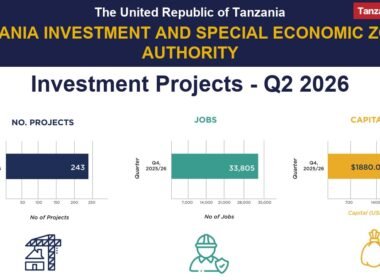
In 2024, the Government's primary agency for investment facilitation reported record-breaking results, registering 901 investment projects worth USD 9.3 billion.[5]
The manufacturing sector led with 415 projects worth USD 4 billion, followed by the transport sector with 149 projects worth USD 1.3 billion.
Other sectors with significant investments included commercial buildings with 105 projects worth USD 1.1 billion, telecoms with 5 projects worth USD 809 million, agriculture with 79 projects worth USD 687 million, and tourism with 83 projects worth USD 348 million.
In 2025, a new record of 915 new investment projects (foreign, domestic, and joint ventures) worth USD 10.95 billion was recorded,[7] further demonstrating renewed international interest in Tanzania's economy.
Policy Framework and Strategic Direction
The Government has put in place several instruments to ensure a favourable and secure investment environment, including a range of fiscal and non-fiscal incentives in priority sectors delivered through Export Processing Zones (EPZs) and Special Economic Zones (SEZs).
To provide legal security, the Government has established protections through various bilateral and multilateral agreements.
The administration of President Samia Suluhu Hassan has focused on restoring investor confidence, reviving relations with international financial institutions, and promoting FDI through regulatory reforms, prioritising regional trade integration, economic diplomacy, and business-friendly policies.
Sovereign Pragmatism Doctrine
In January 2026, President Samia Suluhu Hassan unveiled "Sovereign Pragmatism," a new policy doctrine setting Tanzania's strategic direction toward trade-driven growth, technology transfer, and value-added investment.
This strategy marks a shift from aid-dependency toward attracting higher-quality FDI that delivers measurable value addition and technology spillovers.
Alignment with Vision 2050 and FYDP IV
FDI is the single largest expected source of financing for Tanzania's long-term development plans, projected to mobilise around 57% of the total investment gap across successive Five-Year Development Plans.
Under the Fourth Five-Year Development Plan 2026/27 to 2030/31 (FYDP IV), the strategy focuses on increasing FDI and boosting domestic direct investment by improving the business environment, reducing non-performing loans, and liberalizing the capital account.
The Plan explicitly describes the private sector, with FDI as a primary channel, as the "engine of financing" for 2026/27.
Investment Opportunities
Manufacturing remains the leading destination for FDI, dominating both the number of projects and capital deployed, with USD 4 billion across 415 projects registered in 2024, offering scope for industrial parks, agro-processing, and import-substitution ventures.
Mining and quarrying continues to attract major capital, particularly from the United Kingdom and Australia following recent shifts in ownership structures within the sector.
Information and communication is one of the fastest-growing FDI segments, with inflows more than doubling to USD 198 million in 2023 on the back of rising demand for internet services and mobile money transfers.
Infrastructure offers a substantial pipeline through Public-Private Partnerships, with transport investments worth USD 1.3 billion registered in 2024 and major projects such as Dar Rapid Transit operations and the Kibaha to Chalinze expressway already in execution.
Commercial buildings (USD 1.1 billion across 105 projects in 2024), telecoms (USD 809 million across 5 projects), agriculture (USD 687 million across 79 projects), and tourism (USD 348 million across 83 projects) round out the priority sectors attracting foreign capital.[5]
Investors from the UAE, China, India, Singapore, and France, the top five FDI sources in 2025, are leading the new wave of partnerships aligned with Tanzania's industrialisation and value-addition agenda.
Last Update: May 2026
References
- https://data.worldbank.org/indicator/NY.GDP.MKTP.CD?locations=TZ (Guide reference #2)
- https://www.bot.go.tz/Publications/Regular/Monetary%20policy%20report/en/2026011919182725.pdf (Guide reference #3)
- https://www.imf.org/external/datamapper/NGDP_RPCH@WEO/TZA/CHN (Guide reference #4)
- https://unctad.org/system/files/official-document/wir2025_en.pdf (Guide reference #5)
- https://www.tiseza.go.tz/uploads/documents/en-1745479851-TIC%202024%20Investment%20FactSheet.pdf (Guide reference #6)
- https://www.bot.go.tz/Publications/Other/Tanzania%20Investment/en/2025022811524146.pdf (Guide reference #51)
- https://www.tiseza.go.tz/news/investment-trend-in-tanzania-2021-2025 (Guide reference #52)
- https://www.tiseza.go.tz/uploads/documents/en-1765102868-Q1-BULLETIN%20JULY%20TO%20SEPT%20_compressed.pdf (Guide reference #53)
Want to know more about FDI in Tanzania? Our free overview of the Tanzania Business and Investment Guide 2026 covers FDI, plus key sectors and investment opportunities. The complete 141-page edition includes policies, taxation, key regulations, full macroeconomic data, and sources, and is also available at no cost upon completion of a short form.
Download Free OverviewGet the Full Edition for Free