Tanzania and DRC Sign Trade Facilitation and Cooperation Agreement

Tanzania and the DRC signed a trade facilitation and cooperation agreement in Dar es Salaam, establishing a joint trade committee to expand bilateral trade and investment. Priority areas of cooperation include transport, exports, trade facilitation, infrastructure, and cross-border trade.
DRC Julien Paluku Kahongya Tanzania Judith Kapinga trade cooperation agreement

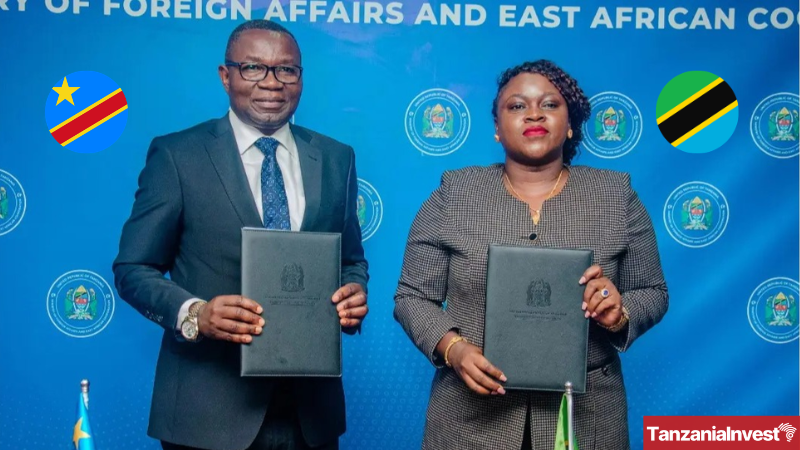
Tanzania and the Democratic Republic of Congo (DRC) have signed a trade facilitation and cooperation agreement in Dar es Salaam aimed at growing both economies and opening more trade and investment opportunities.

The agreement was signed by the Minister for Industry and Trade, Judith Kapinga (MP), and the DRC Minister of Trade, Julien Paluku Kahongya.

The signing followed a recent visit by the DRC President focused on trade opportunities, with the DRC relying heavily on the Port of Dar es Salaam to transport goods to the country.

Tanzania Investment Guide 2026 Free Edition

Kapinga outlined the priority areas of cooperation as transport, exports, trade facilitation, infrastructure, and cross-border trade.

The two countries also agreed to establish a joint trade committee to improve the business environment between them.

The DRC delegation visited the Tanzania Ports Authority (TPA) to observe how the Port of Dar es Salaam operates as a key link in trade between Tanzania and the DRC.

Speaking to reporters, the Director of Trade Development at the Ministry of Industry and Trade, Sempeho Manongi, described the DRC as an important country for Tanzania in trade relations.

Manongi noted that goods produced in the DRC, including minerals, can pass through the Port of Dar es Salaam and use Tanzanian infrastructure, while goods produced in Tanzania reach the DRC market.
TanzaniaInvest Capital Markets Report Banner

Trade between Tanzania and the DRC has grown into a substantial economic relationship centred on the Port of Dar es Salaam, which serves as the landlocked DRC’s main gateway to the sea.

In 2025, Tanzania exported goods worth TZS 795 billion to the DRC, while imports from the DRC were valued at TZS 24 billion.

Earlier in 2026, the two countries’ presidents agreed to strengthen economic and social cooperation in strategic areas including trade and investment, agriculture, mining, energy, transport, infrastructure and health.

The President of DRC announced that the country has begun preparations to build a dry port in Dar es Salaam to streamline the handling of Congolese cargo moving through Tanzania’s main gateway to international markets.

Want to know more about the Economy in Tanzania? Our free overview of the Tanzania Business and Investment Guide 2026 covers the Economy, plus key sectors and investment opportunities. The complete 141-page edition includes policies, taxation, key regulations, full macroeconomic data, and sources, and is also available at no cost upon completion of a short form.

Download Free OverviewGet the Full Edition for Free
Related Posts
IMF World Economic Outlook 2026 Tanzania
Read More

Tanzania GDP to Grow 6.0% in 2026 and 5.9% in 2027 With Inflation at 4.0%, IMF Projects

In its World Economic Outlook October 2026, the IMF projects Tanzania’s real GDP growth at 6.0% in 2026 and 5.9% in 2027, above the 4.5% sub-Saharan Africa average and Kenya’s 4.5%, while Uganda and Rwanda are projected at 6.2% and 7.4%. Tanzania’s inflation is projected at 4.0% in 2026 and 4.2% in 2027, below the 8.6% sub-Saharan Africa average and Kenya’s 6.0%.
Central Bank of Tanzania BOT CBR Interest Rate Q4 2026
Read More

BOT Maintains Tanzania Central Bank Rate at 6.25% for Q4 2026; GDP Growth Projected at 7.2% in Q4 2026, Driven by Agriculture, Construction, Mining, and Tourism

The Bank of Tanzania (BOT) released its Monetary Policy Report of October 2026, in which the Monetary Policy Committee (MPC) decided to maintain the Central Bank Rate (CBR) at 6.25% for the fourth quarter of 2026, allowing the July 2026 increase to fully transmit through the economy. The MPC will keep policy agile and flexible to limit risks to the inflation outlook from the Middle East conflict and potential El Niño-related disruptions, and keep inflation within the 3-5% target range.
Interview Jana Bricco IMF Resident Representative Tanzania no logo
Read More

Interview with Jana Bricco, New IMF Resident Representative in Tanzania, on Economic Growth, Private Investment, and Needed Reforms

In this exclusive interview with TanzaniaInvest, the new IMF Resident Representative Jana Bricco says Tanzania can sustain growth of around 6% by preserving macroeconomic stability and accelerating reforms supporting private investment, productivity and jobs. She calls for fewer regulatory obstacles, more predictable taxation, faster VAT refunds and better access to finance for businesses and SMEs, and explains how IMF support will evolve following the end of its financing programmes, with the relationship now focused on policy dialogue and capacity development.