Tourist Arrivals to Tanzania Up By +49% in January and February 2023

Tanzania Tourist Arrivals January-February 2023

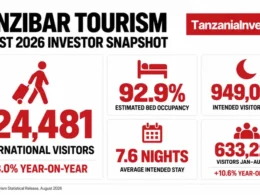
According to the latest data released by Tanzania’s National Bureau of Statistics (NBS), in January and February 2023, the number of international visitors to Tanzania reached 290,896.

This is an increase of 95,413 visitors, equivalent to +48.8%, from 195,483 visitors during the corresponding period in 2022.

On the other hand, the number of international visitors entering the country through Zanzibar was 114,169, equivalent to 39.2% of the total international visitors.

Tanzania Investment Guide 2026 Free Edition

The growth in international visitors is attributed to the lifting of lockdowns in most countries, and Tanzania’s continued Government efforts to promote tourism attractions.

The top six source markets from outside of Africa were France with 25,837 visitors followed by Italy (18,556), the United States of America (16,567), Germany (15,705), Poland (12,369) and the United Kingdom (10,657).

Meanwhile, the top six source markets from Africa were Kenya (29,615), Burundi (16,832), Rwanda (7,627), Malawi (6,563), Uganda (6,511) and South Africa (5,196). The top 15 source markets out of 212 recorded 189,005 visitors accounting for 65% of total arrivals.

The majority of international visitors (263,934) to Tanzania came for leisure and holidays accounting for 90.7%; followed by those who came to visit friends and relatives (16,307) accounting for 5.6%.

Other purposes were visitors in transit to other countries were 6,035, accounting for 2.1% and business visitors were 3,418, accounting for 1.2%.

Tanzania Investment Guide 2026 Full Edition

Want to know more about Tourism in Tanzania? Our free overview of the Tanzania Business and Investment Guide 2026 covers Tourism, plus key sectors and investment opportunities. The complete 141-page edition includes policies, taxation, key regulations, full macroeconomic data, and sources.

Download Free OverviewGet the Full Guide
Related Posts
Tanzania Minister Ashatu Kijaji Parliament Bunge
Read More

Tanzania Tourism Budget 2026/2027 of TZS 334.35 Billion Targets 20% GDP Share, with Sector Earnings at USD 4.4 Billion and 5.93 Million Tourists

Tanzania’s Minister of Natural Resources and Tourism, Dr. Ashatu Kijaji, tabled a TZS 334.35 billion budget for the Ministry for the 2026/27 financial year, with TZS 62.30 billion directed to development across wildlife, forestry, tourism, and antiquities. Tourism earnings reached USD 4.4 billion in 2025, with 5.93 million tourists, and the Ministry projects revenue of TZS 1.49 trillion in 2026/27, more than four times its budget.
Tanzania ASSESSMENT OF ECONOMIC IMPACTS ON TANZANIA ARISING FROM THE GULF CRISIS
Read More

Tanzania Gulf Crisis Report Rates Energy, Food, Transport, Tourism and Budget at High Risk

A May 2026 rapid assessment by Tanzania's National Planning Commission and UNDP rates energy, food, transport, tourism and the Government budget at high risk from the Gulf crisis, which raised Dar es Salaam fuel prices by up to 69% between January and May 2026. The report flags a possible TZS 153.7 billion monthly customs revenue shortfall and fuel subsidy needs rising to TZS 1,384.2 billion by July, alongside buffers including a 124% food self-sufficiency ratio, USD 6.3 billion in reserves and 57 trillion cubic feet of gas.
Dodoma Region Investment Guide
Read More

Tanzania Government Calls for Investment in Dodoma Mining, Agriculture, Tourism and Trade

Tanzania's Finance Minister and the Dodoma Regional Commissioner have jointly called on investors to tap into opportunities in Dodoma's mining, agriculture, tourism, and trade, with mining flagged as the region's largest potential through value addition. Specific openings include a proposed dry port to leverage Dodoma's central location at the heart of Tanzania, the construction of five-star hotels and international conference centres, and the development of mineral processing facilities, alongside the rollout of the Tourism Development Strategy for Dodoma Region 2025–2030.