

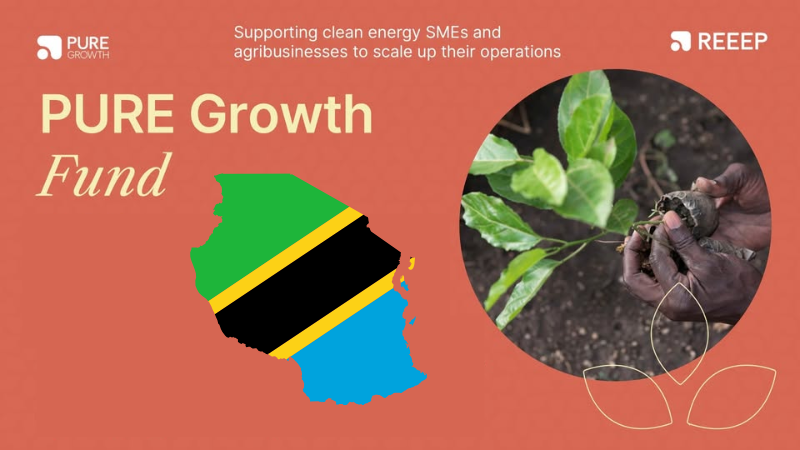
In May 2025, the Renewable Energy and Energy Efficiency Partnership (REEEP) launched the €2.5 million Pure Growth Fund in Tanzania to support the use of renewable energy in agricultural value chains.
The Fund aims to de-risk and increase the level of private investment (company’s own and third-party investment) into impactful small and medium sized enterprises (SMEs) in the sector, and promote economic and social development, which should lead to a process of sustainable economic activity and economic growth, combined with structural and social change.
The fund will provide incentive capital and technical assistance to for-profit businesses operating at the intersection of agriculture and renewable energy, with a focus on increasing productivity, and fostering a more enabling policy environment.

The initiative targets companies that operate in solar-powered production, cold storage, processing, electric transport, and scalable bioenergy solutions and will run from 2026 to 2029.
REEEP will sign three-year contracts ranging from EUR 250,000 to EUR 1 million per company, with the application window open from 21st May to 1st August 2025.
The Pure Growth Fund will operate through a reverse auction mechanism, selecting companies based on a “Pure Impact Index” that evaluates both the technological value and service provision impact of proposed projects.
Services include repair and maintenance, while optional services like market access and agricultural best practices increase competitiveness.
REEEP clarified that companies involved in tobacco, alcohol, cannabis, fossil fuels, or those with adverse environmental or human rights impacts are ineligible, and only clean energy technologies tied to agri-food value chains will be considered.

The fund encourages the formation of consortia, allowing for-profit companies to partner with non-profit organizations to deliver value-added services. However, only for-profit entities can serve as lead applicants. Co-financing is not mandatory, but it improves application competitiveness.
Applicants are required to demonstrate operational readiness, gender inclusivity in alignment with the 2X Challenge criteria–the global industry standard for assessing and structuring investments that provide women with leadership opportunities–and a commitment to deploy mature, market-ready technologies.
Speaking at the first call for proposals, the Lead Expert for Energy Access at REEEP, Andrew Lopez, said, “By encouraging productive use of renewable energy technologies inside agricultural value chains, we have a chance to align our outcomes with the national goals of stakeholders here in Tanzania.”
The Senior Specialist at REEEP, Kumbira Makanza, added: “We are looking to support growth-stage businesses that have already generated between €50,000 and €10 million in revenue in the last financial year. These companies must be registered in Tanzania or willing to register by the time of application.”
On her part, REEEP CEO Eva Kelly stated, “We are thrilled to launch the PURE Growth Fund in Tanzania as the first step in a multi-country program. There is extraordinary potential for renewable energy to transform agri-food value chains across the Global South.’’
About REEEP
Established in 2002, the Renewable Energy and Energy Efficiency Partnership (REEEP) is an international non-profit organization headquartered in Vienna, Austria that works to advance markets for clean energy and energy efficiency in low- and middle-income countries.
REEEP focuses on strengthening the enabling environment for clean energy through tailored financing mechanisms, technical assistance, and policy engagement.
Over the past two decades, REEEP has supported more than 200 clean energy projects across Africa, Asia, and Latin America.
The PURE Growth Fund is part of REEEP’s broader goal to catalyze sustainable development through renewable energy deployment and private sector engagement, with Tanzania selected as the pilot country due to its strong market potential and alignment with national development goals.
Want to know more about Agriculture in Tanzania? Our free overview of the Tanzania Business and Investment Guide 2026 covers Agriculture, plus key sectors and investment opportunities. The complete 141-page edition includes policies, taxation, key regulations, full macroeconomic data, and sources, and is also available at no cost upon completion of a short form.
Download Free OverviewGet the Full Edition for Free