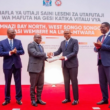


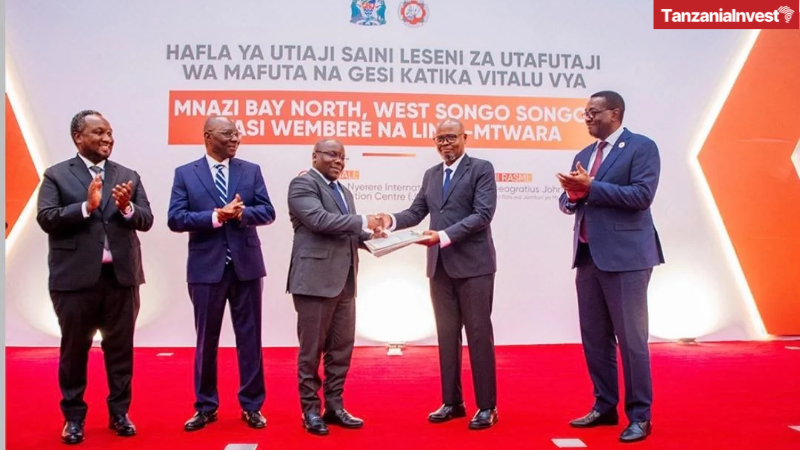
On 28th October 2026, the Government of Tanzania granted the Tanzania Petroleum Development Corporation (TPDC) four oil and natural gas exploration licences at a ceremony in Dar es Salaam.
The government also announced that the state-owned corporation would take over operations of the Songo Songo gas field from 29th October 2026.
This marks the first time TPDC has received petroleum exploration licences directly as the sole licensee, rather than in partnership with international oil companies.

The four exploration blocks are the Eyasi Wembere, the Mnazi Bay North, the West Songo Songo, and the Lindi Mtwara blocks.
The Eyasi Wembere block covers approximately 5,797 square kilometres across Tabora, Singida, Arusha, Simiyu, and Shinyanga regions.
Airborne gravity gradiometry (AGG) and 2D seismic surveys have been conducted on the block, to assess its hydrocarbon potential before further exploration decisions.
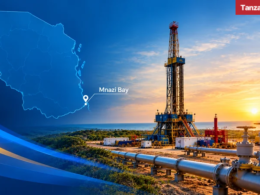
The Mnazi Bay North block, located in Mtwara Region, includes onshore and offshore areas with water depths ranging from zero to 980 metres.
In this block, Initial 3D seismic analysis covering 131 square kilometres indicates an estimated natural gas potential of 968 billion cubic feet (Bcf) across three main reservoirs.

Technical evaluation has been completed, and preparations are underway to drill the first exploration well.
The West Songo Songo block covers approximately 500 square kilometres in Kilwa District, Lindi Region, immediately west of the producing Songo Songo gas field.
At this block, Interpretation of 2D seismic data has identified gas-bearing potential, while TPDC is procuring a contractor to conduct a 3D seismic survey before exploration drilling.
The Lindi Mtwara block covers approximately 322 square kilometres in the Ruvuma Basin, across Lindi and Mtwara regions, with most of the area onshore and a smaller offshore section.
The block’s 2D seismic analysis has been completed, and 3D seismic data collection is ongoing to identify specific drilling targets.
Speaking at the ceremony, Tanzania’s Vice President, Deogratius John Ndejembi, stated, “In order to implement the national energy plan, the National Energy Compact, and achieve the goal of expanding electricity access to 100% nationwide by 2030, the government has intentionally approved the granting of oil and natural gas exploration licences in the Mnazi Bay North, West Songo Songo, Eyasi Wembere, and Lindi-Mtwara blocks. This event is sufficient proof of the commitment of this Sixth Phase Government, led by Her Excellency President Dr. Samia Suluhu Hassan, President of the United Republic of Tanzania, to continue strengthening the energy sector by creating an enabling environment for business and investment, and enabling the utilization of the country’s resources to bring development to our nation of Tanzania.”
On his part, Tanzania’s Minister for Energy, Dr. Juma Zuberi Homera, confirmed; “The signing and issuance of these licences is in accordance with the Petroleum Act of 2020, which grants TPDC the right to be issued licences directly for petroleum and gas exploration activities. This discovery is expected to increase the country’s available natural gas reserves, which are currently estimated at 57.54 trillion cubic feet.”
“As of September 2026, Your Excellency Vice President, we have a total of 22 operational CNG stations, 20 vehicle gas system conversion workshops, over 20,000 motor vehicles powered by natural gas, 57 factories, 31 institutions, and approximately 3,000 households connected directly to natural gas pipelines,” added Homera.
In his address, the Permanent Secretary of Tanzania’s Ministry of Energy responsible for Oil and Gas, Dr. James Peter Matarajio, announced that TPDC would become the operator of the Songo Songo gas field on 29th October 2026, following the conclusion of the development licence previously held by PanAfrican Energy after 20 years of commercial production.
Matarajio explained that this is the first time the government is issuing licences directly to TPDC. All previous licences were issued to TPDC in partnership with foreign companies, namely international oil companies (IOCs).
In his address, the Managing Director of TPDC, Mussa Mohamed Makame, commented, “We are currently preparing to procure a contractor to acquire 3D seismic data, after which we will proceed to drill the first exploration well in that area.”
Makame added; “Success in oil and gas exploration is not measured solely by discoveries, but by the ability to turn those resources into real economic opportunities that generate revenue, employment, reliable energy, and development for citizens.”
For his part, the Director General of the Petroleum Upstream Regulatory Authority (PURA), Eng. Charles Sangweni, stated, “We will oversee operations in the four blocks to ensure compliance, transparency, accountability, and local content participation. From now on, TPDC has its own strategic blocks for oil and natural gas exploration, ready to fulfill the responsibility assigned to it under the Petroleum Act, Cap 392.”
Tanzania’s Natural Gas Sector
Tanzania’s natural gas exploration dates back to 1974, when the Songo Songo gas field was discovered, followed by Mnazi Bay in 1982.
Commercial production began at Songo Songo in 2004 and Mnazi Bay in 2006, supplying gas for electricity generation, industrial use, CNG and households.
In 2015, Tanzania commissioned major gas transmission pipelines connecting the Mtwara and Lindi gas fields to Dar es Salaam.
The Tanzania Petroleum Development Corporation (TPDC) was established in 1969 to oversee the exploration and development of the country’s petroleum resources.
Historically, exploration was reliant on international oil companies but TPDC has developed its technical capacity in geological surveys and seismic data interpretation to lead exploration independently.
Want to know more about Energy in Tanzania? Our free overview of the Tanzania Business and Investment Guide 2026 covers Energy, plus key sectors and investment opportunities. The complete 141-page edition includes policies, taxation, key regulations, full macroeconomic data, and sources, and is also available at no cost upon completion of a short form.
Download Free OverviewGet the Full Edition for Free