


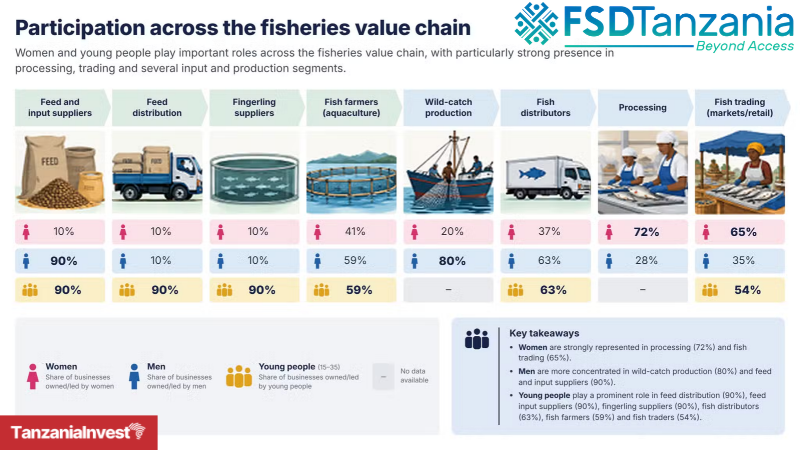
Tanzania’s Financial Sector Deepening Trust (FSDT) outlined the steps needed to unlock fisheries value chain finance in a post published on 29 October 2026, noting that 47% of surveyed fisheries operators have never borrowed.
The post argues that the sector already has the foundations for lending, with 91% of respondents saving, 82% keeping financial records, and 97% having mobile phones, but that lenders need better data, shared risk, and new collateral options.
Fisheries Value Chain Finance Gap
The post indicates that the fisheries sector grew by 6.3% in 2025 from 1.4% in 2024, with the value of fish products rising by 4.6% from TZS 4.36 trillion to TZS 4.56 trillion.

The fisheries value chain contributes 2.2% of national GDP, and the Fisheries Sector Master Plan 2021/22 to 2036/37 targets 10% by 2037, which FSDT says will require higher production, processing, exports, and investment.
Most participants in Tanzania’s fisheries and aquaculture sector are micro, small, and medium enterprises (MSMEs), such as fishers, boat owners, traders, processors, pond and cage farmers, seaweed farmers, hatcheries, and feed producers.
Although highly informal, these businesses own productive assets such as boats, cages, nets, and cold-storage facilities and serve established markets, yet FSDT notes that finance rarely reaches them.
FSDT links the lack of borrowing to limited borrower readiness, a mismatch between available financial products and fisheries needs, and the perceived risk of lending to the sector.
Steps to Expand Finance to Fisheries
Many fisheries MSMEs have short or insufficient credit histories, and lenders lack a clear picture of how the value chain works, which makes it harder to identify viable financing opportunities and to judge the risks of lending to the sector.
FSDT calls for better data and market intelligence, alternative data and credit-scoring models, and risk-sharing mechanisms such as credit guarantee schemes and blended finance, so that lenders can assess these businesses, design suitable products, and expand their engagement with the sector.
FSDT also stresses financial literacy among MSMEs to support responsible borrowing, a better understanding of loan terms, and productive use of finance.
FSDT further calls for accessible and affordable insurance, and suggests that bundling insurance with loans could improve affordability and uptake while protecting businesses against risk.
Secured Transactions (Movable Property) Act 2026
FSDT highlights the recently passed Secured Transactions (Movable Property) Act 2026, which allows equipment, vehicles, inventory, receivables, and other movable assets to be used as security for loans.
The Act creates a Collateral Registry administered by the Bank of Tanzania (BoT), so operators who own boats, cages, processing equipment, or cold-storage facilities but no land could use them to support loan applications.
FSDT supported the Ministry of Finance in drafting the Act with demand-side insights and technical support, and is now working with the BoT to establish the registry and develop its regulations.
FSDT Alternative Credit Scoring
FSDT is piloting an Alternative Credit Scoring Initiative in the Kilombero sugarcane value chain, and it expects lessons from the pilot to be applicable to fisheries and other value chains.
The FinScope MSME Tanzania 2026 Survey by FSDT, projected for launch this financial year, will provide demand-side data on MSMEs, including those operating in the fisheries value chain.
Want to know more about Agriculture in Tanzania? Our free overview of the Tanzania Business and Investment Guide 2026 covers Agriculture, plus key sectors and investment opportunities. The complete 141-page edition includes policies, taxation, key regulations, full macroeconomic data, and sources, and is also available at no cost upon completion of a short form.
Download Free OverviewGet the Full Edition for Free