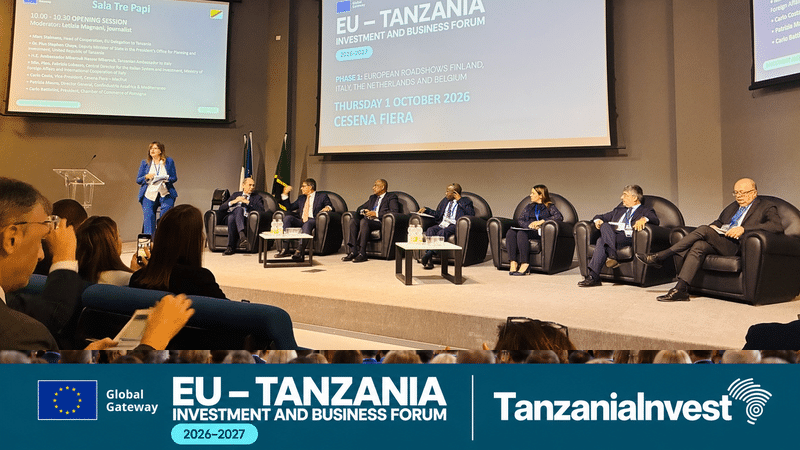


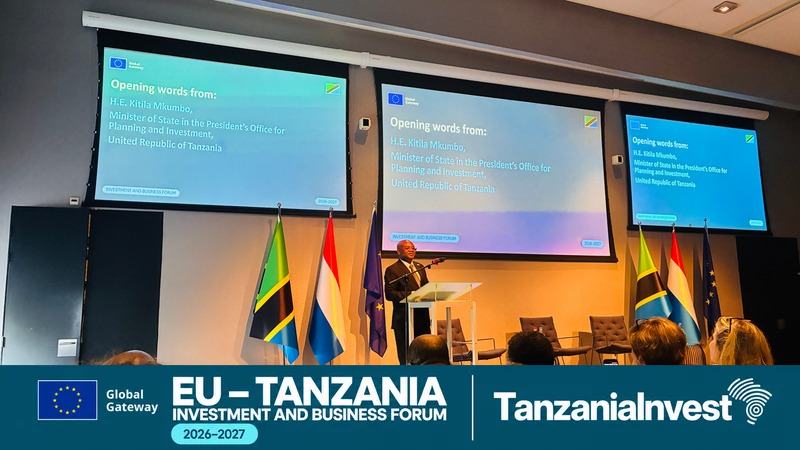
The EU-Tanzania roadshow reached The Hague on 5 October 2026 for its final leg, with investment pitches in coffee and cashew processing, critical minerals, ports and logistics.
The Hague was the third and final leg of the EU-Tanzania Investment and Business Forum 2026-2027 roadshows, after Helsinki and Cesena, with a field visit to Belgium following on 6 October.
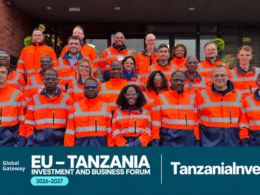
The Tanzanian delegation was led by the Minister of State in the President’s Office for Planning and Investment, Hon. Prof. Kitila Mkumbo, and the Deputy Minister of Agriculture, Hon. David Silinde, and around 90 businesses took part.

Table of Contents
- Opening Session: Netherlands Is Tanzania’s Largest EU Investor as EU Grants Exceed EUR 900 Million
- Presentations: TISEZA and ZIPA Pitch Agro-Processing, Logistics, Minerals, and Zanzibar Projects
- Financing Session: Global Gateway and EU Instruments to Mobilise Private Capital
- Breakout Sessions: Agribusiness, Transport and Critical Minerals
- Matchmaking and Site Visits
Opening Session: Netherlands Is Tanzania’s Largest EU Investor as EU Grants Exceed EUR 900 Million
EU and the Netherlands: Ports, Food Exports, and Critical Minerals Make the Case
Virginie de Ruyt, Head of the Eastern and Central Africa Unit at the European Commission’s Directorate-General for International Partnerships, set out the priority sectors as critical raw materials, digital innovation and fintech, and agriculture and agribusiness, with transport and energy as the enablers.
She noted that the port of Dar es Salaam handles 95% of Tanzania’s international trade, with 40% of its throughput serving landlocked neighbours and cargo volumes above 30 million tonnes last year.
In agriculture, she pointed to around 44 million hectares of arable land, much of it uncultivated, to an EU share of around 40% of Tanzania’s coffee exports, with production at a record 90,000 tonnes in 2023/24, and to cashew, where less than 10% of production is processed locally.
In critical minerals, she highlighted some of the world’s largest proven graphite reserves and one of the largest undeveloped high-grade nickel sulphide deposits, adding that the bigger opportunity lies in processing capacity, infrastructure and logistics rather than extraction alone.
De Ruyt also cited the standard gauge railway (SGR), with a planned network of 2,500 km linking Dar es Salaam to Mwanza and Kigoma, and upgrades at the ports of Dar es Salaam, Tanga and Mtwara.

She explained that the EU has committed more than EUR 900 million in grants to Tanzania over 2021-2027, which act as catalytic capital to unlock larger investments from the European Investment Bank, European development finance institutions, and private companies.
Frederieke Quispel, Director of the Africa Department at the Netherlands Ministry of Foreign Affairs, observed that the Netherlands, despite one harvest a year, is the world’s second-largest agricultural exporter after the United States, and offered Dutch expertise to help Tanzania grow its agricultural exports.
She noted that the Netherlands is the largest EU investor in Tanzania and its fifth-largest foreign investor overall, and welcomed the recently launched business dialogue between the Tanzanian government and EU member states.
Quispel added that the Netherlands Minister for Foreign Trade and Development Cooperation met Minister Mkumbo that morning to discuss transport and logistics, agricultural value chains, horticulture and critical minerals.
Speaking to TanzaniaInvest after the session, Quispel stressed that most room for Dutch companies is in agriculture, food production, and adding value to raw materials, with several companies already active in Tanzania.
Caroline Chipeta, Ambassador of Tanzania to the Netherlands, highlighted that the forum provides an important opportunity to translate support into practical partnership, exchange ideas, identify areas of mutual interest, and explore concrete opportunities for investments and cooperation, and reminded the audience that the Embassy stands ready to facilitate these engagements and support their follow-up.
Keynote: Minister Mkumbo Offers Tailored Incentives and a Dedicated EU Desk
Minister Mkumbo described agriculture as the first priority sector for European and Dutch investors, noting that coffee, spices, tea, and cocoa already meet European standards, that African countries imported USD 110 billion of food last year, and that Tanzania, with food self-sufficiency of 130%, aims to become a food basket for Africa.
On critical minerals, he recalled that EU studies under the Critical Raw Materials Act identify Tanzania and Mozambique as low-risk sources in Africa.
He pointed out that five years ago Tanzania ranked among the ten least attractive investment destinations in Africa, that it is now among the top five, and that it aims to be among the top three by 2030/31.
TISEZA has a dedicated desk for EU investors, and in August the Government agreed an action plan with European ambassadors and companies to address VAT refunds and the stability of tax laws, with regular follow-up meetings.
Mkumbo listed a market of up to 300 million people through the East African Community (EAC) and the Southern African Development Community (SADC), and 1.4 billion through the African Continental Free Trade Area (AfCFTA), three large ports, a population that is 76% under the age of 35, and growth of 5.9% last year, projected at 6.3% this year and around 7% by 2027/28, with inflation below 5% for more than 20 years.
The Minister closed his remarks by asking European partners to move from aid to trade and investment, especially in value addition and manufacturing, to create jobs for young Tanzanians.
Presentations: TISEZA and ZIPA Pitch Agro-Processing, Logistics, Minerals, and Zanzibar Projects
TISEZA: Coffee, Cashew, Port Logistics, and Critical Minerals Open to Dutch Investors
George Mukono, Director of Investment Promotion at the Tanzania Investment and Special Economic Zones Authority (TISEZA), presented opportunities in agro-processing, transport and logistics, and critical minerals, and explained that TISEZA offers customised incentives for EU investors and desk officers dedicated to Dutch companies.
Download the TISEZA presentation: https://www.tanzaniainvest.com/wp-content/uploads/2026/10/TISEZA-NETHERLANDS.pdf
Its One-Stop Facilitation Centre brings more than 15 government institutions under one roof, handling everything from business registration and tax to land acquisition.
In coffee, grown in the northern zone and the southern highlands, he invited Dutch partners into value addition, washing stations, roasting and branding, traceability, storage and the modernisation of existing factories, since part of the crop is still exported raw.
In cashew, centred on the Mtwara, Lindi and Ruvuma corridor, TISEZA wants partners across processing and exports so that Tanzania stops exporting raw nuts, and it also promotes agro-food parks with cold chain and food processing facilities.
In transport and logistics, Mukono identified opportunities around Dar es Salaam port in cold chain development, port digitisation, terminal equipment supply and maintenance, and cargo evacuation, along corridors to Burundi and Rwanda, Zambia and the lake zone.
He noted that more than 500 km of the standard gauge railway (SGR) already runs from Dar es Salaam to Dodoma, to link the whole country by rail and road by 2030.
In critical minerals, he pointed to graphite at Mahenge, Nachingwea and Lindi, the Kabanga Nickel project, rare earths at Ngualla and lithium exploration, with opportunities in shared infrastructure, logistics and maintenance, and value addition.
TISEZA registers normal and strategic investors, with strategic investors able to negotiate tailored incentives, and it also runs export processing and special economic zones, including the Bagamoyo Eco-Maritime City, one of seven flagship programmes under the Fourth Five Year Development Plan.
Standard incentives include exemptions on capital goods and deemed capital goods and depreciation allowances depending on the sector.
ZIPA: Zanzibar Seeks PPP Investors for a Railway and the Mangapwani Port Hub
Farida Mohamed, Manager for Investment Promotion and Marketing at the Zanzibar Investment Promotion Authority (ZIPA), presented Zanzibar, an archipelago of the two main islands of Unguja and Pemba and more than 50 smaller islands, whose economy grew 7% and whose current agenda is the blue economy.
Download the ZIPA presentation: https://www.tanzaniainvest.com/wp-content/uploads/2026/10/ZIPA-NETHERLANDS.pdf
She invited Dutch investors into two projects: the electric Zanzibar Mwambao Railway on Unguja, estimated at USD 300 million to 400 million and offered as a public-private partnership (PPP) with a concept note available, and the Mangapwani Green Smart Hub, a freeport city with a class A shipyard and green energy maritime hub on more than 933 hectares, estimated at about USD 300 million.
The Mangapwani project has eight investment zones covering a smart city, clean energy, a liquid and LPG terminal and a bulk terminal.
Mohamed noted that Zanzibar hosts around 100 Dutch projects, mostly in hospitality, and that ZIPA wants to bring Dutch investors into these larger projects as well.
Investors can apply online through the Zanzibar Investment Electronic Window, and the incentives include 100% ownership, corporate tax relief of up to 10 years depending on the investment, land leases of 33 to 99 years, key positions for expatriates and repatriation of profits after tax, while PPP incentives are negotiated directly with the Government.
Q&A: Mineral Value Addition and the New Bagamoyo Port
Asked by a consultant whether local SMEs are ready to partner with foreign investors, Minister Mkumbo acknowledged that most still operate informally and need both training in financial literacy and entrepreneurship and access to capital, and he committed to stepping up that training.
Irina Patrahau of The Hague Centre for Strategic Studies asked which mineral supply chains Tanzania wants to develop, and Mkumbo replied that Tanzania holds around 22 of the 34 critical raw materials identified by the EU, with active projects in graphite, lithium, cobalt, niobium and nickel.
He explained that the law sets minimum value addition, for example 40% for nickel, and that the policy is “we should no longer export rocks,” with the long-term goal of exporting batteries rather than raw materials.
On port readiness, Mohamed noted that the Mangapwani multipurpose port already has a feasibility study and some investors on site, and offered to connect interested companies with the Zanzibar Ports Corporation.
Mkumbo added that the ports of Dar es Salaam, Tanga and Mtwara are all being expanded, that Dar es Salaam works efficiently since private operators came in but is congested, and that the new Bagamoyo port, planned as the largest in East Africa, will be developed as a PPP, with feasibility studies and investment plans ready and expressions of interest already received.
He said the Tanzania Ports Authority (TPA) has started on basic facilities, with the aim of a new port within ten years, and that he would visit the ports of Antwerp and Rotterdam the following day.
Asked how European investors compare with others, Mukono pointed to TISEZA’s dedicated desk officers and to a business environment unit in the Minister’s office that can adapt policies for European investors.
For his part, Mkumbo stressed that Tanzanians associate European companies with high integrity, but also noted that Europeans are less competitive due to slow decision-making and risk aversion.
Financing Session: Global Gateway and EU Instruments to Mobilise Private Capital
Global Gateway: Nearly EUR 100 Million in EU Grants Has Leveraged About EUR 1 Billion in Tanzania
In the afternoon session on the Global Gateway Strategy and EU instruments to mobilise private capital, Francis Lemoine, Investment Officer in the Eastern and Central Africa Unit of the European Commission’s Directorate-General for International Partnerships, explained that Global Gateway aims to leverage EUR 300 billion of investment, including EUR 150 billion in Africa.
In Tanzania, EU blending has so far supported two large energy projects, signed or close to signature, a Lake Victoria sanitation project and an urban food investment project near Lake Victoria, with nearly EUR 100 million of EU contributions leveraging about EUR 1 billion of projects.
The pipeline now includes digital, transport and logistics, and corridors that would bring agricultural and critical raw material value chains to export.
On the guarantee side, 24 operations have been signed or are active in Tanzania, mostly intermediated lending through Tanzanian banks such as NMB Bank and CRDB Bank under the European Investment Bank’s (EIB) private sector window, alongside local currency guarantees with TCX and transactions in digital and biodiversity.
Lemoine noted that the guarantee pipeline is shifting from banking and infrastructure towards private sector processing and manufacturing, including water, infrastructure and agricultural value chains.
As an example, he cited a recent EUR 60 million EIB loan to the Tanzania Agricultural Development Bank (TADB) to finance the coffee, cashew and rice value chains, with a focus on women’s economic empowerment.
Responding to the Minister’s remarks on slow European decisions, he presented the new investment hub at DG International Partnerships, a single entry point for projects aligned with Global Gateway, designed to speed up decisions, with companies applying through an EU company, entity or development finance institution and their member state’s national team.
Financing Tools: AgriFI, ElectriFI, TCX and RVO for Companies Investing in Tanzania
Mark Koppejan, Investment Officer at EDFI Management Company, which has managed EU instruments on behalf of European development finance institutions since 2016, explained that its AgriFI facility invests EUR 1 million to 5 million in equity or debt in early-stage agri-food and forestry companies working with smallholder farmers, which need a track record but do not yet need to be profitable.
AgriFI has made three investments in Tanzania so far, in a digital finance solution, East Africa Foods and 1001 Spices, and Koppejan noted that funding is still available for Tanzanian agricultural businesses seeking long-term finance of five to six years.
Its sister facility ElectriFI invests up to EUR 10 million per ticket in renewable energy, with EUR 300 million available, a critical raw materials facility is coming, and the company’s mandates have grown to EUR 1 billion.
Kevin Laryea, Vice President for Trading at TCX, explained that the fund, set up in 2007, hedges currency risk so that development finance institutions can lend in Tanzanian shillings while still earning a hard currency return, protecting local borrowers from devaluation.
He pointed to a new EUR 150 million guarantee from the European Commission that lowers the local currency rates paid by borrowers, with the aim of mobilising EUR 2 billion over the next four to five years.
Laryea added that over the last five years Tanzania has consistently ranked among TCX’s top five countries globally, that it drew the most submissions from lenders in the latest funding round, and that under EC programmes it was the country with the largest transaction volume between 2021 and 2025, so far mostly in financial services, with more agriculture and infrastructure expected.
Dik van de Koolwijk, Private Sector Development Advisor at RVO, the Netherlands Enterprise Agency, described its support for Dutch companies through studies, capacity building, partnerships, trade missions, business financing, and pilots and demonstrations, focused on climate and energy, sustainable agriculture and food systems, and the digital economy.
He referred Dutch companies to the subsidy and funding guide on rvo.nl and to RVO’s Tanzania contact, Brigitta Groenland.
Breakout Sessions: Agribusiness, Transport and Critical Minerals
Agribusiness Breakout: Wheat, Edible Oils, Horticulture and Livestock Join Coffee and Cashew
Prof. Peter Lawrence Msoffe, Deputy Permanent Secretary of the Ministry of Agriculture, presented a wider pipeline than in Cesena, covering crops, livestock and fisheries under the Agriculture Master Plan 2050, which targets a USD 100 billion agricultural GDP contribution and USD 20 billion in agricultural exports by 2050.
Download the agriculture presentation: https://www.tanzaniainvest.com/wp-content/uploads/2026/10/Tanzania-Agri-Investment-Opportunities.pptx
Agricultural export earnings are expected to rise from USD 3.73 billion in 2024/25 to USD 6 billion by 2030, and the Ministry is seeking partners to scale up production and processing in wheat, to raise output from 115,826 tonnes to 1 million tonnes by 2030 and cut import dependence from 90% to 50%, and in sunflower oil, from 300,000 to 3 million tonnes.
Further targets for 2030 cover soya beans (48,000 to 500,000 tonnes), palm oil (51,834 to 1 million tonnes), maize (10.7 million to 18.8 million tonnes) and avocado for export (190,000 to 290,000 tonnes).
On inputs, Tanzania wants partners in fertiliser blending and lime to lift output from 158,628 to 1 million tonnes, in seed production from 56,000 to 650,000 tonnes, and in irrigation technology to expand the irrigated area from 983,000 to 5 million hectares.
Horticultural exports reached USD 569.3 million in 2024, with Europe taking 36.3%, and the target of USD 2 billion by 2030 requires annual growth of 31.6%, against a historical 12.4%.
The deck also opened livestock and fisheries to investors, with three flagship calls: the NARCO ranching and export abattoir corridor, with about 500,000 hectares available for sub-leasing and a plan to scale export-certified abattoirs from two to seven, a forage-to-feed and dairy value chain to close a projected milk gap by 2030, and the Kilwa Port and Exclusive Economic Zone corridor, a PPP-ready fishing port for processing, cold chain and tuna landings.
Tanzania has 40.6 million cattle, 29.6 million goats and 9.9 million sheep, two abattoirs already export 14,000 tonnes of meat to Saudi Arabia, and fingerling supply covers 51.3 million of a 120 million demand, opening space for hatcheries and aquaculture.
The coffee programme with EU traders and the USD 137 million Maranje Cashew Industrial Park, presented in Cesena, were also on offer, with TADB as the official agricultural financing platform.
On the sidelines, Kwan Yuk Li, co-founder and Chief Operating Officer of Fairways.Tech, which builds digital infrastructure that turns farm activity into finance-ready records for banks, told TanzaniaInvest that the company’s next project is in Tanzania, where the company is already in talks with a large bank.
Fairways.Tech started in Ghana with 130 farmers and now reaches 26,500 there, and in Tanzania it is looking for both partner banks and agricultural clients, since “everything boils down to finance,” whether in coffee, rice, maize, fisheries or processing.
Transport and Logistics Breakout: Bagamoyo Port, Dry Ports, and Two New SGR Lines Open to Investors
Dr. Baraka Raphael Mdima, Deputy Director General of the Tanzania Ports Authority, explained that the Government expects the private sector to provide about 70% of the investment needed under Vision 2050, which took effect on 1 July 2026, and invited European investors, financiers, contractors, technology providers and logistics operators to partner on ports and rail.
Download the transport presentation: https://www.tanzaniainvest.com/wp-content/uploads/2026/10/Tanzania-Transport-Investment-Opportunities.pptx.pptx
The opportunities he listed are the new Bagamoyo port at Mbegani, Mwambani port in Tanga, and dry ports at Ihumwa, Katosho, Fela and Kwala-Ruvu, together with the expansion of the Dar es Salaam container terminal.
In rail, the open projects are the 1,000 km Mtwara-Mbamba Bay standard gauge railway (SGR) towards Malawi and Mozambique, the 1,028 km Tanga-Arusha-Musoma SGR linking Mwambani port to Lake Victoria, a 160 km commuter rail network in Dar es Salaam and a 104.66 km commuter rail line in Dodoma.
The SGR backbone covers about 1,219 km in its first phase, from Dar es Salaam to Mwanza and the Isaka dry port, and a second phase towards Burundi and the DRC through Tabora-Kigoma (506 km) and Uvinza-Musongati (182 km), with the Dar es Salaam-Dodoma section operational and freight services running from Dar es Salaam port to Bahi since July 2025.
The Government is also revamping the TAZARA line to Zambia, and plans for the Central and TAZARA corridors connect Tanzania’s ports with Uganda, Rwanda, Burundi, the DRC, Zambia, Malawi and Zimbabwe.
Critical Minerals Breakout: Geological Survey Plans to Triple Airborne Survey Coverage by 2030
Eng. Ally Samaji, Chief Executive Officer of the Geological Survey of Tanzania (GST), presented the same critical minerals proposition shown in Helsinki, with mining contributing 10.3% of GDP in 2025 and more than 50% of export earnings.
Download the critical minerals presentation: https://www.tanzaniainvest.com/wp-content/uploads/2026/09/Tanzania-Critical-Minerals-Potential-Investment-Proposition-and-Partnership-Priorities.pdf
GST plans to raise high-resolution airborne geophysical coverage from 16% to 50% of the country by 2030, prioritising areas with critical mineral potential, and geochemical coverage from 24% to 50%.
Nickel, copper, cobalt, rare earths, tin, tungsten and platinum group metals are concentrated in the north and north-west, while graphite, titanium minerals, rare earths and heavy mineral sands lie in the south-east.
Under the Mining Act, the state takes a free carried interest of at least 16% in mining projects, and the rules also cover local content, corporate social responsibility and domestic value addition.
GST invited exploration and mining companies, financiers, technology providers and research institutions to invest across exploration, mining, processing, smelting, refining and manufacturing.
Matchmaking and Site Visits
B2B, B2G and B2F Meetings Close the Day
Following the financing session, the programme allocated the afternoon to meetings between Tanzanian and European businesses, government representatives and financial institutions, with B2B, B2G and B2F matchmaking.
Site Visits: Rotterdam, Dutch Agri and Mining Companies, and the Port of Antwerp-Bruges
On 6 October, the delegation splits into three tracks, starting at APM Terminals in Rotterdam: an agriculture track visiting Rijk Zwaan and OTC Organics, a critical minerals track visiting IHC Mining and C. Steinweg, and a logistics track led by Minister Mkumbo at the Port of Antwerp-Bruges in Belgium.
The visits close the European roadshows ahead of the EU-Tanzania Investment and Business Forum in Dar es Salaam, planned for early 2027.
Want to know more about Agriculture in Tanzania? Our free overview of the Tanzania Business and Investment Guide 2026 covers Agriculture, plus key sectors and investment opportunities. The complete 141-page edition includes policies, taxation, key regulations, full macroeconomic data, and sources, and is also available at no cost upon completion of a short form.
Download Free OverviewGet the Full Edition for Free