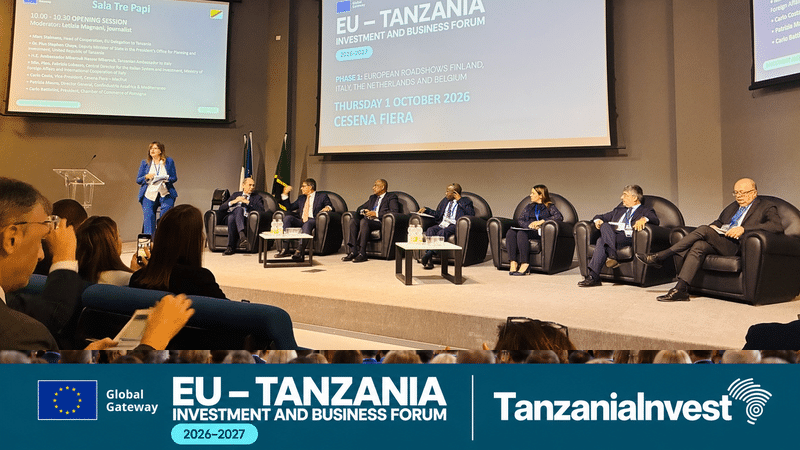



The EU–Tanzania roadshow continued in Cesena on 1 October, opening the Italian leg with investment pitches in agro-processing, renewable energy and digital infrastructure.
Tanzania highlighted projects in rice, cashew and coffee, alongside power generation, transmission and digital connectivity.
The Cesena meetings were the fourth day of the EU–Tanzania Investment and Business Forum 2026–2027 roadshows, following two days in Helsinki.

The programme at Cesena Fiera began with an opening session, followed by presentations from Tanzania’s investment promotion agencies and breakout sessions on agribusiness, digital transformation, and renewable energy and power.
Opening Session: EU Funding and Italy–Tanzania Investment Opportunities
Marc Stalmans, Head of Cooperation at the EU Delegation to Tanzania, described the roadshow as a way to bring European companies closer to Tanzanian opportunities before the main business forum.
He outlined Tanzania’s Vision 2050 ambition to quadruple GDP per capita over 25 years, its natural resources and the limited presence of EU companies.
Agriculture, mining, transport, renewable energy and digital infrastructure were among sectors with scope to expand, alongside critical minerals such as graphite, nickel, copper, lithium and cobalt.
The EU offers grants, guarantees, blended finance and loans through European development finance institutions.

Stalmans referred to a EUR 156 million grant package for Tanzania approved at the end of July, describing it as part of a renewed economic partnership.
The EU–Tanzania Investment and Business Forum is tentatively scheduled for 5–6 February 2027 in Dar es Salaam.
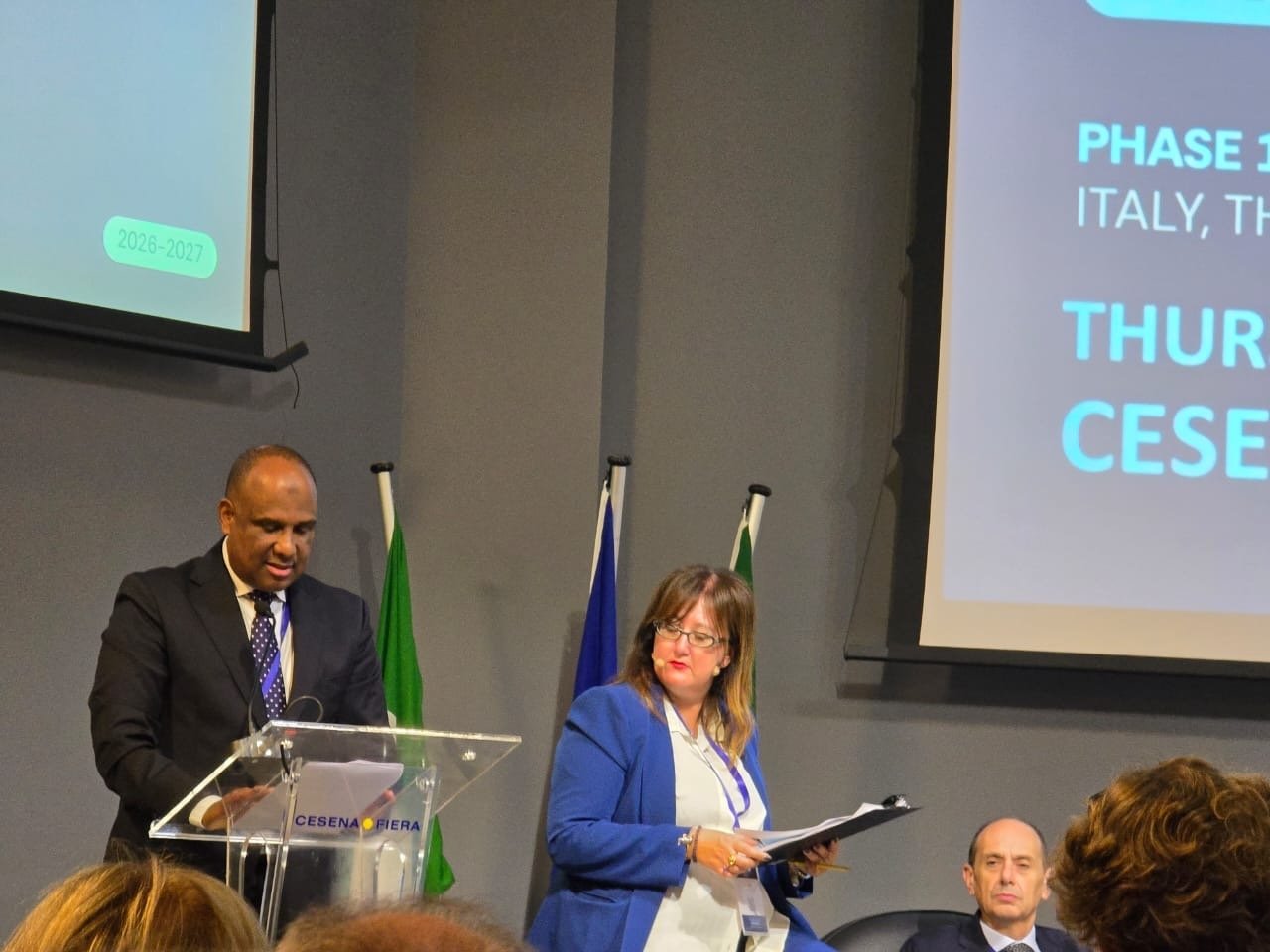
Deputy Minister Sets Out Tanzania’s Investment Case for Italian Companies
The Deputy Minister of State in the President’s Office for Planning and Investment, Hon. Dr. Pius Stephen Chaya, framed Tanzania’s investment offer around a shift from exporting raw commodities to processing and exporting higher-value products.
He urged Italian companies to invest across agricultural value chains, from production and storage to processing, packaging, cold-chain logistics and market access.
An Italian Trade Agency study valued Tanzania’s packaging market at about USD 370 million in 2024, pointing to demand for Italian food-processing and packaging machinery, refrigeration, bottling, labelling and quality-control systems.
Chaya also outlined opportunities in precision farming, smart irrigation, digital market platforms, weather information, traceability, digital payments and supply-chain management, and invited Italian financial institutions to develop buyer-credit frameworks.
Investors can use Tanzania as a base to serve the East African Community, the Southern African Development Community and the African Continental Free Trade Area, with support from the President’s Office for Planning and Investment, the Tanzania Investment and Special Economic Zones Authority (TISEZA) and the Zanzibar Investment Promotion Authority (ZIPA) throughout the investment cycle.
He identified local value addition, jobs, technology transfer, skills, export growth and links with local enterprises as priorities.
“Come not only to sell to Tanzania, but to produce, process, innovate, as well as export from Tanzania,” he urged.
On energy, Chaya welcomed Italian expertise in renewable generation, storage, transmission and distribution, naming solar, wind, hydropower, geothermal and biomass.
He also highlighted decentralized opportunities in mini-grids, rural solar, clean cooking and productive use of energy in agriculture and manufacturing, linking the sector to Italy’s Mattei Plan for Africa.
In digital infrastructure, he cited broadband, data centres, cloud services, cybersecurity, fintech, e-government, artificial intelligence and digital skills, and recalled 2024 discussions between Tanzania and Sparkle on ICT infrastructure and connectivity.
Chaya closed by inviting Italian companies to the EU–Tanzania Investment and Business Forum planned for 2027 in Dar es Salaam: “Tanzania is ready to partner, Tanzania is ready to invest, Tanzania is ready to transform.”
After his presentation, Chaya spoke separately with TanzaniaInvest.
He described Italian businesses as positive about Tanzania’s opportunities and said the two countries should build on their long-standing cultural relationship by strengthening trade and investment.
Investors he had met showed particular interest in tax incentives and the energy sector.
“What we have agreed is that we share with them the list of the potential pipeline projects that we have done the feasibility and detailed designs for, so that then they can scrutinize and see which from that list they can be able to finance,” Chaya said, linking stronger trade and investment ties to delivery of Vision 2050.
In a separate conversation with TanzaniaInvest, Andrew Mahiga, Director of Private Investment at the President’s Office for Planning and Investment, highlighted discussions with Cassa Depositi e Prestiti (CDP) on energy financing and Italian interest in rural water and sanitation projects.
He noted that Italian companies had arrived with identified projects and wanted to take discussions further, and that follow-up would benefit from the relevant ministries and decision-makers.
The Tanzanian Ambassador: Italian Company Pursues 50 MW Solar Investment
Tanzania’s Ambassador to Italy, Mbarouk Nassor Mbarouk, told the opening session that he had been informed that morning that an Italian company attending the roadshow was investing in 50 MW of solar power in Tanzania.
He did not identify the company.
Mbarouk also pointed to Italian-Tanzanian cooperation in coffee, including a planned Coffee Training Center in Moshi, and welcomed partnerships in energy storage, efficiency and financing.
Italian Institutions Cite Growing Investment and Business Links
Fabrizio Lobasso, Central Director for the Italian System and Investment at Italy’s Ministry of Foreign Affairs and International Cooperation, cited USD 8.6 billion in foreign investment registered in Tanzania in the last year, up 56%.
He described the relationship as moving from trade towards productive partnerships in machinery, digitalisation and agricultural logistics.
Patrizia Mauro, Director General of Confindustria Assafrica & Mediterraneo, said Italian interest had accelerated since the launch of the Mattei Plan for Africa.
Members are active in construction, machinery, transport, digital connectivity and training.
Leonardo (Euronext Milan: LDO) and Sparkle were due to present in the afternoon sessions.
Carlo Costa, Vice-President of Cesena Fiera–Macfrut, highlighted mechanisation, irrigation, logistics, cold chains and post-harvest processing.
Carlo Battistini, President of the Chamber of Commerce of Romagna, welcomed the opportunity to connect local firms with Tanzanian partners.
According to Chaya, Italy–Tanzania trade reached about EUR 235 million in 2024.
The 2025 business forum in Dar es Salaam brought together 48 Italian and about 300 Tanzanian companies and generated nearly 500 B2B meetings.
Tanzanian Investment Agency Presentations
TISEZA: Rice, Cashew, Coffee, Renewable Power and Digital Infrastructure
Gilead J.
Teri, Director General of TISEZA, presented opportunities in agriculture, renewable energy and digital infrastructure.
He said TISEZA’s One Stop Facilitation Centre has a dedicated desk for Italian and European investors, assisting with registration, visas and residence permits.
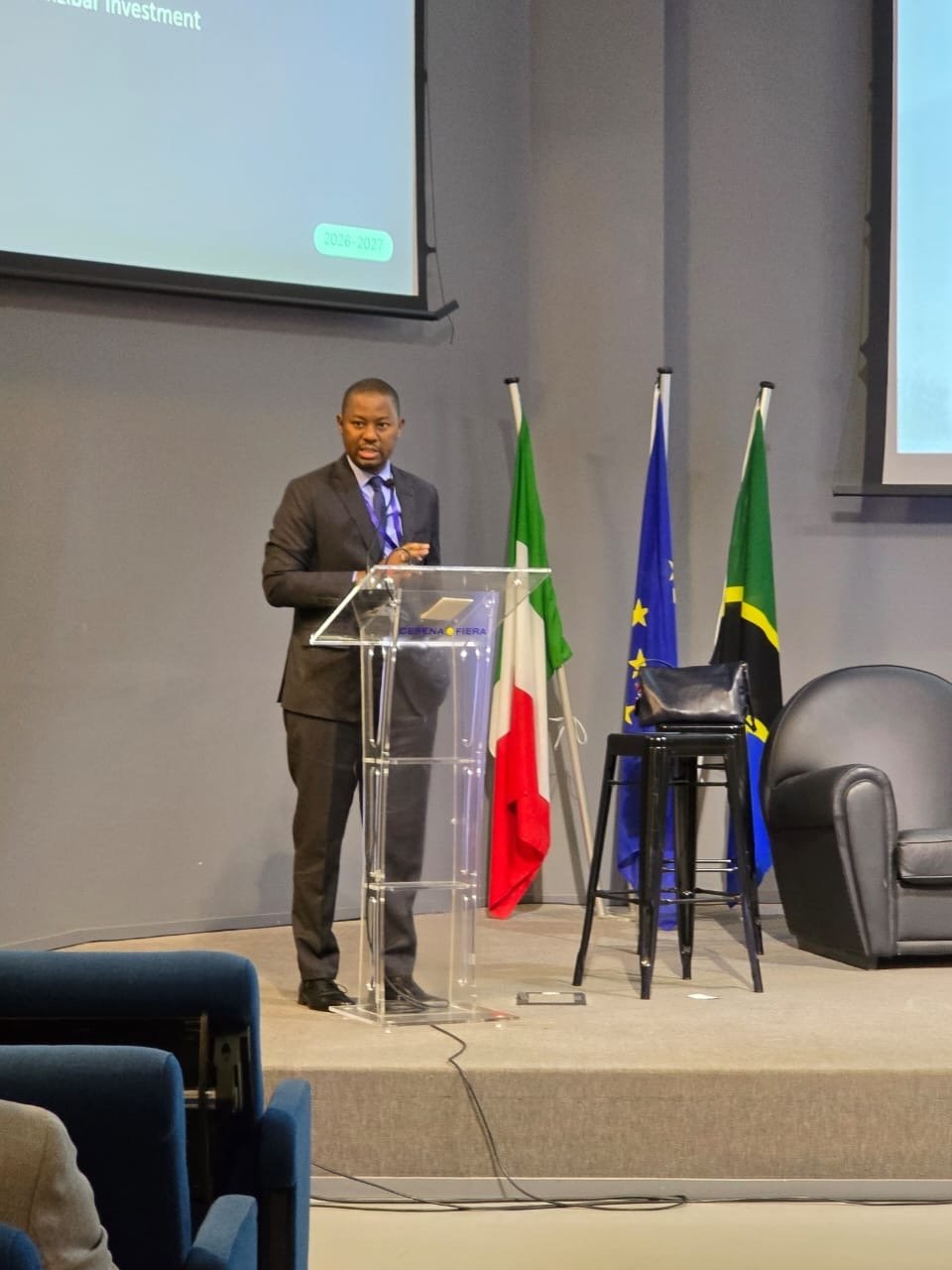
Teri, Director General of the Tanzania Investment and Special Economic Zones Authority (TISEZA), presents investment opportunities.
Tanzania produces about 2.2 million tonnes of rice a year.
Teri estimated the rice investment opportunity at USD 200–370 million, spanning irrigation, mechanisation, milling, storage, warehouse-receipt systems, integrated clusters and packaging.
The Government could also hire storage facilities built by investors.
Tanzania produces about 400,000 tonnes of cashew annually, but 90%–95% is processed abroad.
Teri said processing can lift value from USD 1.50 per kilogram to USD 8–12.
Anchor processing plants could require USD 10–50 million, with enabling infrastructure requiring USD 1–15 million.
Coffee opportunities include washing stations, drying, traceability, outgrower platforms, roasting and grinding; Teri noted a 10-year corporate income tax exemption for coffee roasted and processed in Tanzania for export.
In energy, Teri outlined investment routes through government supply, captive power for manufacturers in special economic zones and battery storage to support the grid.
Digital areas include data centres, cybersecurity, fibre connectivity and digital government.
TISEZA expects investors to bring at least USD 500,000; projects above USD 50 million may negotiate tailored incentives.
ZIPA: Zanzibar Telecom Gateway and Island Energy Projects
Farida Said Mohamed, Manager for Investment Promotion and Marketing at ZIPA, presented Zanzibar’s investment climate and project pipeline.
ZIPA registered 650 projects worth USD 7.2 billion from 2021 to 2025, expected to create 30,500 jobs.
European investors accounted for 279 projects worth USD 2.8 billion; 25 registered public-private partnership projects carry a combined value of USD 1.23 billion.
Projects presented included a proposed USD 67 million international telecommunication gateway in the Fumba special economic zone under a public-private partnership, and a roughly USD 90 million energy-storage and electrification project for Tumbatu, Uzi, Ntumbe and Kojani.
ZIPA also has a master plan for a data centre to share with interested investors.
Investors may operate with full private ownership, through a local joint venture or a public-private partnership.
Incentives include up to 100% import duty and VAT relief on capital goods, corporate tax relief of up to 10 years, land leases of 33–99 years and full repatriation of profits after tax.
Applications can be made online through the Zanzibar Investment Electronic Window.
Download the ZIPA investment climate presentation (PDF).
Breakout Sessions: Agribusiness, Digital and Renewable Energy
Agribusiness: Rice Mechanisation, Coffee Partnerships and Cashew Processing
The Deputy Minister of Agriculture, Hon. David Ernest Silinde, described agriculture as contributing about 24.6% of GDP, employing more than 55% of the workforce and supplying around 30% of export earnings.
He invited investment in crop production, irrigation, mechanisation, agro-processing, storage, logistics and agricultural finance.
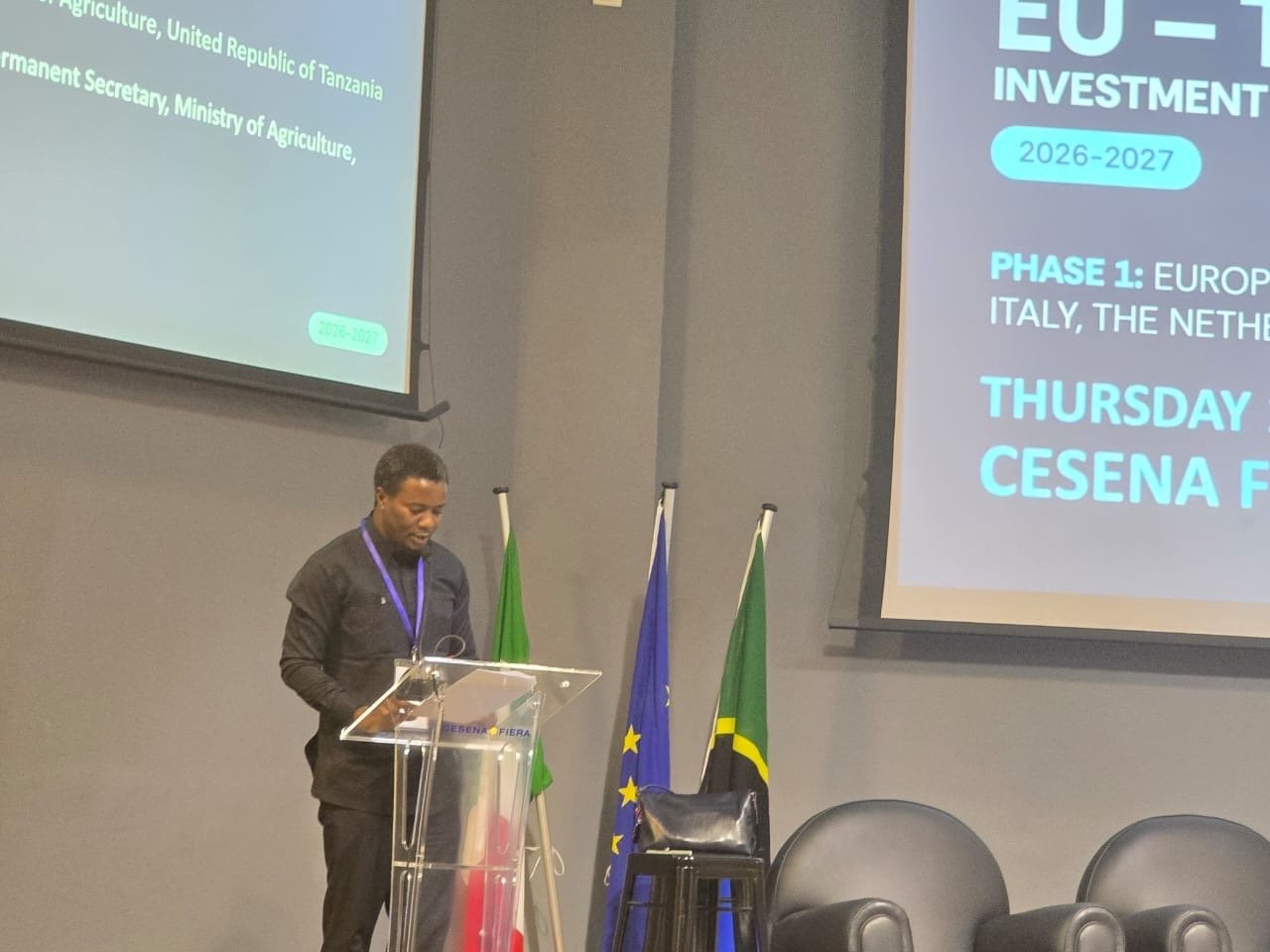
The Ministry identified an indicative USD 192.67 million requirement to expand rice mechanisation.
A coffee programme links more than 600 agricultural marketing cooperative societies with EU traders on quality, traceability, compliance and branding.
Construction is under way at the Maranje Cashew Industrial Park, designed for kernel processing, cashew nut shell liquid, drying, warehousing and laboratory services.
The Ministry aims to increase national grain storage to 3 million tonnes by 2030, creating opportunities in warehouses, logistics and commodity management through public-private partnerships.
Its presentation also outlined irrigation rehabilitation, solar pumping, drip and sprinkler systems and climate-resilient production.
The EU bought 43% of Tanzania’s coffee exports in 2025/26, about 14.5 million kilograms; Italy imported 2.59 million kilograms.
The Ministry’s presentation put the Maranje park investment at USD 137 million.
Silinde closed with a call for practical partnerships: “Tanzania is ready to work with investors prepared to contribute to the transformation of our agricultural sector.”
Download the Ministry of Agriculture presentation (PDF).
Digital Transformation: Broadband, Data Centres and Digital Public Services
The programme included a digital transformation breakout.
The ICT Commission and Ministry of Communication and Information Technology presentations, also delivered in Helsinki on 28 September, outline Tanzania’s digital outlook and investment priorities.
The ICT Commission reported that the National ICT Broadband Backbone had reached 13,820 kilometres, 85% of the planned network, connecting all mainland regions, Zanzibar and 109 of 139 districts.
The Government plans to mobilise TZS 7 trillion for broadband and data centres by 2031.
Opportunities include the Kilimanjaro One submarine cable, data centres, fibre-to-the-home expansion, device manufacturing, a digital technology and innovation park, and smart classrooms.
The Ministry presentation outlined the Jamii Stack—digital identity, e-payments, data governance and a Swahili large language model—and opportunities in government cloud, last-mile broadband, artificial intelligence, digital payments and device assembly.
Download the ICT Commission presentation (PDF) · Download the Ministry of Communication and Information Technology presentation (PDF).
Renewable Energy: TANESCO Generation, Grid and Interconnection Projects
Marietha Kileo, Head of the Investment Desk at the Tanzania Electric Supply Company (TANESCO), presented a power system with about 4.6 GW of installed generation capacity and a Government target of 8 GW by 2030.
Demand is expected from mining, agribusiness, special economic zones and data centres.
Priority generation projects include the 222 MW Rumakali hydropower plant (USD 634.5 million) and the 100 MWp Manyoni solar plant (USD 79.6 million), alongside the 358 MW Ruhudji hydropower plant and 321 MW Kikonge multipurpose dam.
Transmission opportunities include the 526-kilometre Sumbawanga–Mpanda–Kigoma line, estimated at USD 292 million, and interconnections with Uganda and Malawi.
Project costs are indicative and are not remaining funding gaps.
Download the TANESCO presentation (PowerPoint).
Ministry of Energy: 3,814 MW Under Construction and Private-Sector Reforms
Styden Rwebangila, Assistant Commissioner for Electricity Development at the Ministry of Energy, reported 3,814.3 MW of generation projects under construction, spanning gas, wind, solar and hydropower.
Peak demand reached 2,505.86 MW in June 2026, with demand rising 10%–15% annually.
The Ministry has revised model power-purchase and implementation agreements to address bankability issues, engaged a technical adviser on risk allocation, and is preparing pilot renewable projects as templates for future independent power producer and public-private partnership deals.
Download the Ministry of Energy presentation (PowerPoint).
Rural Energy Agency: Last-Mile Connections and Mini-Grids
The Director General of the Rural Energy Agency (REA), Eng. Hassan Seif Saidi, outlined a target of more than 8.3 million additional household connections by 2030.
Priorities include last-mile connections, substations, network reinforcement, smart metering and electricity for agro-processing, cold chains, irrigation, mining and rural industry.
Where grid extension is unsuitable, REA is seeking partners for solar, wind, small hydro and hybrid mini-grids, clean cooking and productive-use appliances.
A rural electrification programme across 25 regions had electrified all 1,145 target areas by 10 September 2026, with implementation at 92.16%.
Download the Rural Energy Agency presentation (PowerPoint).
Italian Project Partners: Advisory, Wind and Industrial Solar
RINA Consulting described its lender advisory and project preparation work, including Tanzania’s Standard Gauge Railway, Lake Victoria ports and feasibility and tender documents for converting TANESCO gas plants to combined-cycle operation.
Geo Wind Power Tanzania presented a proposed 100 MW first phase of the Singida wind project, expandable to 300 MW, with an indicative cost of USD 110–150 million.
The company is seeking investors, lenders, export credit agencies, engineering and turbine partners.
An existing power-purchase agreement covers the original 50 MW project; an amendment for the expanded phase remains to be pursued.
Studio Santi presented a 15 MWp solar farm at Twiga Cement in Dar es Salaam, producing about 26 GWh annually.
Heidelberg Materials developed the behind-the-meter plant, with Studio Santi providing design, permitting and construction supervision.
Download the Singida Wind project booklet (PDF) · Download the Studio Santi presentation (PowerPoint) · Download the RINA presentation (PowerPoint).
EU and Italian Institutions Outline Investor Financing
Global Gateway: Grants, Guarantees and Blended Finance
Francis Lemoine, Investment Officer at the European Commission’s Directorate-General for International Partnerships, explained how Global Gateway combines grants, guarantees and blended finance.
EU grants can lower project costs and support technical assistance and feasibility studies, while companies can approach European development finance institutions for project guarantees, lending, investment funds and currency-risk cover.
Lemoine also described the Sustainable Investment Hub as an entry point for early project identification and preparation.
Italian Finance: Export Credit, Concessional Loans and Project Preparation
Representatives of the Italian Trade Agency, CDP, SACE, SIMEST and the Italian Agency for Development Cooperation outlined support for market entry and investment.
CDP reported advanced discussions in Tanzania on projects worth about EUR 400 million in energy, rural water access and coffee, and said it was finalising a loan to a Tanzanian agribusiness working with Italian companies.
SACE offers export-credit guarantees that can let Tanzanian buyers repay purchases of Italian machinery over longer periods.
SIMEST described equity participation and subsidised finance for feasibility studies, trade fairs, digitalisation and training.
The Italian Agency for Development Cooperation is preparing a EUR 50 million impact-enterprise measure.
Matchmaking Closes Day One of the Italian Leg
The day concluded with B2B, B2G and B2F matchmaking, connecting Italian companies with Tanzanian firms and public agencies.
The programme continues on 2 October with a visit to Gruppo Martini in Cesena, before the roadshow moves to The Hague on 5–6 October.
The European roadshows will lead to the EU–Tanzania Investment and Business Forum in Dar es Salaam in 2027.
Want to know more about Agriculture in Tanzania? Our free overview of the Tanzania Business and Investment Guide 2026 covers Agriculture, plus key sectors and investment opportunities. The complete 141-page edition includes policies, taxation, key regulations, full macroeconomic data, and sources, and is also available at no cost upon completion of a short form.
Download Free OverviewGet the Full Edition for Free