

Tanzania’s Ministry of Natural Resources and Tourism has tabled a TZS 334.35 billion budget for the 2026/27 financial year, with TZS 272.04 billion (81.4%) directed to recurrent expenditure and TZS 62.30 billion (18.6%) to development projects across wildlife, forestry, tourism and antiquities.
The budget was presented to the National Assembly by Minister of Natural Resources and Tourism Dr. Ashatu Kijaji on 15 May 2026 in Dodoma.
The 2026/27 allocation is broadly flat against the TZS 336.52 billion approved for 2025/26, a decrease of about 0.6%.

The Ministry projects revenue collection of TZS 1.49 trillion in 2026/27 from its departments and institutions, more than four times the size of its own budget.
Tanzania Natural Resources and Tourism Budget 2026/27 Structure
The Ministry has requested Parliament to approve TZS 334,345,870,000 for the 2026/27 financial year.
Recurrent expenditure accounts for TZS 272,044,425,000 (81.4%), comprising TZS 144,691,490,000 for salaries and TZS 127,352,935,000 for other operational charges.
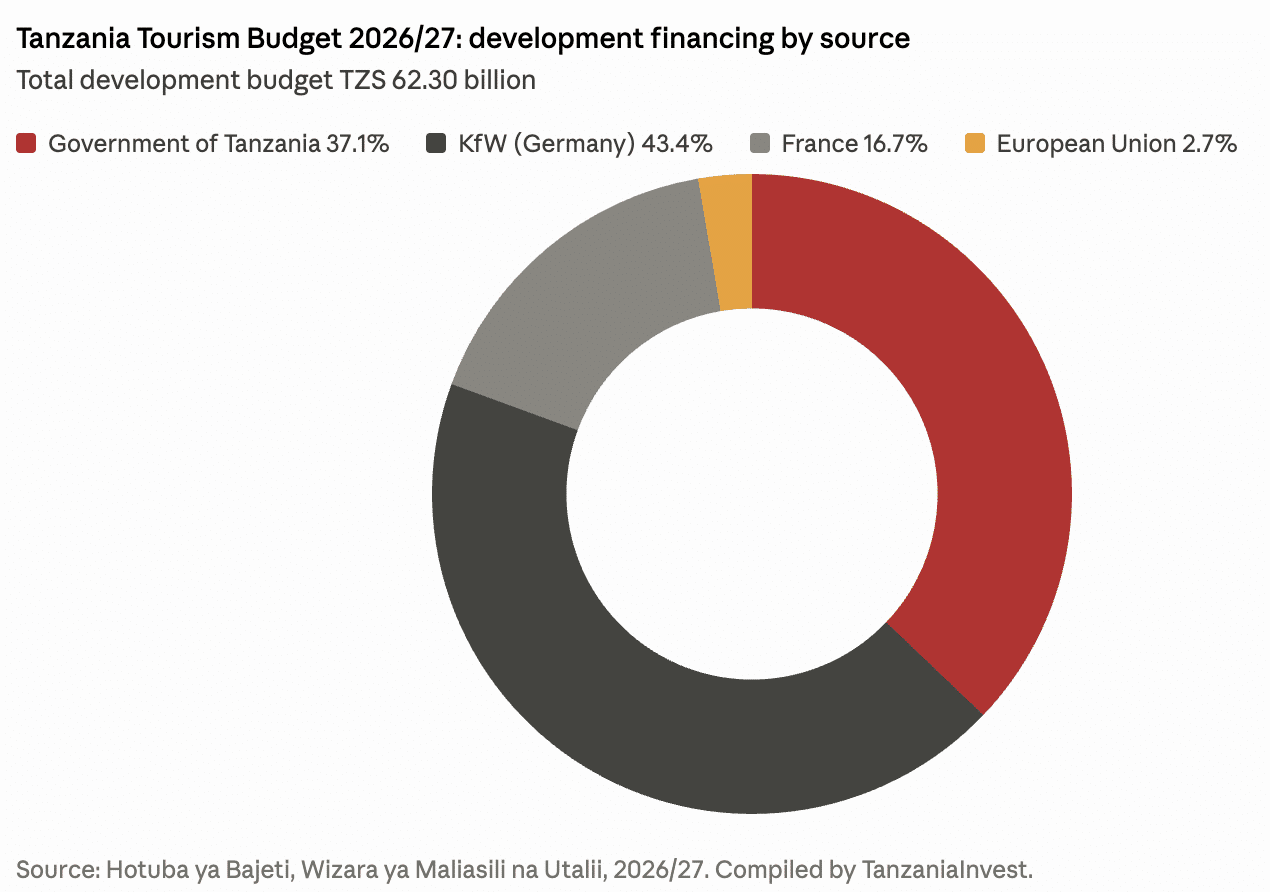
Development expenditure accounts for TZS 62,301,445,000 (18.6%), with TZS 23,134,770,000 financed from domestic sources and TZS 39,166,675,000 from external sources.
Of the development budget, TZS 13,686,497,742 covers projects run by the Ministry’s departments and units, and TZS 48,614,947,258 covers projects run by its institutions, including the Tanzania National Parks (TANAPA), the Tanzania Wildlife Management Authority (TAWA), the Tanzania Forest Service (TFS), the National Museums of Tanzania, the National College of Tourism, and the Tanzania Wildlife Research Institute (TAWIRI).

For 2026/27, the Ministry projects revenue collection of TZS 1,486,502,065,176, drawn largely from TANAPA, which is expected to contribute TZS 720.31 billion, and the Ngorongoro Conservation Area Authority (NCAA), expected to contribute TZS 387.38 billion.
Tanzania Tourism Performance in 2025
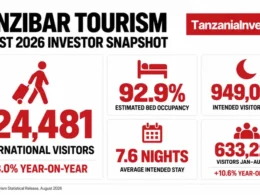
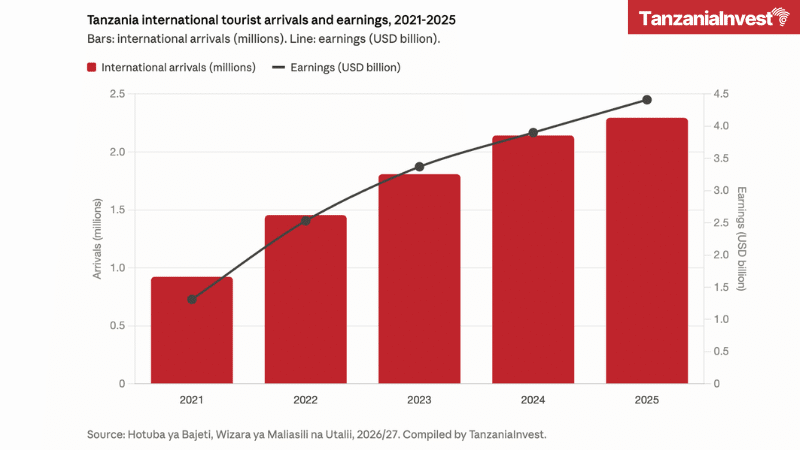
Tanzania received 5,935,561 tourists in 2025, a 10.7% increase from 5,360,247 in 2024.
International arrivals rose 7.1% to 2,294,495 from 2,141,895, while domestic tourists rose 13.1% to 3,641,066 from 3,218,352.
Total earnings from tourism rose to USD 4.4 billion in 2025 from USD 3.9 billion in 2024, an increase of 12.82%, making tourism the country’s second-largest source of foreign exchange after mining.
The tourism sector contributed 17% of Gross Domestic Product in 2025, with the Government targeting 20% by 2030.
UN Tourism ranked Tanzania 11th in the world for growth in international arrivals compared with 2019, and 3rd globally as the best-performing market by visitor spending in 2025.
The Serengeti National Park was named World’s Leading National Park 2025 at the World Travel Awards, and Tanzania was named World’s Leading Safari Destination for the third consecutive year.
National park visitor revenue reached TZS 468.44 billion by April 2026, while the Ngorongoro Conservation Area generated TZS 251.89 billion over the same period.
Tanzania Natural Resources and Tourism 2026/27 Budget Priorities
The 2026/27 budget supports priorities across the four sub-sectors of wildlife, forestry and beekeeping, tourism, and antiquities.
The priorities include expanding the range of tourism products, strengthening conservation and anti-poaching capacity, adopting modern technology in revenue collection and tourism marketing, reviewing sector policies and laws to improve the investment environment, and strengthening research and human resource development.
The priorities align with the Government’s ambitions to lift tourism’s contribution to GDP to 20% and increase the number of tourists visiting the country to 8 million by 2030.
Tourism Development Projects 2026/27
The MICE Tourism Development Project, covering meetings, incentives, conferences and events tourism, will receive TZS 908,979,433 in domestic financing, including the preparation of bills of quantities for construction works and the development of the Travel Companion booking system.
The Southern Tourism Development Project will receive TZS 9,341,280,593 in domestic financing to develop the southern tourism circuit.
The National College of Tourism will receive TZS 1,654,595,091 in domestic financing to complete an academic building at its Arusha campus.
TANAPA will implement TZS 27,062,435,990 in projects financed by the German development bank KfW, covering biodiversity restoration, Serengeti ecosystem conservation, and conservation of the Katavi and Mahale Mountains national parks, including the construction of the Kogatende bridge and connecting roads in the Serengeti National Park.
TAWA will implement TZS 7,487,896,003 in domestically financed projects.
The Online Safari Booking System will be developed as part of a TZS 57,476,764 public financial management project to enable tourists to book and pay digitally.
Forestry, Wildlife and Antiquities Projects 2026/27
The Government Forest Plantations Management Strengthening Project will receive TZS 10,410,020,174 in financing from France.
The Food Systems, Land Use and Restoration project (FOLUR) will receive TZS 1,694,218,836 in financing from the European Union.
TAWIRI will receive TZS 1,000,000,000 in domestic financing to continue construction of its headquarters building, which will house offices, wildlife laboratories, and conference halls.
The National Museums of Tanzania will receive TZS 1,000,000,000 in domestic financing for the construction of the Presidents’ Museum in Dodoma, covering research and exhibition design.
A capacity building project for game reserves and the anti-poaching unit will receive TZS 1,114,138,124 in domestic financing.
A capacity-building project for forestry and beekeeping institutions and training will receive TZS 570,403,992 in domestic financing.
Want to know more about Tourism in Tanzania? Our free overview of the Tanzania Business and Investment Guide 2026 covers Tourism, plus key sectors and investment opportunities. The complete 141-page edition includes policies, taxation, key regulations, full macroeconomic data, and sources, and is also available at no cost upon completion of a short form.
Download Free OverviewGet the Full Edition for Free