




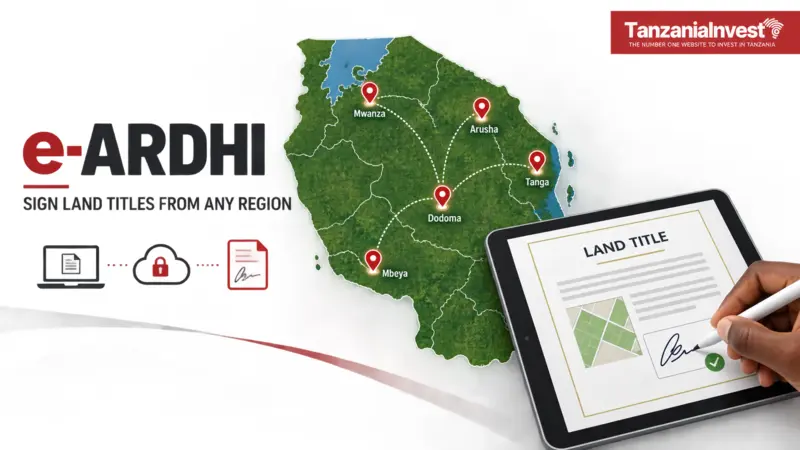
Tanzanians can now access and complete several land services through the digital e-Ardhi system, including signing their title deeds without having to travel to the region where the service originated.
The Assistant Commissioner for Lands in Ruvuma Region, Said Juma Kijiji, said the system has brought major improvements to land service delivery through the use of technology, speaking during a public education session on the e-Ardhi system broadcast on Jogoo FM Ruvuma.
He explained that the benefits of the system include enabling citizens to obtain services more easily, reducing travel costs and time, and simplifying the tracking of land services.

Kijiji pointed to the ability to complete title-signing remotely as a key change for citizens.
“Through the e-Ardhi system, a citizen can sign their title deed while in any region, so it is no longer necessary to travel to the region where their service originated,” Kijiji said.
A Senior Land Officer from the ministry’s headquarters, Hisani Mtolera, urged citizens and land-sector stakeholders to learn and use the e-Ardhi system in order to benefit from the services offered digitally.
He noted that use of the system continues to be an important part of land-service reforms by enabling citizens to obtain services more efficiently and easily.
The Assistant Registrar of Titles for Ruvuma Region, Christina Nyerere, called on citizens to embrace and use the system and to keep building their understanding of e-Ardhi to follow up on and access land services digitally.

The public education was delivered through Jogoo FM Ruvuma as part of government efforts, through the Ministry of Lands, Housing and Human Settlements Development, to raise citizens’ awareness of using digital systems to access land services.
The e-Ardhi system is Tanzania’s flagship digital land-administration platform run by the Ministry of Lands, Housing and Human Settlements Development, covering planning, surveying, land allocation, registration and valuation functions that were previously paper-based and tied to the region where a title was issued.
The Dodoma, Arusha, Tanga, Mbeya and Mwanza regions, along with several municipal and district councils, have started using the platform.
The push for wider adoption follows direct ministerial pressure, with the Minister for Lands, Housing and Human Settlements Development, Deogratius Ndejembi, urging land-sector officials during Land Week commemorations in December 2024 to ensure they fully use the digital land system in areas where it has already been rolled out.
The ministry has also been expanding related digital tools, including a mobile app for submitting land disputes and complaints and the ILMIS-based “Ardhi Kiganjani” mobile platform, part of a broader drive to shift land services from physical offices to remote, phone- and internet-based access nationwide.
Want to know more about Construction in Tanzania? Our free overview of the Tanzania Business and Investment Guide 2026 covers Construction, plus key sectors and investment opportunities. The complete 141-page edition includes policies, taxation, key regulations, full macroeconomic data, and sources, and is also available at no cost upon completion of a short form.
Download Free OverviewGet the Full Edition for Free


