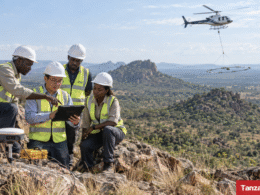




Helium exploration company Helium One (AIM: HE1) has announced the presence of helium enriched gas in drilling mud in the Lake Bed Formation at the Tai-1 well at the Rukwa Project in Tanzania.
David Minchin, CEO of Helium One, commented: “We are very excited to have identified the presence of helium in drilling mud from very shallow depth. Drilling will now continue to the base of the Lake Bed Formation at which point we will run wireline tools to obtain more detailed formation evaluation. Although concentrations of 2.2% He are encouraging indicators of free gas, it is important to note that a helium show is not evidence of commerciality and further evaluation is required by wireline logging to confirm any potential pay zones. It is also important to note that gas concentrations encountered in mud logging are qualitative rather than quantitative and in-situ grade may be higher or lower than what is measured.
“With over 1000 meters still to drill at Tai-1 these are early days in our exploration drilling. Early helium shows give us a great deal of optimism for the remaining program and we look forward to providing further updates as the project develops,” Minchin concluded.

Helium One commenced its drilling program at the Rukwa Project in southwestern Tanzania on 12th June 2021.
The company plans a three wells program targeting shallow structures in close proximity to the Itumbula Helium Seeps.
Drilling of the first well is expected to take approximately one month to complete and will produce valuable information about the subsurface.
Helium detection will be constantly monitored during drilling to identify helium gas shows from mud logging.
The Rukwa Helium Project
Rukwa is a large-scale, high-grade, primary helium project covering an area of approximately 3,590 km2 in southwestern Tanzania with the potential to become a strategic asset in resolving a supply-constrained market.

Rukwa hosts independently verified (SRK-2019) Best-Estimate Unrisked Prospective Recoverable Helium Resource (2U/P50) of 138 billion cubic feet (Bcf), making this the largest known primary helium resource in the world.
The 2U Risked Prospective Resource is estimated at 14.0 Bcf.
Want to know more about Mining in Tanzania? Our free overview of the Tanzania Business and Investment Guide 2026 covers Mining, plus key sectors and investment opportunities. The complete 141-page edition includes policies, taxation, key regulations, full macroeconomic data, and sources, and is also available at no cost upon completion of a short form.
Download Free OverviewGet the Full Edition for Free