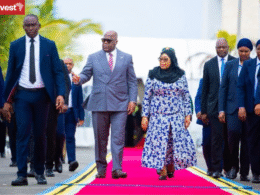




On 28th December 2021, the President of Tanzania Samia Suluhu Hassan witnessed the signing of the agreement for the construction of the third phase of the Standard Gauge Railway (SGR) connecting Makutupora to Tabora.
The agreement was signed between the Tanzania Railways Corporation (TRC) and Yapi Merkezi of Turkey at a ceremony held at the State House in Dar es Salaam.
The construction of the section includes 294 km of main rail and 74 km of intersections for a total of 368 km will cost TZS 4.41 trillion.

President Samia said that the government will look at any convenient way to borrow concessional loans to finance the project, pointing out that major projects cannot be found by the money collected from local taxes.
She reminded that the government has already invested TZS 14.7 trillion into the SGR project and that the money invested will be meaningless if the government does not borrow to complete the project.
In addition, President Samia instructed the Ministry of Works and Transport through TRC to complete the procurement process for the construction of the remaining sections of Tabora to Isaka and from Tabora to Kigoma.
She also invited various financial institutions around the world to participate in financing the construction as it will help connect Tanzania with neighboring countries using the Port of Dar es Salaam to transport cargo shipments.
Tanzania Standard Gauge Railway (SGR)
The government of Tanzania is currently expanding the country’s rail network with the construction of the Standard Gauge Railway (SGR) along the central corridor.

The SGR consists of a network of 1,219 km developed in five phases:
- Phase 1: Dae es Salaam – Morogoro (Km 300)
- Phase 2: Morogoro- Makutupora (Km 422)
- Phase 3: Makutupora –Tabora (Km 294)
- Phase 4: Tabora – Isaka (Km 130)
- Phase 5: Isaka – Mwanza (Km 249)
Want to know more about Transport in Tanzania? Our free overview of the Tanzania Business and Investment Guide 2026 covers Transport, plus key sectors and investment opportunities. The complete 141-page edition includes policies, taxation, key regulations, full macroeconomic data, and sources, and is also available at no cost upon completion of a short form.
Download Free OverviewGet the Full Edition for Free