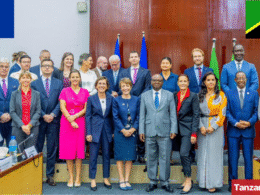



The Tanzanian-European Union Business Forum 2023 opened yesterday in Dar es Salaam to high-level dignitaries and businesses from the Tanzanian government and various European countries.
The forum is being organized by the European Union in Tanzania, together with the Government of Tanzania, in cooperation with the EU member states and the Tanzanian private sector.
The Forum was officiated by His Excellency Dr Phillip Isdor Mpango, Vice President of Tanzania. It was also addressed by Olivier Becht, Minister Delegate for Foreign Trade and Economic Attractiveness of France; Hon. Dr Ashatu Kijaji, Minister for Investment, Industry and Trade of Tanzania; Thomas Östros, Vice President of the European Investment Bank (EIB); and Helena Konig, Deputy Secretary General of the European External Action Service- of the European Union (EU).

All speakers insisted on the opportunities for both EU and Tanzania businesses that can be realised from the business forum, while the EU representatives reiterated the need to strengthen partnerships, especially at a time when the world has faced and is facing multiple challenges.
In his remarks, Vice President Mpango presented the philosophy guiding the sixth phase of the Tanzanian which is based on the 4Rs-Reform, Reconciliation, Resiliency and Rebuilding-to achieve the country’s vision of becoming an upper-middle income country, sustainably and inclusively.
Following the opening of the forum, three agreements were signed worth EUR 353 Million (approximately TZS 882.5 Billion) between Tanzania and European Union Institutions.
The three agreements were: an Air Service Agreement between the Government of France and the Tanzania Civil Aviation Agency; a Memorandum of Understanding (MOU) between the Port of Antwerp-Bruges International and Tanzania Ports Authority; and an agreement for the construction of the new Kakono hydro-power plant in the Kagera region.
In the afternoon, a number of panels featured discussions on the investment opportunities in agriculture, energy transition, manufacturing, connectivity, construction, transport, and logistics.

Want to know more about Trade in Tanzania? Our free overview of the Tanzania Business and Investment Guide 2026 covers Trade, plus key sectors and investment opportunities. The complete 141-page edition includes policies, taxation, key regulations, full macroeconomic data, and sources, and is also available at no cost upon completion of a short form.
Download Free OverviewGet the Full Edition for Free