

EACOP Ltd., the company responsible for the construction and future operation of the East African Crude Oil Pipeline (EACOP), has announced the successful closing of the first tranche of external financing for the project.
The financing is provided by a syndicate of financial institutions, including regional banks such as the African Export-Import Bank (Afreximbank), The Standard Bank of South Africa Limited, Stanbic Bank Uganda Limited, KCB Bank Uganda, and The Islamic Corporation for the Development of the Private Sector (ICD).
The EACOP project, with an estimated total cost of $5 billion, was initially funded through equity contributions from its shareholders following the Final Investment Decision (FID) in February 2022.

These contributions, made by TotalEnergies (62%), the Uganda National Oil Company Limited (UNOC – 15%), the Tanzania Petroleum Development Corporation (TPDC – 15%), and CNOOC (8%), enabled significant progress in the early stages of construction.
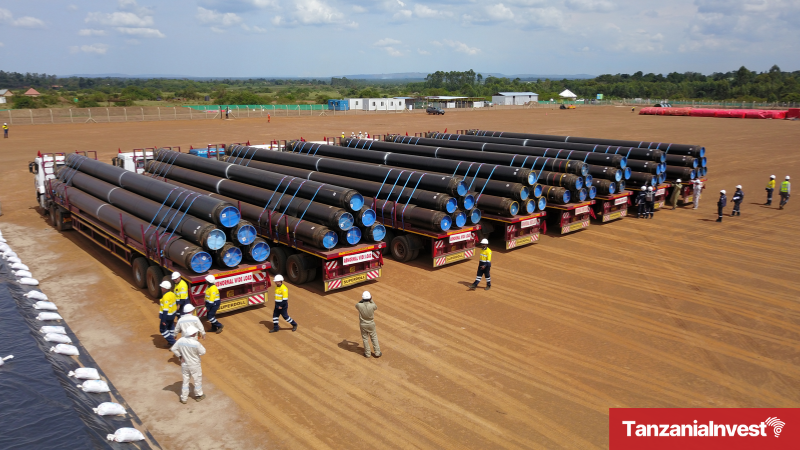
By the end of 2024, the project had surpassed 50% completion, with major milestones achieved in pipe haulage, infrastructure development, and workforce training.
The first tranche of external debt financing, announced in March 2025, will now fund the remaining phases of construction and operational setup.
Over 8,000 Ugandan and Tanzanian citizens are currently employed on the project, with approximately 400,000 man-hours of training provided to date.
Additionally, $500 million has been spent locally on goods and services, further contributing to the region’s economic development.

EACOP
The East African Crude Oil Pipeline is a world-class crude oil export infrastructure designed to transport Uganda’s crude oil from Kabaale in Hoima, Uganda, to the Chongoleani peninsula near Tanga, Tanzania, for export to international markets.
The pipeline will have a capacity of 246,000 barrels of crude oil per day and will span 1,443 kilometers, with 296 kilometers in Uganda and 1,147 kilometers in Tanzania.
The project includes six pumping stations, two pressure reduction stations, and a marine export terminal in Tanzania, which will feature a 3 MWp solar plant.
The pipeline will be insulated and buried, with power supplied primarily by hydro-based national grids.
Want to know more about Energy in Tanzania? Our free overview of the Tanzania Business and Investment Guide 2026 covers Energy, plus key sectors and investment opportunities. The complete 141-page edition includes policies, taxation, key regulations, full macroeconomic data, and sources, and is also available at no cost upon completion of a short form.
Download Free OverviewGet the Full Edition for Free