

In this exclusive interview with TanzaniaInvest, Peter Nalitolela, Chief Executive Officer of the Dar es Salaam Stock Exchange (DSE), discusses the performance and outlook of Tanzania’s capital markets, including the growth of equities and fixed income, ETFs and Sukuk, new listings, international investors, digital investment and the integration of African capital markets.
Tanzania’s capital markets have entered a period of strong expansion, with the Dar es Salaam Stock Exchange (DSE) recording rapid growth in market capitalisation and trading activity while expanding its range of investment products and seeking to attract more companies to the market.
In the first half of 2026, DSE market capitalisation reached TZS 35.18 trillion, up 79.11% year-on-year, while equity turnover reached TZS 1.068 trillion, already 61.94% above the full-year 2025 level.

The interview examines the expansion of fixed-income products, the development of Tanzania’s Sukuk market, the introduction of a third ETF, the opening of Treasury bills and bonds to international investors, and efforts to bring telecommunications, mining and state-owned companies to the exchange.
Nalitolela also discusses the DSE’s efforts to increase retail participation through digital investment, including the Hisa Kiganjani mobile trading platform, as well as the exchange’s plans to expand products, improve market access and contribute to the integration of African capital markets.
The interview forms part of TanzaniaInvest’s coverage of Tanzania’s developing capital markets and will also feature in the upcoming free Tanzania Capital Markets Report & Guide, being prepared by TanzaniaInvest with the endorsement of the DSE.
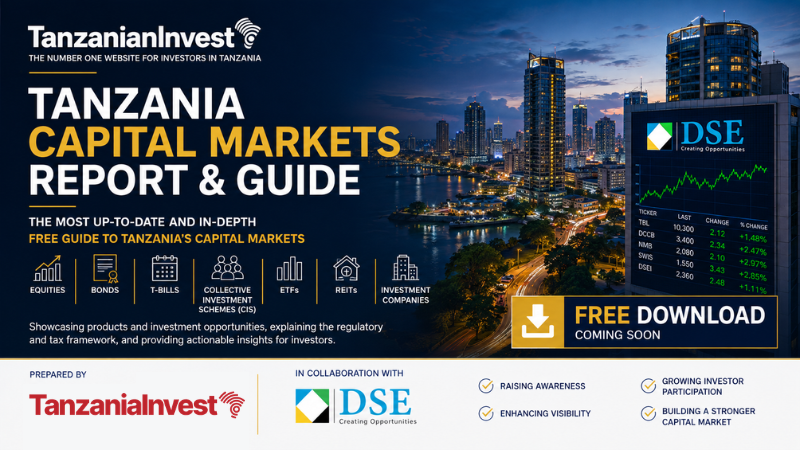
The free report will cover the DSE, equities, bonds and Treasury bills, collective investment schemes, ETFs and REITs, listed companies, market intermediaries, regulation and taxation.
TanzaniaInvest: DSE’s H1 2026 results showed market capitalisation up 79% year-on-year, alongside strong growth in equity turnover. What is driving this performance?

Nalitolela: The performance reflects a combination of strong investor sentiment leading to increased investor activity, improved market liquidity, institutional participation, and positive performance of listed companies.
Additionally, the new listings, particularly on the fixed income board, as well as the rights issue on the equities board, helped to bring in new investors into the market as well as reignite investor participation from existing investors. In total, 6 new issuances were listed in H1 of 2026 (1 ETF and 5 Fixed Income).
By the end of Q2 2026, total market capitalization stood at TZS 35.18 trillion, representing a 79.11% increase year-on-year, while domestic market capitalization increased by 84.85% to TZS 23.74 trillion.
Equity turnover has also been exceptionally strong. In H1 2026, equity turnover reached TZS 1.068 trillion, already 61.94% higher than the entire 2025 full-year turnover.
A significant part of the momentum came from increased trading in leading counters, particularly CRDB, NMB, TBL, TCC and TCCL. Institutional and pre-arranged trades also contributed significantly to the increase in activity.
So, fundamentally, we are seeing more capital, more trading activity and stronger valuations coming into the market.
“We are seeing more capital, more trading activity, and stronger valuations coming into the market.”
DSE plc’s own profitability also rose sharply this half, with profit after tax up 90%. What is behind these results?
The key driver has been the significant increase in market activity, particularly equity trading.
DSE Group revenue increased by 79.78%, from TZS 7.78 billion in H1 2025 to TZS 13.99 billion in H1 2026. Transaction fees increased by 209.64%, while Registry and CSD fees increased by 106.76%.
Profit before tax increased by 93.78% to TZS 6.56 billion, while profit after tax increased by 88.83% to TZS 6.20 billion.
Importantly, revenue grew faster than expenses. Revenue increased by approximately 80%, compared with expense growth of about 69%. This improved our cost-to-income ratio from 56.48% to 53.09%, demonstrating stronger operating leverage.
Therefore, this is fundamentally an operational performance story driven by stronger market activity, rather than a one-off effect.
DSE has continued expanding its exchange-traded fund offering, with a third ETF now listed on the exchange. How would you assess the results of the first two ETFs, and what can we expect from this growing segment going forward?
We are very encouraged by the development of the ETF market.
ETFs were only introduced on the DSE in October 2025, so this is still a relatively young segment. By the end of Q2 2026, ETF market capitalization had reached TZS 187.52 billion, compared with TZS 183.49 billion at the end of Q1.
More importantly, investor activity is increasing. In June alone, ETF turnover grew by 98.51% month-on-month, while volumes increased by 72.10%.
The introduction of additional ETFs is therefore important because it gives investors more choice, diversification and relatively accessible investment options.
Going forward, we expect ETFs to become an increasingly important part of the DSE product offering, particularly as we continue financial education and expand digital access to investment.
“Going forward, we expect ETFs to become an increasingly important part of the DSE product offering.”
The latest and third ETF to list is a fund-of-funds with a regional mandate. How does this fit into the rapid growth of collective investment in Tanzania?
The ETF launched by Zan Securities invests in other collective investment schemes. At present, these will mostly be unlisted schemes, and the mandate is not limited to Tanzania: they have approval for East Africa, so up to about 50% of the targeted portfolio can be in collective investment schemes elsewhere in the region.
This matters because of what has been happening to the investor profile in Tanzania. We have seen a very large surge of investment coming through collective investment schemes, with UTT Asset Management and Investor Services (UTT AMIS) leading. Its total assets under management are now in excess of TZS 6 trillion and heading towards TZS 7 trillion, and the number of investors has increased substantially to around 1.5 million, from about half a million not long ago.
So many investors have already started investing through that avenue. What a product like this does is say: if you have an appetite for collective investment schemes, you can now take that same exposure through an instrument that is listed on the exchange, which gives you an easier exit than going directly back to the issuer to sell.
For us it is both a new revenue line and a way of giving a Tanzanian investor access to East Africa-wide risk through a locally listed instrument.
Bond and government securities turnover also grew substantially in H1 2026. What is driving activity in the fixed income market?
The fixed-income market continues to benefit from strong investor demand for income-generating and relatively predictable investment instruments.
In H1 2026, fixed-income turnover increased by 34.64% year-on-year, from TZS 2.25 trillion to TZS 3.03 trillion.
Government bond activity also continued to grow, with YTD face value traded increasing by 19.75%, while corporate bond trading increased by 81.87% compared with H1 2025.
We have also seen a growing pipeline of new fixed-income products. During Q2 alone, the market saw listings such as MAKAZI Bond, EFTA Bond, MAPATO Sukuk, NYUMBA Bond, and iTRUST Bond, with total new listings of TZS 236.42 billion.
This demonstrates that the fixed-income market is becoming increasingly diversified.
“We have seen a growing pipeline of new fixed-income products. This demonstrates that this market is becoming increasingly diversified.”
Sukuk issuance has become a visible part of that pipeline. How do you assess the development of the Sukuk market in Tanzania so far, and what role do you see Sukuk and other Islamic finance products playing in the future of the exchange?
Sukuk is one of the growth areas for us, both in Tanzania and regionally. There have been a number of issuances over roughly the last half-decade, initially through private placements.
The first listed Sukuk was by KCB, at about TZS 11 billion, a three-year instrument issued in December 2023.
Last year, two large ones came in. The first was from the Revolutionary Government of Zanzibar, the first sovereign Sukuk issuance we have had. Zanzibar wanted to raise financing for infrastructure investment on the islands, and went to the Sukuk market partly to attract Zanzibaris in the diaspora, who will invest in a Sharia-compliant instrument since Zanzibar is majority Muslim.
But they also managed to attract funds from the GCC countries and from markets such as Malaysia. It was issued in both local and foreign currency, and they raised in excess of USD 80 million in the foreign currency tranche.
The second was Al Barakah Sukuk, from the Islamic banking arm of CRDB. This year CRDB issued a new one, Mapato Sukuk, which replaced the instrument that had matured in December.
Broadly, Tanzania is roughly half Christian and half Muslim, so there is a large population of potential investors from the Muslim community. But Sukuk is not limited to Muslim investors; anyone can invest, and Christians do invest. On top of that, we are seeing interest from GCC countries and from markets such as Indonesia and Malaysia.
As we speak, we are in the process of developing written Sukuk guidelines. We have had issuances in the market, but there have not been Sukuk-specific guidelines. We have support from the United Nations Economic Commission for Africa (UNECA), which is working with us to prepare them.
The purpose of the guidelines is to make issuance faster and easier for issuers, advisors, and reviewers alike. At the moment, any issuer needs a Sharia board. There are only a handful of licensees well-versed in this area.
With one set of well-documented rules, issuers do not have to second-guess or go hunting for one specific expert: the regulator can publish what is required, and issuers know what they have to satisfy over and above the normal process. For us as reviewers, it is equally clear when a requirement has been met.
“We are in the process of developing written Sukuk guidelines to make issuance faster and easier for issuers, advisors, and reviewers alike”
So it has worked well so far, but the potential ahead is much larger. Uganda is currently looking at financing part of its standard gauge railway construction using Sukuk, and has been on a roadshow here looking to raise financing locally and regionally.
Even in a market like Zambia, without a predominant Muslim community, Sukuk issuance is being considered. It opens a whole new door of investors beyond the borders of East Africa or Southern Africa, to the Middle East, to Southeast Asia, and we also see considerable interest from Europe and North America.
Foreign investors recently gained full access to Treasury bills and bonds, a market previously restricted to EAC and SADC residents. What does this mean for the market going forward?
We see this as a very positive development for Tanzania’s capital markets.
Opening the market more broadly to international investors can increase the pool of available capital, improve liquidity, and deepen participation in government securities.
“Opening the market more broadly to international investors can increase the pool of available capital, improve liquidity, and deepen participation in government securities.”
It also enhances Tanzania’s attractiveness as an investment destination because international investors increasingly look for markets where they can access a broader range of asset classes.
For the DSE, this reinforces the importance of developing a market that is transparent, efficient, accessible, and internationally competitive.
Despite new bonds, there has not been a major equity listing since 2018, notwithstanding a legal requirement for large telecom companies to list. What is the situation with telecoms, mining and state-owned companies, and can investors expect actual share listings rather than only bonds?
Equities have dried up in Tanzania for a number of years now, and that is true across the continent as well. In our case, at least we have not had delistings, whereas in some markets globally there are visible delisting trends.
The Electronic and Postal Communications Act requires telecommunication companies that cross a certain threshold of capitalisation to come and list at least 25%. Vodacom Tanzania PLC complied almost right away. The other large telecoms each had different reasons why they did not.
Take what used to be Millicom Tanzania, or Tigo. They have been going through a number of transitions. First they acquired Zantel, which was part of the Etisalat group. Later, ownership changed as Millicom sold its interest to Axian, which is now Yas. After that, they had to rebrand, and they are now looking at coming to list.
Then there is Airtel Tanzania, which, after discussions with the government, moved to a 51/49 ownership structure with the government. And Halotel has its own considerations at the level of its parent company holding. So we have been in different discussions with each of them.
At some point, stakeholders raised the question of whether the requirement still made sense if only one telecom company had listed. But after a long discussion as part of the budget process, it was agreed unanimously by capital markets experts and across the various experts on the budget task force that we do need to enforce it and make sure those that had delays or stays for various reasons now comply. So we are working with the main regulator, the Capital Markets and Securities Authority ( CMSA ), and with the Ministry for Telecommunications to bring these companies on board.
Mining companies are also supposed to come and list, so we are working with the Mining Commission on that, though there are issues to work through. Some companies point out that they already pay royalties to the government and that the government holds a 16% free-carried interest, and ask whether they still need to list on top of that. Those are hurdles we are trying to cross with the Ministry of Minerals and the other regulators.
“The Electronic and Postal Communications Act requires telecommunication companies that cross a certain threshold of capitalisation to come and list at least 25%. Mining companies are also supposed to come and list, so we are working with the Mining Commission on that.”
Alongside that, DSE is taking the initiative with the Mining Commission and the Ministry of Minerals to train the mining value chain. Last week we completed training for suppliers, distributors and small-scale miners on how to access capital from the capital market. So there is a voluntary track with the smaller players, while for those required by law, we are working with the government on who might get a waiver and who will not. Our hope is that everyone comes and lists.
We also have state-owned companies. The biggest is STAMICO, which has expressed interest, with support from the Treasury Registrar’s Office since it is entirely government-owned. STAMICO itself may not list, but it is considering listing its commercial mining subsidiaries, such as STAMIGOLD, its gold mining arm.
More broadly on listings: when the exchange started, it did so on the back of state-owned companies privatising and coming to list. That went dry, the last one being NMB Bank in 2008.
But during the DSE’s celebration of 30 years at the beginning of July 2026, the Treasury Registrar, Nehemiah Mchechu, indicated that about four or five companies are investment-ready and looking to come to the market sometime this year or early next year.
“The Treasury Registrar indicated that about four or five companies are investment-ready and looking to come to the market sometime this year or early next year.”
The indication is that they will come through the main market, which means showing profitability over recent years.
There are around 300 state-owned entities in total, and the piece of work we are doing is establishing how many of them have the financial muscle to be attractive on the exchange.
Beyond those that are investment-ready, a number have subsidiaries that are commercial in nature and periodically need funding for their business case to make sense, so the DSE’s Enterprise Growth Market (EGM) looks very attractive, and we are looking internally at how to target those subsidiaries specifically.
Some of them may end up preferring bonds because they do not want to be diluted. But the philosophy behind coming to this list is twofold, and it is a philosophy shared by the Treasury.
First, we have seen success stories where the government allowed itself to be diluted. Most of that happened during the reforms that followed the socialist period, and those companies turned out to be very profitable. Even where the government holds around 30%, it still receives significant dividends, and the companies contribute through corporate tax and employment. NMB is the example usually cited: with about a 31% government holding, it is one of the largest contributors on dividend day, which is held annually around mid to end of June.
Second, allowing private capital in to a substantial extent changes how these companies operate. They divest a little from government holding, they operate more like free commercial entities rather than along traditional state-owned lines, and private shareholders may want to weigh in on matters such as the appointment of directors. Others will simply calculate that if they can source money at 10% or 11%, and hopefully single digits further down the road, borrowing makes more sense for them.
Obviously we are not going to get 300 companies listed. As an exchange, we want the top cream. But the timing matters: the last IPO from a former state-owned entity was NMB in 2008, and the last major IPO was Vodacom in 2018. In between, there was a smaller one, JATU, which turned out to be a disappointment. If we do not get something soon, it will be a decade since our last major listing. So we are keen to bring something to the market, but something that is worth bringing to the market.
Retail participation remains an area of focus for the exchange. What initiatives are underway to grow the investor base and improve market awareness?
Retail participation is one of our strategic priorities. We are combining financial education, digital onboarding, investor awareness campaigns and partnerships to make the market easier to understand and access.
“Retail participation is one of our strategic priorities. We are combining financial education, digital onboarding, investor awareness campaigns, and partnerships to make the market easier to understand and access. Our mobile trading platform had onboarded 267,144 investors by the end of Q2 2026.”
One of our most important initiatives is DSE Hisa Kiganjani, our mobile trading platform. By the end of Q2 2026, the platform had onboarded 267,144 investors.
During Q2 alone, 69,134 new CDS accounts were opened, while 48,657 new accounts were onboarded through Hisa Kiganjani.
We are particularly encouraged by young people. The majority of Hisa Kiganjani accounts are in the 21–30 age group, showing that technology is helping us reach a new generation of investors.
DSE has been investing in technology, including its mobile trading platform, international card payments for diaspora investors, and plans for fractional share trading. What developments can investors expect on this front?
Technology will remain at the centre of our strategy. We want investing in the DSE to become as simple and convenient as possible, regardless of where an investor is located.
“We want investing in the DSE to become as simple and convenient as possible, regardless of where an investor is located.”
Hisa Kiganjani is already demonstrating the impact of technology. During Q1 2026, trades through the platform generated TZS 174.57 billion in turnover, equivalent to 82.38% of turnover from normal trades, with 66,913 investors trading through the platform.
We will continue improving the digital investor journey, including onboarding, payments, trading, and access for Tanzanians living abroad.
We are also looking at innovations such as fractional share trading, which can potentially lower the entry barrier and make some higher-value shares accessible to smaller investors.
The objective is simple: use technology to democratise access to the capital market.
Looking ahead, what are your ambitions, what is the strategy, what are the challenges, and how do you rate DSE’s attractiveness in the African continent?
Our ambition is to build the DSE into a deeper, more diversified, and more accessible capital market, serving both Tanzanian and international investors.
“Our ambition is to build the DSE into a deeper, more diversified, and more accessible capital market, serving both Tanzanian and international investors.”
The strategy is built around three areas: bringing more issuers to the market, expanding the range of investment products, and making access to the market easier through technology.
We are already seeing progress through equities, corporate bonds, Sukuk, ETFs, and other products. The pipeline of new products and listings during 2026 demonstrates that the market is becoming more diversified.
The challenge is to continue building liquidity, a broader investor base, and greater awareness, particularly among retail investors.
However, I believe Tanzania has a strong proposition. With a large and growing economy, a population of over 70 million, improving economic growth, and an increasingly diversified capital market, the DSE has significant potential to position itself as one of the important investment destinations in Africa.
“With a large and growing economy, a population of over 70 million, and an increasingly diversified capital market, the DSE has significant potential to position itself as one of the important investment destinations in Africa.”
African exchanges are pursuing integration while also competing for the same investors. How do you see that balance developing, and where does the DSE sit in it?
Integration is the topic of the day right now. As a member of the East African Securities Exchanges Association, our position is that we are “one market, infinite possibilities”. Cross-listings and products built on securities from other markets are how we bring that integration into the spotlight.
Tanzania is part of the East African Community (EAC) and part of Southern African Development Community (SADC), and we have our own integration projects happening in both regions. From a Pan-African perspective, there is the African Exchanges Linkage Project, which we are working towards.
A lot of us are trying to think through how to integrate. There are three challenges still facing us.
The first is technological: how to connect our systems. The second is the harmonisation of regulations, which we have to work through with our capital markets regulators. The third is settlement, because each country operates its own currency and there is currently not a great deal of liquidity from an FX market perspective across those currencies.
So the question is whether we settle through one of the hard currencies or establish a stablecoin to help with that
On integration versus competition, if I am being brutally honest, there is always going to be an element of national pride and of wanting to be number one, to be the centre of focus. That will not disappear.
But I believe we are at a point where there is one common purpose among African markets, because we have realised that going at it alone, or competing against each other, actually renders our markets too small.
A fund manager in New York, London or Hong Kong is not going to worry about a single deal happening in Tanzania alone. But if it is something Pan-African, then it makes sense.
One of the developments in the news recently is Dangote considering a Pan-African IPO. It is still very unclear how that will work out, and we have not discussed it among ourselves as exchanges.
But if we can get more issuers of that scale raising capital from within the continent, targeting the 1.6 billion people and roughly USD 1.6 to 1.7 trillion of combined market capitalisation already existing on the continent, then we can get global investors looking at us with much more focus.
Personally, I believe that is the way to go. As much as we still have our own internal pride, the integration story will prevail.
What is your message to investors about the future of the DSE?
My message is that the future of the DSE is very promising, but investors should participate with knowledge, patience, and discipline.
The numbers tell an encouraging story. Market capitalization has grown strongly, equity turnover has already exceeded TZS 1 trillion in H1, fixed-income activity is expanding, new products are being introduced, and the number of investors accessing the market digitally continues to increase.
But we don’t want growth to be measured only by market numbers. We want to build a market where more Tanzanians save, invest, own productive assets, and participate in the growth of the economy.
So my message to investors is: learn, diversify, invest for the long term, and use licensed and regulated channels.
And to prospective investors who are still watching from the sidelines, I would say: the capital market is not only for large investors. There is a place for you at the DSE.
“To prospective investors who are still watching from the sidelines, I would say: the capital market is not only for large investors. There is a place for you at the DSE.”
The Exchange is committed to making that place increasingly accessible, digital, transparent and attractive.
Want to know more about Capital Markets in Tanzania? Our upcoming Capital Markets Guide covers the Dar es Salaam Stock Exchange (DSE), listed companies, bonds, and private equity, plus the regulatory framework for investing in Tanzania’s capital markets.
Learn MoreWant to know more about the Capital Markets in Tanzania? Our free overview of the Tanzania Business and Investment Guide 2026 covers the Capital Markets, plus key sectors and investment opportunities. The complete 141-page edition includes policies, taxation, key regulations, full macroeconomic data, and sources, and is also available at no cost upon completion of a short form.
Download Free OverviewGet the Full Edition for Free