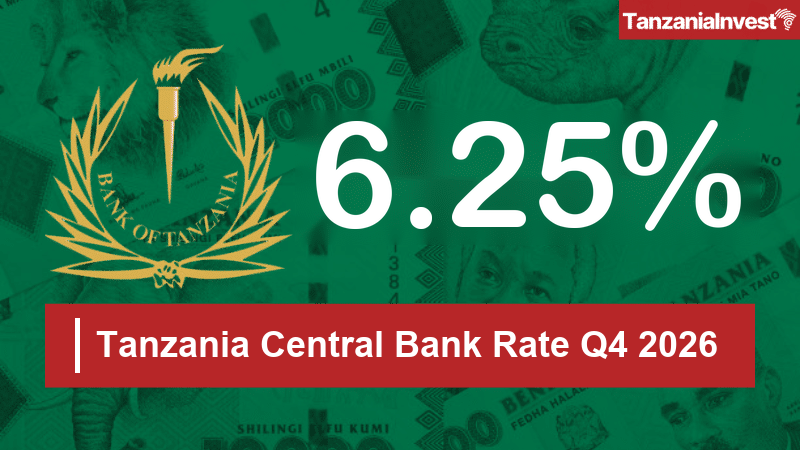
At its meeting held on 7th October 2026, the Monetary Policy Committee (MPC) of the Bank of Tanzania maintained the Central Bank Rate (CBR) at 6.25% for the fourth quarter of 2026.
The decision reflects the MPC’s forecast of inflation remaining within the target range of 3-5% in the medium term.
The current policy rate remains appropriate in dampening emerging inflationary pressures and fostering economic growth, while giving the July 2026 increase in the CBR sufficient time to fully transmit through the economy.

The MPC reiterated that monetary policy will remain agile and sufficiently flexible to limit risks to the inflation outlook from the geopolitical conflict in the Middle East and potential El Niño-related disruptions.
The Monetary Policy Report of October 2026 shows that under the baseline scenario the implied CBR remains unchanged at 6.25% through December 2026, with further tightening warranted only if inflation pressures become more persistent, broad-based, and generate second-round effects.
Alternative scenarios of severe El Niño effects and higher oil prices imply a 25 basis point increase to about 6.50%, or a 50 basis point increase to about 6.75% under the more severe case.
Economic Performances
The ongoing conflict in the Middle East and potential El Niño-related disruptions continue to pose risks to the domestic economy, though growth remained strong in 2026.
GDP
The National Bureau of Statistics (NBS) and the Office of the Chief Government Statistician (OCGS) rebased GDP for Mainland Tanzania and Zanzibar, moving the reference base year from 2015 to 2019.

On the new series, nominal GDP of Mainland Tanzania in 2025 rose to TZS 234,104 billion (USD 92.3 billion), from TZS 230,073 billion (USD 90.7 billion).
Real GDP growth in Mainland Tanzania was 6% in the first quarter of 2026, up from 4.3% in the same quarter of 2025, and is estimated at around 6% in the second and third quarters.
Growth in the first quarter was mostly contributed by agriculture, mining, construction, and tourism.
Leading indicators for the second and third quarters of 2026 show cement production expanding by 18.9%, electricity generation rising by 14.6%, and mining export earnings increasing by 33.8%.
GDP growth is projected at 7.2% in the fourth quarter of 2026, compared with 5.5% in the same quarter of 2025, and at around 6.1% for 2026 as a whole.
The Zanzibar economy grew by 6.8% in the first and second quarters of 2026, compared with 6.1% in the same period of 2025, led by tourism and construction.
Inflation
Annual headline inflation in Mainland Tanzania rose to 4.3% in September 2026, from 4% in June 2026, remaining within the target range of 3-5%.
The increase was largely driven by higher global oil prices, which raised domestic fuel pump prices and transport costs.
Core inflation accelerated to 4% in the third quarter of 2026 from 3.4% in the second quarter, while energy, fuel, and utilities inflation reached 7.7% from 5.5%.
Food inflation declined to 3.9% in the third quarter of 2026, from 5.2% in the previous quarter, supported by the 2025/26 harvest of 25.2 million tonnes.
In Zanzibar, inflation eased to 4.3% in September 2026 from 6% in June 2026, compared with the target of 5%.
Inflation is projected at 4.2% in Mainland Tanzania and 6% in Zanzibar in the fourth quarter of 2026, with risks tilted to the upside from global commodity prices and potential El Niño-related disruptions.
Credit Supply
Private sector credit growth averaged 32.5% in the third quarter of 2026, up from 25% in the preceding quarter, supported by adequate liquidity and sustained demand for financing.
Personal loans accounted for the largest share of outstanding credit at about 34.1% in August 2026, followed by trade, agriculture, and manufacturing.
Credit to agriculture was partly supported by the TZS 1 trillion Special Loan Facility and statutory minimum reserve relief provided to the sector.
Lending rates remained broadly unchanged at around 15%, while deposit rates stood at 8.78%.
The banking sector remained stable, with the non-performing loans ratio at 2.5% in August 2026, compared with the tolerable threshold of 5%.
Payment systems continued to operate smoothly and efficiently, with transaction values and volumes increasing.
External Sector
The current account deficit widened to an estimated 2.5% of GDP in the year ending September 2026, from 2.4% in the year ending June 2026, and is projected at 2.4% of GDP for 2026.
In the quarter ending September 2026, the current account deficit widened to an estimated USD 157.3 million, from USD 65.2 million in the same quarter of 2025, on higher imports of industrial supplies, petroleum products, and capital goods.
Exports of goods and services grew by 16.1% to USD 5,983.6 million in the quarter, supported by gold, manufactured goods, traditional exports, and travel services.
Gold exports amounted to USD 5,723.4 million in the year ending September 2026, up 29.2%, while tourism earnings are estimated at USD 4,565.8 million, up 4.1%.
Imports of goods and services rose by 21.1% to USD 5,862.4 million in the quarter, with petroleum products imports at USD 1,034.9 million, from USD 524.7 million.
The Zanzibar economy sustained a current account surplus, estimated at USD 1,035.4 million in the year ending September 2026, with tourist arrivals up 20.6% to 1,067,803.
Forex
The shilling remained broadly stable in the quarter ending September 2026, trading at an average of TZS 2,655.15 per US dollar, a 1.3% depreciation from the previous quarter and 6.7% year-on-year.
Total Interbank Foreign Exchange Market (IFEM) turnover amounted to USD 559.1 million, of which the Bank of Tanzania’s intervention accounted for 30.5%.
Foreign exchange reserves remained adequate at above USD 6 billion at the end of September 2026, equivalent to 4.3 months of projected imports, compared with the national minimum of 4 months.
Reserves were supported by gold exports, tourism receipts, and the gold purchase program.
The exchange rate is expected to remain broadly stable, supported by continued foreign currency inflows from gold, tourism, and agricultural exports.
Fiscal Performance
Fiscal performance remained strong in the third quarter of 2026, with tax revenue reaching approximately TZS 7,724.5 billion, exceeding the target by 8%.
The outperformance was driven by Pay-As-You-Earn (PAYE), corporate income tax, and Value Added Tax (VAT) collections.
Non-tax revenue amounted to TZS 1,164.4 billion, a shortfall of 15.5% against the quarterly target.
Government expenditure amounted to TZS 10,512.2 billion during the quarter, with recurrent expenditure accounting for 77.2% of the total.
Public debt stood at USD 46,244.9 million at the end of August 2026, of which 66.5% was external debt.
The domestic debt stock stood at TZS 40,899.5 billion, equivalent to 15.1% of projected GDP for 2026/27.
Want to know more about Banking in Tanzania? Our free overview of the Tanzania Business and Investment Guide 2026 covers Banking, plus key sectors and investment opportunities. The complete 141-page edition includes policies, taxation, key regulations, full macroeconomic data, and sources, and is also available at no cost upon completion of a short form.
Download Free OverviewGet the Full Edition for Free