


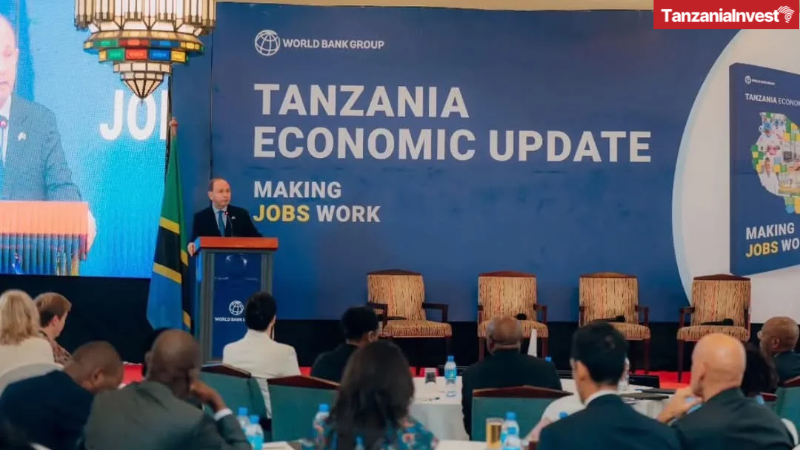
On 2nd October 2026, the World Bank Group and the Government of Tanzania launched the latest Tanzania Economic Update (TEU) themed “Making Jobs Work” in Dar es Salaam.
The TEU is a biannual report analyzing recent economic developments. The latest report examines how Tanzania can translate sustained economic growth into productive, better-paying, and more secure jobs.
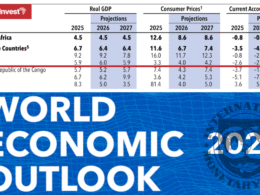
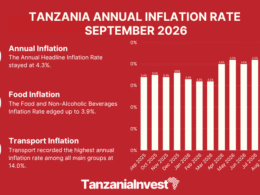
The report highlights that Tanzania’s real GDP grew by 5.9% in 2025 and is projected to grow by 6.1% in 2026, while inflation stood at 4.3%, within the Bank of Tanzania’s target range.
Public debt remains at a moderate risk of debt distress. Despite this macroeconomic stability, the report finds that economic growth has not translated into proportional poverty reduction, with growth concentrated in capital-intensive sectors that generate relatively few formal jobs.
More than two-thirds of working-age Tanzanians are employed, but over half of workers remain in low-productivity smallholder agriculture, where the median wage is TZS 1,000 per hour.
The report assesses Tanzania’s 26 million jobs against four criteria for job quality: decent earnings, a written employment contract, social security protection and predictable, non-gig employment stability.
It estimates that an average single-earner household requires earnings of at least TZS 3,830 per hour to remain above the lower-middle-income poverty line and only 550,000 jobs meet all four criteria, with just 120,000 of these in the formal private sector.
On the private-sector side, the report identifies a significant productivity gap between firms ans the top 10% of frontier firms are 32 times more productive than the bottom 10%, generate 97% of total market sales, but account for only 18% of employment.
Laggard firms employ most workers, but operate with older technology, pay four times lower average wages and face limited capacity to provide formal contracts.
The labour market is also under pressure from rapid demographic growth and skills shortages with about 1.6 million young adults enter Tanzania’s workforce each year, compared with approximately 400,000 leaving.
Learning-adjusted schooling averages 4.5 years, secondary-school enrolment is around 40%, and 83% of advertised formal vacancies require skills that applicants lack. Women account for 46% of the workforce but only 32% of quality jobs.
The report recommends simplifying digital business licensing, improving insolvency and debt-reorganisation frameworks, implementing the Secured Transactions Act, and expanding secure land access.
It also recommends introducing flexible community-based skills training, strengthening social assistance, providing childcare support, and establishing a national Labour Market Information System.
The launch also featured a panel discussion with panelists noting that SMEs create most entry-level jobs but often lack resources to train graduates, while larger frontier firms have structured training systems.
Pariticipants also highlighted that informal employment should be addressed as a central part of Tanzania’s labour market and proposed a three-pillar approach of protecting workers through social assistance, connecting them to opportunities through training and labour-market information, and partnering with private platforms through outcome-based contracts.
The panel urged on expanding social safety nets and outcome-based contracts, measuring policy success through business results, aligning statutory costs with regional benchmarks, and linking practical, sector-specific training to actual employment opportunities.
In his keynote speech, Tanzania’s Minister of Planning and Investment, Prof. Kitila Mkumbo stated; “We must translate the 2050 aspirations into opportunities and translate opportunities into production and translate production into productivity and translate productivity into better incomes and improved quality of life.”
“We must move from measuring processes to measuring results. Employment without productivity cannot deliver transformation. A job should not merely provide activity. A good job should provide a pathway to higher productivity, high income, strong skills, greater resilience, dignity, and economic mobility,” added Prof. Mkumbo.
On his part, the World Bank’s Country Director for Tanzania, Dr. Firas Raad, stated: “Tanzania begins from an economic position that many developing economies in the region and beyond would envy. And yet the foundation is not the same thing as a broad-based drive towards prosperity.”
Raad added: “Tanzania’s economy grew by 5.9% in 2025, and growth averaged 5.7% annually over the past two decades. But that growth has not yet translated in commensurate poverty reduction. Tanzania does not face a jobs shortage in our view; it faces a job quality challenge.”
World Bank’s Lead Economist, Aghasi Mkrtchyan, added, “We are launching this report at the moment when Tanzania is experiencing a strong growth momentum underpinned by its resilience and macroeconomic foundations. The 6% to 6.5% growth hasn’t been enough to reduce poverty substantially. So the question is how we accelerate growth going forward, but also how we make the growth quality-job-rich.”
In her closing remarks, International Finance Corporation (IFC)’s Division Director for Tanzania, Mary Jean Moyo, said: “While education and skills are essential, they’re only part of the solution. The bigger challenge is creating enough productive formal jobs for the growing number of young people entering the labor market.”
Moyo added; “Tanzania’s problem is not that people are not working. It is what kind of work is available. Roughly 95% of employment in this country is informal.”
In her presentation, World Bank’s Senior Social Protection Specialist, Claudia Zambra, stated, “More than half of the workers today in Tanzania face both limited readiness and limited opportunity. So for these workers, a formal wage job tomorrow is really not in the realm of possibility. Building a quality workforce is not a one-size-fits-all proposition. We need to tailor approaches to the different segments of the workforce. We need to meet them where they are today.”
On her part, World Bank’s Private Sector Specialist, Josephine Sab, concluded, “If you walk through any market or business district in Tanzania, you will notice something striking. Right next to a thriving, innovative business has barely changed its operations in a decade. Frontier firms generate almost all the sales, but then when we look at the jobs that they are creating, that’s only 18% of the jobs.”
Want to know more about the Economy in Tanzania? Our free overview of the Tanzania Business and Investment Guide 2026 covers the Economy, plus key sectors and investment opportunities. The complete 141-page edition includes policies, taxation, key regulations, full macroeconomic data, and sources, and is also available at no cost upon completion of a short form.
Download Free OverviewGet the Full Edition for Free