


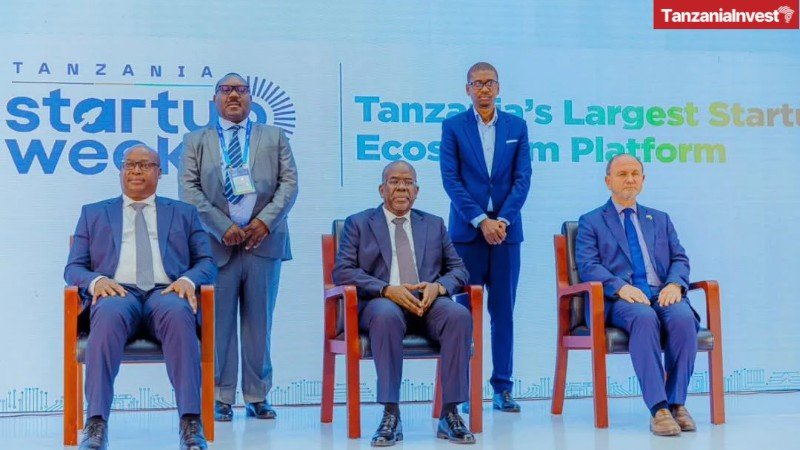
The Tanzania Startup Association (TSA) presented plans for a USD 50 million Tanzania Venture Capital Fund that targets a further USD 180 million in private co-investment for startups and small and medium-sized enterprises (SMEs), in Dar es Salaam on 20 October 2026.
The Operations and Program Lead at TSA, Praygod Japhet, explained that the fund is designed for businesses that have progressed beyond angel investment but are not yet mature enough to qualify for traditional bank loans.
TSA targets 15% of the initial USD 50 million, equivalent to USD 7.5 million, from a government allocation, with the remaining 85% to be raised from private institutional investors, pension funds, and development finance institutions (DFIs).

Japhet added that the initial capitalisation is meant to anchor 18 local and regional venture funds, which together would mobilise the additional USD 180 million in private co-investment.
The fund is one of four pillars identified by the Capital Markets and Securities Authority (CMSA), alongside policy and tax reforms, fund manager development, and enterprise development, after it drafted capital market regulations and benchmarked models in India and Ghana.
The plans were presented on the second day of Tanzania Startup Week 2026, which runs from 19 to 23 October 2026 and is co-hosted by TSA with the Ministry of Finance, the CMSA, and the Ministry of Industry and Trade.
The day focused on alternative financing, private equity and venture capital, and investment pipeline development, as well as the tax and regulatory reforms and the role of commercial banks in supporting venture-backed businesses.
The Minister of Finance, Ambassador Khamis Mussa Omar, delivered the keynote address, setting the financing discussion against the targets of Development Vision 2050.
“Achieving the objectives of Development Vision 2050 requires access to capital, investment in industries and improvements in the business environment, with the aim of growing Tanzania’s economy from approximately USD 100 billion to USD 1 trillion by 2050,” Omar said.
Omar reported that Tanzania’s economy grew by 5.6% in 2024 and 5.9% in 2025, with growth targeted at 6.3% in 2026, while inflation remained below 5% and private sector lending grew by 33% in the year to August.
He noted that agriculture contributes about 24% of the economy and industry 8%, and that the industrial sector has not yet benefited substantially from the growth in private sector credit.
The Deputy Minister for Industry and Trade, Dennis Londo, urged entrepreneurs to become investment ready through sound business plans, transparent systems, and stronger management practices, which he described as the basis of investor confidence.
The World Bank Country Manager for Tanzania, Firas Raad, framed the need for equity finance around the pressure of a fast-growing young workforce on the labour market.
“Each year 2 million young Tanzanians enter the labor market. 400,000 leave. That gap, about 1.6 million young people every year, represents both Tanzania’s greatest challenge and its greatest opportunity,” Raad stated.
Raad pointed out that Vision 2050 and its Long-Term Perspective Plan commit to mobilising 70% of the required financing from domestic and foreign private sector sources.
“To employ our young workforce, firms need more than debt, they need patient risk bearing equity capital,” he added.
The Director for Research, Policy and Planning at the CMSA, Alfred Mkombo, described the gap in Tanzania’s financial system that the new fund is intended to close.
“This middle bit of the market segment, where you are talking of an equity ticket size of USD 50,000 to USD 1 million, this is the area that is lacking a local financing mechanism,” Mkombo said, adding that such businesses lack the collateral commercial banks require.
The CEO of TSA, Zahoro Muhaji, reported that Tanzania’s startup ecosystem has attracted more than USD 400 million in investment over the last five years, and that investment is projected to surpass USD 120 million in 2026.
The Senior Financial Sector Specialist at the World Bank Group, Aun Ali Rahman, explained why the fund is structured as a fund of funds rather than a single fund.
“The benefit of going with a fund of funds is that you are not trying to bet on one fund manager. You are trying to build the entire market across the capital value chain,” Rahman noted.
Venture Capital Financing for Tanzanian Startups
In February 2025, the Financial Sector Deepening Trust (FSDT), with European Union funding, called for advisers to design a venture capital fund for Tanzanian startups together with the CMSA and the Ministry of Finance, covering a feasibility study, fund structure, and fund manager selection.
Tanzanian startups raised USD 52 million in the first half of 2026, placing the country fifth in Africa for startup funding, according to figures reported in July 2026.
President Samia Suluhu Hassan announced a youth startup policy in June 2025, in the same address that set out the launch of Development Vision 2050.
Want to know more about Capital Markets in Tanzania? Our upcoming Capital Markets Guide covers the Dar es Salaam Stock Exchange (DSE), listed companies, bonds, and private equity, plus the regulatory framework for investing in Tanzania’s capital markets.
Learn MoreWant to know more about the Capital Markets in Tanzania? Our free overview of the Tanzania Business and Investment Guide 2026 covers the Capital Markets, plus key sectors and investment opportunities. The complete 141-page edition includes policies, taxation, key regulations, full macroeconomic data, and sources, and is also available at no cost upon completion of a short form.
Download Free OverviewGet the Full Edition for Free