
Tanzania To Implement Climate-Smart Farming Techniques To Boost Agriculture Sector

tanzania-climate-smart-farming-techniques

Tanzania’s Ministry of Agriculture, Food Security and Cooperatives has recently announced that it will soon release the Climate-Smart Agriculture Guidelines program on the Ministry’s website, meant to improve smallholders’ farming techniques to reduce the impact of climate change on crop production.

The program is within the scope of the Climate Change Agriculture and Poverty Alleviation (CCAP) project which was launched in October, 2012 and that is being financed by the British Department for International Development (DFID) and the Danish International Development Agency (DANIDA).

The Climate-Smart Agriculture Guidelines program is an additional government’s initiative to support small-scale farmers to address climate change mitigation and adaption by the implementation of climate-smart techniques to reduce deforestation and greenhouse gas emissions, explained Mrs. Shakwaanande Natai, Head of Environment Management Unit at the Ministry of Agriculture.

Tanzania Investment Guide 2026 Free Edition

These climate-smart techniques have so far helped to increase crop production and local districts authorities are closely working with Tanzania Forest Conservation Group (TFCG) to spread their use further, explained District Head of Land Use and Marketing Information Network, Mr. Mark Farahan.

Climate-smart small-scale agriculture is being implemented in six villages in Kilosa and Chamwino districts in Dodoma and Morogoro, Tanzania’s central region.

The area was chosen by the Food and Agriculture Organization of the United Nations (FAO) as a pilot program in Tanzania which together with Kenya are being benefited with CCAP projects.

According to TFCG, the different projects being developed to implement climate-smart farming techniques have had positive results for small-scale farmers as improved profitability and better life quality.

Strengthening knowledge and tools for climate change adaptation is the last project being implemented in the pilot area at a total investment of GBP 1.5 million provided by DFID and that will be completed by March, 2016.

TanzaniaInvest Capital Markets Report Banner

According to Tanzania’s National Adaptation Plan for Action (NAPA), agriculture is the second most vulnerable sector to the impacts of climate change by affecting the rainfall which has shifted from the October/November period to December/January in the last years, affecting crop plantation.

In addition, an increase on temperature of 0.7 degrees per annum since 2004, is making the lands more arid affecting the crops by increasing their evapotranspiration rate then water needs which currently experiences a shortage since climate change reduced its levels.

According to Tanzania’s Ministry of Agriculture, the adverse effects of climate change are reducing the crops subsector contribution to GDP at a rate of 2.47% per annum.

Want to know more about Agriculture in Tanzania? Our free overview of the Tanzania Business and Investment Guide 2026 covers Agriculture, plus key sectors and investment opportunities. The complete 141-page edition includes policies, taxation, key regulations, full macroeconomic data, and sources, and is also available at no cost upon completion of a short form.

Download Free OverviewGet the Full Edition for Free
Free Newsletter

Get our monthly update on business and investment in Tanzania.

Related Posts
Tanzania fisheries value chain
Read More

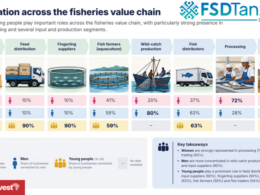
FSDT Outlines Steps to Unlock Fisheries Value Chain Finance as 47% of Tanzanian Operators Have Never Borrowed

Tanzania’s FSDT outlined steps to unlock finance for the fisheries value chain, noting that 47% of surveyed operators have never borrowed, while 91% save and 97% have mobile phones. The steps include better data, credit guarantees, alternative credit scoring, digital payments, and bundled insurance, alongside the Secured Transactions (Movable Property) Act 2026, which lets boats and cages serve as collateral through a Bank of Tanzania registry.
Tanzania Khamis Mussa Omar World Bank Anna Bjerde
Read More

Tanzania and World Bank Map Central Corridor Investment Opportunities in Agriculture, Logistics, Mining, and Tourism

Tanzania and the World Bank are mapping Central Corridor investment opportunities in agriculture, mining, tourism, transport, and logistics, with a possible extension to Rwanda, while UNDP prepares investor-ready projects for a June 2027 investment conference and seeks Asian Infrastructure Investment Bank financing. The World Bank named job creation its top priority and discussed shifting small business lending from collateral to cash-flow assessment, while Tanzania pursues a 40% value addition target through agriculture, livestock, and minerals.
EU-Tanzania Investment & Business Forum 2026-2027 Helsinki day 1
Read More

Tanzania Pitched a 68-Project, USD 30.1 Billion Pipeline at the EU–Tanzania Roadshow in Finland, Italy, the Netherlands and Belgium Ahead of the Early 2027 Dar es Salaam Forum

The EU-Tanzania roadshow 2026 took Tanzanian ministers and agencies to Helsinki, Cesena, The Hague, Rotterdam, and Antwerp between 28 September and 6 October, pitching critical minerals, agribusiness, renewable energy, digital, and port and rail projects from a 68-project, USD 30.1 billion pipeline. The roadshow leads to a high-level EU-Tanzania Investment and Business Forum in Dar es Salaam planned for early 2027.
EU-Tanzania Roadshow 2026 APM Terminals at Maasvlakte Rotterdam
Read More

EU–Tanzania Roadshow Ends With Rotterdam and Antwerp Port Visits as Tanzania Pitches Port, Rail and Logistics Opportunities to European Companies

The EU-Tanzania roadshow ended in Antwerp on 6 October 2026 after port visits in Rotterdam, with Tanzania's port and rail authorities pitching openings for terminal operators, EPC contractors, private rail operators and digital rolling stock tracking, while rail operator Vecturis, minerals logistics group Polytra, heavy lifting company Sarens and marine data company GEOxyz outlined their plans in Tanzania. The EU said it will join the World Bank and the EIB, which has a formal financing request, in supporting the Dar es Salaam port expansion, and offered Global Gateway guarantees, equity and feasibility funding for company projects screened by member states.