

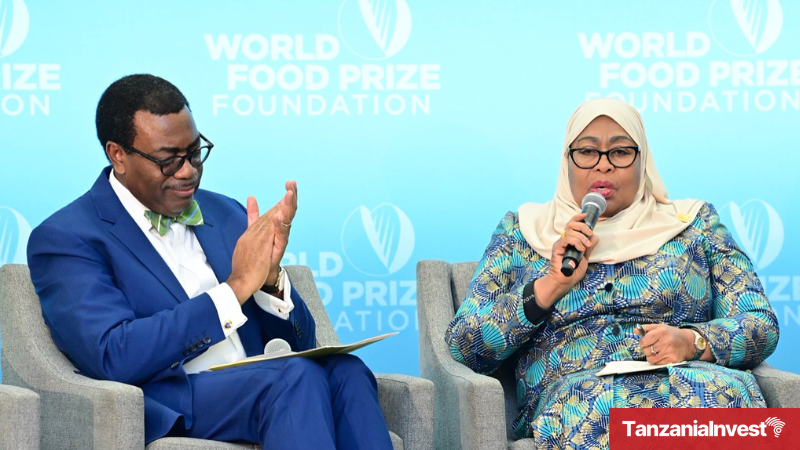
Tanzania’s President H.E. Dr. Samia Suluhu Hassan has set out an agenda for agricultural reform aimed at achieving food self-sufficiency and positioning Tanzania as a regional food hub.
Speaking at the Norman E. Borlaug International Dialogue in Des Moines, Iowa, Mama Samia emphasized the critical role of agriculture in addressing global food security while unveiling Tanzania’s three key goals for transforming its agricultural sector.
Building on discussions from her recent mission to Dakar, Senegal, President Samia highlighted the first objective of Tanzania’s agricultural strategy—boosting productivity to ensure food self-sufficiency.
The plan aims to improve not only the quantity of food produced but also its quality, accessibility, and affordability.
The President stressed that self-sufficiency is essential for both national food security and for positioning Tanzania as a reliable contributor to the region’s food supply.
The second pillar of Tanzania’s agricultural reform focuses on enhancing food storage and processing capacities to reduce post-harvest losses.
President Samia noted that adding value to agricultural products through processing is a key priority for the country, which will help stabilize food supplies and increase economic returns for Tanzanian farmers.
This focus on the entire value chain—from production to processing—was echoed in discussions with U.S. agricultural stakeholders at the event.
The third goal is to establish Tanzania as a “food basket” for East Africa and beyond. By bolstering agricultural output and minimizing wastage, the country aspires to play a leading role in supplying food to neighboring regions, including Southern Africa.
“We haven’t reached the target yet, but I assure you, we are on track,” President Samia told participants at the roundtable discussions, expressing optimism about Tanzania’s progress toward these goals.
To ensure these ambitions are realized, President Samia stressed that Tanzania has established the Presidential Advisory Agricultural Council—a body formed in response to directives issued during the Dakar 2 Summit in January 2023.
The primary task of the council is to ensure that agricultural advancement and food production strategies outlined during the Summit are effectively implemented in Tanzania.
“It is doing a good job in advising the Government on how to implement the Tanzanian impact on food delivery and security,” President Samia explained.
The overarching goal is to build a future where every Tanzanian has access to sufficient, safe, and nutritious food.
The President’s speech was part of the broader Norman E. Borlaug International Dialogue, a platform that brings together global agricultural experts and leaders to explore solutions to food security challenges.
This year’s event underscored the importance of public-private partnerships and technology in modernizing Africa’s agricultural sector.
Tanzania’s vast agricultural potential, fertile land, and skilled workforce were highlighted as key assets in attracting foreign investment into the sector.
In addition to participating in the main dialogue, President Samia held bilateral discussions with U.S. government officials and private sector stakeholders to explore new investment opportunities in Tanzania’s agricultural value chains.
These meetings, she emphasized, are essential for fostering international cooperation and ensuring that Tanzania can effectively contribute to addressing global hunger and malnutrition.
Tanzania Food Security
Food security remains a critical concern in Tanzania, where approximately 25% of the population faces food insecurity according to the World Food Programme (2023).
The Tanzania National Bureau of Statistics reports that rural areas are particularly affected, with 31.8% of rural households experiencing food insecurity compared to 19.7% in urban areas.
According to FAO (2023), agricultural productivity is constrained by heavy reliance on rain-fed agriculture, with only 2% of arable land under irrigation.
Despite challenges, Tanzania has made progress, with the national food self-sufficiency ratio improving from 112% in 2015 to 118% in 2022 according to the Ministry of Agriculture.
The government’s Agricultural Sector Development Programme Phase II (ASDP II) aims to reduce food insecurity by 20% by 2025, focusing on modernizing agriculture and improving market access for smallholder farmers.
Want to know more about Agriculture in Tanzania? Our free overview of the Tanzania Business and Investment Guide 2026 covers Agriculture, plus key sectors and investment opportunities. The complete 141-page edition includes policies, taxation, key regulations, full macroeconomic data, and sources, and is also available at no cost upon completion of a short form.
Download Free OverviewGet the Full Edition for Free