
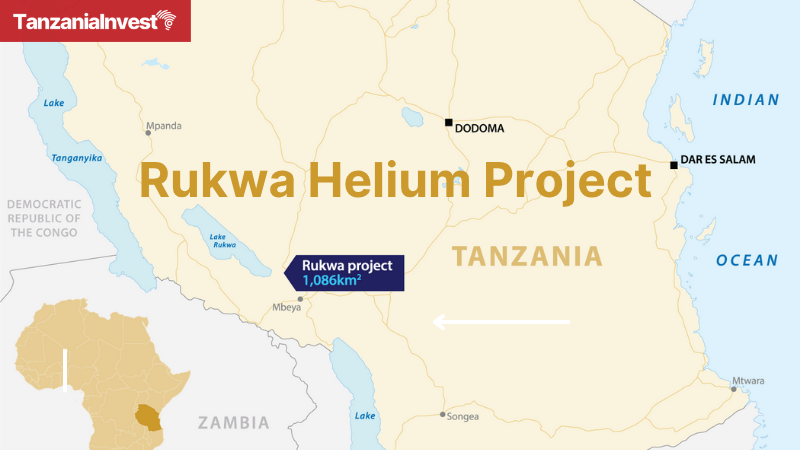
Noble Helium (ASX:NHE) has announced plans to drill five wells at its North Rukwa project in southwest Tanzania to search for helium gas.
The wells will target areas where previous tests showed signs of helium in the ground and at the surface.
The company aims to confirm and expand its estimated helium resource of 225.5 billion cubic feet.

If the drilling is successful, Noble Helium plans to start small-scale production and begin generating revenue within 18 months.
The first well, Mbelele-1A, will be drilled to 88m to follow up on earlier results that showed helium concentrations of up to 2.46% in pressurised fluid samples.
The other four wells will be drilled at Kinambo, around 30km southeast of Mbelele, where helium has been detected bubbling at the surface and where seven possible gas zones have been identified between 180m and 600m depth.
All five wells will be vertical and drilled using a water and geothermal rig that is already on standby and ready for fast mobilisation.
The company expects drilling costs to be much lower than in its previous campaign, as the geological conditions and safety risks are now better understood.

Noble Helium has completed a safety and logistics survey, and its technical team has inspected the drilling sites in preparation for the work.
The drilling plan has been reviewed and approved by independent industry experts. It is based on an updated technical model that incorporates data from previous drilling and new analysis.
The Executive Chairman of Noble Helium, Dennis Donald, commented: “We have every confidence that our next drilling plan, comprising five holes across two prospects, will return the results we are looking for. To minimise risk and maximise the probability of success, the plan was preceded by a comprehensive integrated technical analysis and signed off by a team of world-class experts.”
The Technical Director, Justyn Wood, added that the company now has a much clearer understanding of the geology at North Rukwa. He said: “The Mbelele appraisal will maximise the value of the opportunity, while geophysical responses distinguish Kinambo as being target-rich, with direct access to charge from helium-rich Karoo and deep crustal sources.”
The North Rukwa project
The North Rukwa project is one of four projects Noble Helium is developing along Tanzania’s East African Rift System. It comprises twelve granted Prospecting Licences (PL) covering a combined area of approximately 1,467 km2.
The company aims to help meet growing global demand for helium, which is in short supply due to limited production and rising use in high-tech sectors.
Helium is a critical gas used in many industries including medical imaging, electronics, and space technology.
Most of the world’s helium comes from hydrocarbon production, but Noble Helium is developing a clean source of primary helium in Tanzania that does not rely on oil or gas.
Want to know more about Mining in Tanzania? Our free overview of the Tanzania Business and Investment Guide 2026 covers Mining, plus key sectors and investment opportunities. The complete 141-page edition includes policies, taxation, key regulations, full macroeconomic data, and sources, and is also available at no cost upon completion of a short form.
Download Free OverviewGet the Full Edition for Free