


Tanzania’s Minister for Finance and Planning Hon. Philip Mpango recently presented to the National Assembly the budget proposal for the fiscal year 2019/20.
The Government plans to spend a total of TZS 33.1 trillion (USD 14.3 billion) in the financial year 2019/20, equivalent to 1.9% of the current budget.
TZS 20.9 trillion (USD 9.08 billion) will be allocated to recurrent expenditures, while development expenditure should reach TZS12.2 trillion (USD 5.3 billion).

The Budget focuses on the National Five Years Development Plan 2016/17-2020/21 to build an industrial economy and improve the welfare of the citizens.
The government will also work to improve the business environment, promote investment, and simplify taxes.
Some major development projects in 2018/19 include:
-Continued construction of the central Railway to Standard Gauge;
-Development of the Rufiji Hydropower Project – MW 1,115;
-Improving the national carrier Air Tanzania;
-Developing the oil pipeline from Uganda to Tanzania.
TZS 23 trillion (USD 10 billion) will be obtained from internal revenue sources, TZS 5 trillion (USD 2.1 billion) will come from loans from local financial institutions, foreign loans will provide TZS 2.3 trillion (USD 1 billion), while TZS 2.8 trillion (USD 1.2 billion) will come from development partners, Mpango explained.
In addition, the Government will continue to strengthen domestic revenue collection and fight tax evasion.

Tanzanian Economy
In his speech, Minister Mpango reminded that Tanzania’s GDP in Q3 2018 grew by 6.8% compared to 5.0% of the same period in 2017.
The economic activities that showed the fastest growth were health (13.2%), transportation and cargo storage (12.4%); Water (10.7%); Construction (7.4%); Information and Communication (7.3%); manufacturing (7.3%); and Business and Maintenance (7.3%).
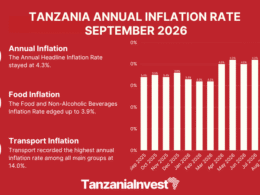
Meanwhile, Tanzania’s inflation rate continued to be stable in the single digit base due to improved access to food in the country and neighboring countries as well as effective management of monetary and fiscal policies.
Inflation fell from an average of 4.0% in January 2018, to reach 3.4% in June 2018 and continued to decline further to 3.0%.
Want to know more about the Economy in Tanzania? Our free overview of the Tanzania Business and Investment Guide 2026 covers the Economy, plus key sectors and investment opportunities. The complete 141-page edition includes policies, taxation, key regulations, full macroeconomic data, and sources, and is also available at no cost upon completion of a short form.
Download Free OverviewGet the Full Edition for Free