

Tanzania Annual Inflation Slow Down to 3.2% in May 2020

TANZANIA INFLATION MAY 2020

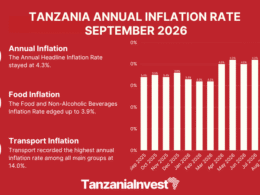
The National Bureau of Statistics of Tanzania (NBS) reveals that the Annual Headline Inflation Rate for the month of May 2020 slowed down to 3.2% from 3.3% in April 2020.

The overall index went up to 120.93 in May 2020 from 117.23 recorded in May 2019.

Food and Non-Food Inflation Rates
Food and Non-Alcoholic Beverages Inflation Rate for the month of May 2020 has decreased to 4.4% from 4.6% recorded in April 2020.

Tanzania Investment Guide 2026 Free Edition

Annual Inflation Rate for food consumed at home and away from home for the month of May 2020 has stagnated at 5.2% as it was recorded in April 2020.

The 12-month index change for non-food products in May 2020 has decreased to 2.4% from 2.5% recorded in April 2020.

Inflation Rate Excluding Food and Energy
The Annual Inflation Rate which excludes food and energy for the month of May 2020 has slightly increased to 2.2% from 2.1% that was recorded in April 2020.

Monthly Headline Inflation Rate

The National Consumer Price Index has increased by 0.2% from April 2020 to May 2020 compared to an increase of 0.4% that was recorded from March 2020 to April 2020.

Tanzania Investment Guide 2026 Full Edition

The overall index has increased to 120.93 in May 2020 from 120.67 recorded in April 2020.

The increase in the overall index is attributed to the price increase for both food and non-food items.

Some food items that contributed to such increase include:- pastry-cook products by 1.5%, sorghum grain by 4.1%, fish by 3.0%, sardines by 1.2%, groundnuts by 2.2%, beans by 5.7%, cassava by 2.6% and cooking bananas by 4.4%.

On the other hand, non-food items that contributed to such an increase include: – cleaning and maintenance products by 1.1%, men’s suit by1.1%, gowns by 1.3%, firewood by 3.0%, exercise books by 1.8% and hairdressing for women by 1.1%.

Want to know more about the Economy in Tanzania? Our free overview of the Tanzania Business and Investment Guide 2026 covers the Economy, plus key sectors and investment opportunities. The complete 141-page edition includes policies, taxation, key regulations, full macroeconomic data, and sources.

Download Free OverviewGet the Full Guide
Related Posts
TANZANIA ANNUAL INFLATION RATE MAY 2026
Read More

Tanzania Inflation Jumps to 4.2% in May 2026 Driven by Fuel and Transport Surge

Tanzania's annual headline inflation accelerated to 4.2% in May 2026, up from 4.0% in April, as transport prices surged 11.9% year-on-year following monthly fuel price increases of 13.8% for diesel and 10.4% for petrol. Core inflation also rose to 3.4% from 3.1%, signaling broadening price pressures beyond volatile food and energy items, according to the National Bureau of Statistics.
Tanzania Khamis Mussa Omar Parliament bunge
Read More

Tanzania Finance Bill 2026 Drops Agricultural Withholding Tax, Softens Used Car Duties and Cuts SME Presumptive Tax to 4%, Effective 1 July 2026

Tanzania’s Finance Bill 2026, presented to Parliament on 24 June 2026 by Finance Minister Ambassador Khamis Mussa Omar, takes effect on 1 July 2026 and amends 26 laws to implement the 2026/27 budget tax measures. The Parliamentary Budget Committee dropped the proposed 1% withholding tax on agricultural produce, the proposed 5% excise on motorcycles and on gambling stakes, softened excise duties on imported used vehicles, cut the SME presumptive tax to 4.0% from 4.5%, confirmed mining Framework Agreement tax incentives during the construction phase, and introduced a new 0.5% stamp duty on agricultural land transfers.
TanzaniaInvest Interview FAyaz Bhojani Managing Partner FB Attorneys
Read More

Interview with Dr FAyaz Bhojani, Managing Partner of FB Attorneys, on the Evolution of the Firm, and Litigation, Arbitration and Taxation Issues in Tanzania

TanzaniaInvest interviewed Dr FAyaz Bhojani, Managing Partner of FB Attorneys, the only law firm in Tanzania ranked at the top by all three leading international legal directories, Chambers and Partners, IFLR1000, and The Legal 500. He discusses the firm’s cross-border and arbitration work, its strength in mining, oil and gas, and M&A, and the two factors foreign investors weigh most before entering Tanzania: the rule of law and a fair, predictable tax system.