

Intra-regional trade within the East African Community (EAC) reached a 20% share of intra-trade to global trade in September 2022 with USD 10.17 billion.
The intra-EAC trade, accounting for imports and exports in the seven EAC Partner States (DRC, Burundi, Kenya, Rwanda, South Sudan, Uganda, and Tanzania), grew from 13% in 2019 at a value of USD 7.1 billion to 15 % in 2021 at a value of USD 9.5 billion.
And by September 2022, the EAC trade value was recorded at USD 10.17 billion representing a 20% share of intra-trade to global trade.

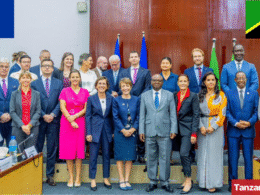
This was disclosed by EAC Secretary General Dr. Peter Mathuki when addressing the media during a retreat for all EAC Staff held in Kenya to discuss EAC’a priorities for 2023.
Mathuki attributed the increase in intra-regional trade to political goodwill among the members of EAC Heads and the relaxation of Covid-19 restrictions in the region amongst other factors.
He further explained that high-level discussions among the Heads of State had eliminated many Non-Tariff Barriers (NTBs) hampering intra-regional trade and expressed hope that this and other factors would help raise the level of intra-regional trade in East Africa to at least 40% over the next five years.
“257 NTBs have been cumulatively resolved since 2007. This is in tandem with the bloc’s goal to increase the volumes of intra-regional trade,” he said.
Dr. Mathuki disclosed that EAC’s total trade with the rest of the world stood at USD 62 billion, adding that there was still room for improvement.

Dr. Mathuki further said that EAC Ministers/ Cabinet Secretaries in charge of Trade and Finance had adopted a 35% EAC Common External Tariff (CET).
“From 1st July 2022, imports of locally available goods into the region; such as meat, furniture and textiles, have been attracting a tariff of 35%. The move aims at promoting local production, value addition and industrialization,” said Dr. Mathuki, adding that the CET is one of the key instruments under the Customs Union pillar, which justifies regional integration through uniform treatment of goods imported from third parties.
On the application by the Federal Republic of Somalia to join the EAC, Dr. Mathuki said that a verification mission to Somalia is scheduled at the end of this month, to assess the country’s readiness to join the Community.
He stressed that Somalia’s long Indian Ocean Red Sea route that links Africa to the Arabian Peninsula represents a vibrant economic zone that will bring immense benefits to the EAC.
“The exploitation of Somalia’s blue economy resources such as fish and the expansive coastline is also set to boost the regional economy,” he said.
In relation to peace and security, the Secretary-General said that EAC was keen on stabilizing the Eastern region of the DRC, a process that he said requires a political solution that will be provided by the Heads of State.
Finally, on the East African Monetary Union, Dr. Mathuki said that EAC would have a single currency within the next four years.
He said that the Council of Ministers is expected to make a decision soon on the location of the East African Monetary Institute, the precursor to the East African Central Bank that will issue the single currency.
“The single currency will ease business and movement of persons within the region. It is in line with our goal to make the region borderless so that people can move and trade freely as envisioned in the Common Market Protocol,” he said.
Want to know more about Trade in Tanzania? Our free overview of the Tanzania Business and Investment Guide 2026 covers Trade, plus key sectors and investment opportunities. The complete 141-page edition includes policies, taxation, key regulations, full macroeconomic data, and sources, and is also available at no cost upon completion of a short form.
Download Free OverviewGet the Full Edition for Free