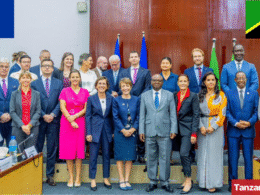


The Confederation of Tanzania Industries (CTI) and the Corporate Council on Africa (CCA) hosted the U.S.-Tanzania Business and Investment Roundtable on November 8th, 2023, in Dar es Salaam.
The roundtable, a convergence of business leaders and government officials from both nations, aimed to fortify the commercial relationship between the United States and Tanzania.
The roundtable followed the recent launch of the U.S.-Tanzania Commercial Dialogue. Dignitaries included Ambassador Elsie S. Kanza of Tanzania to the United States and U.S. Ambassador Michael Battle.

The dialogue centered on advancing bilateral trade and investment initiatives, signaling a mutual commitment to enhancing formal business cooperation.
U.S. Ambassador Michael Battle emphasized the importance of a robust private sector as a cornerstone for economic growth and job creation.
“The strong private sector is a major basis for economic growth in many developed countries,” said Ambassador Battle.
He also underlined the pivotal role of U.S.-Tanzania trade cooperation in fostering economic development in both countries.
Echoing his sentiments, CTI Chairman Paul Makanza highlighted ongoing efforts to facilitate the entry of American products into the Tanzanian market and to encourage U.S. investment in local value-added production.

He stated, “Our discussions have been fruitful in envisioning how American products can seamlessly enter the Tanzanian market, fostering a win-win situation for both economies.”
The roundtable discussions also touched on the African Growth and Opportunity Act (AGOA), with Ambassador Battle reaffirming bipartisan support in the U.S. for the program, which has been instrumental in enabling African countries to access the American market.
The roundtable event concluded with a forward-looking approach, as stakeholders from both nations expressed a keen interest in continuing these dialogues to realize the full potential of their trade relations.
US-Tanzania Relations
US-Tanzania trade in goods totaled USD 424 million in 2022, with the US exporting USD 260 million and importing USD 164 million.
Tanzania is eligible for preferential trade benefits under AGOA. The United States also has Trade and Investment Framework Agreements with the East African Community (EAC), of which Tanzania is a member.
US foreign direct investment (FDI) in Tanzania totaled USD 1.4 billion in 2022, a 3.5% increase from 2021.
Want to know more about Trade in Tanzania? Our free overview of the Tanzania Business and Investment Guide 2026 covers Trade, plus key sectors and investment opportunities. The complete 141-page edition includes policies, taxation, key regulations, full macroeconomic data, and sources, and is also available at no cost upon completion of a short form.
Download Free OverviewGet the Full Edition for Free