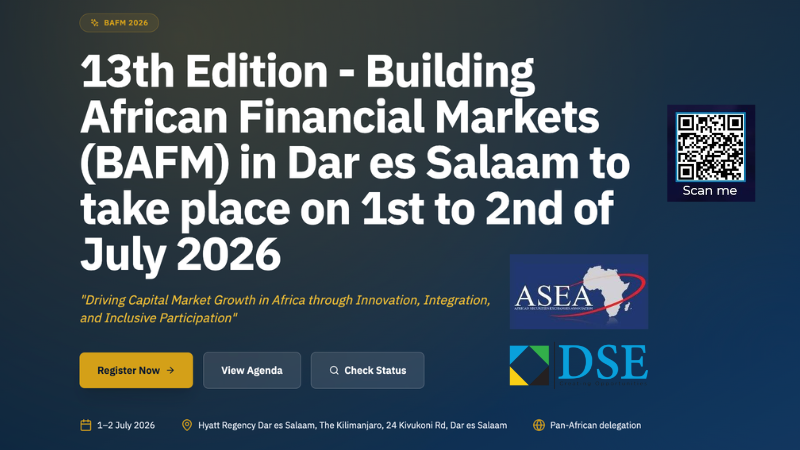
Tanzania will host the 13th edition of the Building African Financial Markets (BAFM) Forum from 1st to 2nd July 2026 in Dar es Salaam.
The forum will take place at the Hyatt Regency Hotel under the theme “Driving Capital Market Growth in Africa through Innovation, Integration and Inclusive Participation,” and is jointly organized by the Dar es Salaam Stock Exchange (DSE) and the African Securities Exchanges Association (ASEA).
It positions Tanzania as the 2026 host of one of the continent’s most prominent capital markets gatherings, following the 12th edition held in Johannesburg in June 2024.

The three-day programme is structured as a high-level strategic platform for knowledge exchange, peer learning, policy dialogue, and business networking across African capital markets.
It is built around four pillars:
1) innovation, covering digital infrastructure, fintech, tokenization, and next-generation market technology,
2) integration, covering cross-border listings, harmonized regulation, AfCFTA-aligned capital flows, and the African Exchanges Linkage Project (AELP),
3) inclusion, covering SMEs, retail investors, women, and underserved regions, and

4) sustainable growth, covering green finance, ESG disclosure, and capital that builds lasting prosperity for the continent.
The forum’s stated objectives include promoting strategies to enhance liquidity and trading activity, facilitating dialogue on digital transformation and emerging brokerage business models, strengthening regional cooperation for cross-border investment, and exploring innovative financing solutions including ESG instruments, Exchange Traded Funds (ETFs), Real Estate Investment Trusts (REITs), and SME platforms.
Discussion will also focus on the mobilization of retail and institutional investors and on deeper collaboration between exchanges, intermediaries, regulators, and development partners.
Key sub-themes for the 2026 edition are market liquidity enhancement and trading ecosystem development, digital transformation and fintech partnerships, regional integration and cross-border capital flows, investor participation and financial inclusion, and sustainable finance and ESG investment trends.
The target audience spans CEOs and senior executives of African stock exchanges, capital market authorities, central banks, ministries of finance, stockbrokers, investment banks, custodians, Central Securities Depositories (CSDs), pension funds, insurance companies, asset managers, listed and prospective issuers, state-owned enterprises, infrastructure sponsors, legal advisors, credit rating agencies, and technology and fintech providers.
Development partners expected to participate include the African Development Bank (AfDB), the International Finance Corporation (IFC), the World Bank, United Nations agencies, and the United Nations Capital Development Fund (UNCDF).
Registration is open through the official event portal at forum.dse.co.tz.
About the BAFM Forum and ASEA
The BAFM Forum is a capacity-building programme initiated by ASEA to promote growth, resilience, efficiency, and inclusivity within African financial markets and to enhance the competitiveness of African stock exchanges on the global stage.
ASEA was established in 1993 with the Nairobi Securities Exchange as the founding member, followed by the Stock Exchange of Mauritius, Uganda Securities Exchange, and the Dar es Salaam Stock Exchange (DSE).
The association today represents 25 exchanges serving 37 African countries, and works to unlock the potential of African capital markets by enhancing member visibility at international level and attracting capital inflows.
The DSE is a full member of the World Federation of Exchanges (WFE), a Partner Exchange in the UN Sustainable Stock Exchanges Initiative, and a member of the Committee of SADC Stock Exchanges (COSSE).
Want to know more about Capital Markets in Tanzania? Our upcoming Capital Markets Guide covers the Dar es Salaam Stock Exchange (DSE), listed companies, bonds, and private equity, plus the regulatory framework for investing in Tanzania’s capital markets.
Learn MoreWant to know more about the Capital Markets in Tanzania? Our free overview of the Tanzania Business and Investment Guide 2026 covers the Capital Markets, plus key sectors and investment opportunities. The complete 141-page edition includes policies, taxation, key regulations, full macroeconomic data, and sources, and is also available at no cost upon completion of a short form.
Download Free OverviewGet the Full Edition for Free