Tanzania to Host Second National Tax and Investment Dialogue on April 15th at JNICC, Dar es Salaam

Tanzania’s second Tax and Investment Dialogue is scheduled for April 15, 2025, at Dar es Salaam’s Julius Nyerere Convention Centre (JNICC). Hosted by the Ministry of Finance and featuring Vice President Mpango, the event will focus on boosting domestic resources through local content development, crucial for upcoming discussions on Tanzania’s economic strategy.
Tanzania Tax Investment Dialogue 2025

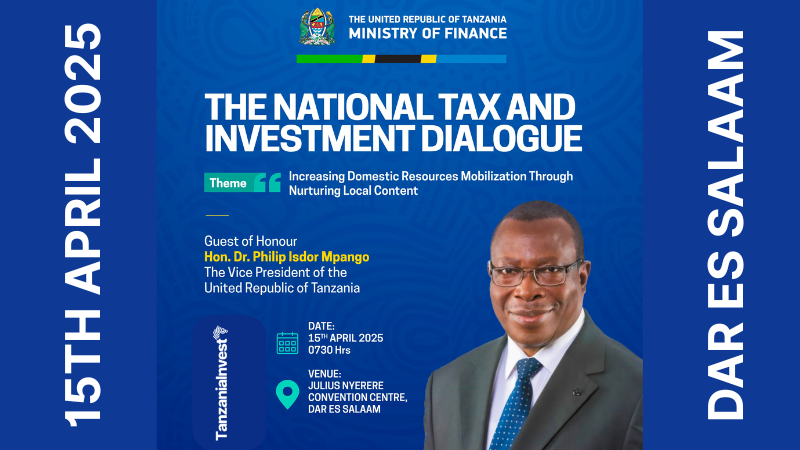
The United Republic of Tanzania, through its Ministry of Finance, is preparing to host the Second National Tax and Investment Dialogue this coming Tuesday, 15th April 2025.

The key event will be held at the Julius Nyerere Convention Centre (JNICC) in Dar es Salaam, with proceedings scheduled to begin at 07.30 Hrs.

This second iteration of the dialogue underscores Tanzania’s ongoing commitment to fostering an open forum for improving its fiscal policies and investment climate.
Tanzania Investment Guide 2026 Free Edition

The significance of the event is further emphasized by the attendance of Hon. Dr. Philip Isdor Mpango, the Vice President of the United Republic of Tanzania, as the Guest of Honour.

Focusing on the theme, “Increasing Domestic Resources Mobilization Through Nurturing Local Content,” the dialogue aims to explore strategies for strengthening the national economy by promoting local industries and participation.

This theme aligns with national goals to enhance economic self-sufficiency and sustainable development.

The dialogue serves as a vital platform for interaction between the government, investors, the business community, and other stakeholders.

It provides an opportunity to discuss challenges, share insights, and contribute recommendations for refining Tanzania’s tax system and attracting further investment.
TanzaniaInvest Capital Markets Report Banner

Previous dialogues have been credited with contributing to policy improvements and positive economic indicators, including increased investment registrations via the Tanzania Investment Centre (TIC) and growth in domestic revenue.

With the event just days away, anticipation is high for productive discussions that will help shape Tanzania’s economic future by boosting local content and optimizing the mobilization of domestic resources.

Want to know more about the Economy in Tanzania? Our free overview of the Tanzania Business and Investment Guide 2026 covers the Economy, plus key sectors and investment opportunities. The complete 141-page edition includes policies, taxation, key regulations, full macroeconomic data, and sources, and is also available at no cost upon completion of a short form.

Download Free OverviewGet the Full Edition for Free
Related Posts
IMF World Economic Outlook 2026 Tanzania
Read More

Tanzania GDP to Grow 6.0% in 2026 and 5.9% in 2027 With Inflation at 4.0%, IMF Projects

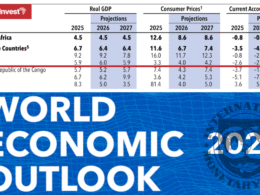
In its World Economic Outlook October 2026, the IMF projects Tanzania’s real GDP growth at 6.0% in 2026 and 5.9% in 2027, above the 4.5% sub-Saharan Africa average and Kenya’s 4.5%, while Uganda and Rwanda are projected at 6.2% and 7.4%. Tanzania’s inflation is projected at 4.0% in 2026 and 4.2% in 2027, below the 8.6% sub-Saharan Africa average and Kenya’s 6.0%.
Central Bank of Tanzania BOT CBR Interest Rate Q4 2026
Read More

BOT Maintains Tanzania Central Bank Rate at 6.25% for Q4 2026; GDP Growth Projected at 7.2% in Q4 2026, Driven by Agriculture, Construction, Mining, and Tourism

The Bank of Tanzania (BOT) released its Monetary Policy Report of October 2026, in which the Monetary Policy Committee (MPC) decided to maintain the Central Bank Rate (CBR) at 6.25% for the fourth quarter of 2026, allowing the July 2026 increase to fully transmit through the economy. The MPC will keep policy agile and flexible to limit risks to the inflation outlook from the Middle East conflict and potential El Niño-related disruptions, and keep inflation within the 3-5% target range.
Interview Jana Bricco IMF Resident Representative Tanzania no logo
Read More

Interview with Jana Bricco, New IMF Resident Representative in Tanzania, on Economic Growth, Private Investment, and Needed Reforms

In this exclusive interview with TanzaniaInvest, the new IMF Resident Representative Jana Bricco says Tanzania can sustain growth of around 6% by preserving macroeconomic stability and accelerating reforms supporting private investment, productivity and jobs. She calls for fewer regulatory obstacles, more predictable taxation, faster VAT refunds and better access to finance for businesses and SMEs, and explains how IMF support will evolve following the end of its financing programmes, with the relationship now focused on policy dialogue and capacity development.