





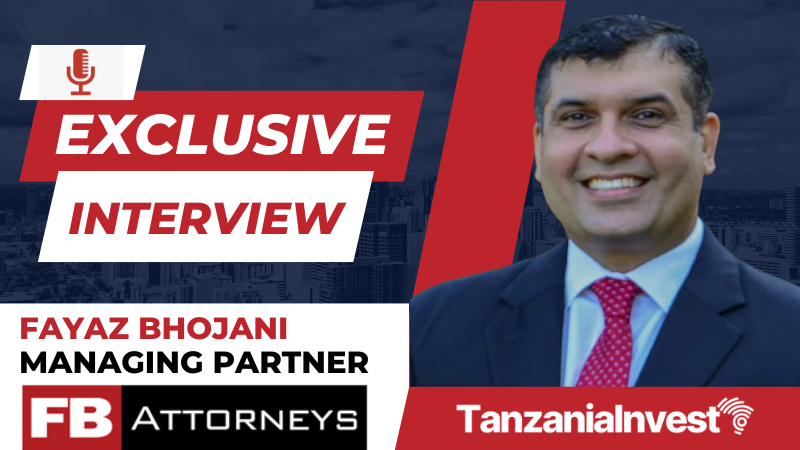
TanzaniaInvest had the pleasure of interviewing Dr FAyaz Bhojani, Managing Partner of FB Attorneys, the only law firm in Tanzania ranked at the top by all three leading international legal directories.
FB Attorneys is ranked Band 1 for General Business Law by Chambers and Partners, top tier by IFLR1000, and a leading firm by The Legal 500. The firm has also been named Tanzania Law Firm of the Year by both IFLR1000 and Chambers and Partners, while Dr Bhojani is individually ranked at the highest level by each directory.
In an increasingly complex legal world, business, technology, taxation, regulation and cross-border disputes often meet in the same room. Lawyers are expected to be more than traditional legal advisers. They must understand commerce, people, risk and, increasingly, technology.

Dr FAyaz Bhojani brings that broader perspective to legal practice. With a background spanning finance, mathematics, actuarial science and law, and recognition from leading international legal directories, he represents a generation of African legal professionals whose work is deeply rooted in the local market while increasingly international in reach.
In this interview, Dr Bhojani reflects on the firm’s journey, its cross-border and international arbitration work, its strength in mining, oil and gas, M&A and tax, the launch of the FB Attorneys Academy, dispute resolution, artificial intelligence, advice to young lawyers, and the two factors foreign companies weigh most before entering a jurisdiction: the rule of law and a fair, predictable tax system.
TanzaniaInvest: Congratulations! FB Attorneys is ranked at the top by all three leading international legal directories, has been named Tanzania Law Firm of the Year, and you are individually ranked at the highest level by each of them. How has the journey been?
Dr FAyaz Bhojani: It has been a long, demanding, and deeply rewarding journey. We are truly grateful to our clients, colleagues, friends, and, above all, our families, whose support has been central to the firm’s growth. These recognitions are ultimately a reflection of the trust our clients place in us and the standards our team works hard to maintain.
The journey is, of course, continuing. Our focus remains on delivering legal excellence in Tanzania, across the region and internationally. I would also like to pay special tribute to all my colleagues at FB Attorneys, each of whom has played an integral role in the firm’s success.

“To be consistently ranked at the top across the leading international directories for many years speaks to the quality of our work, the depth of our team, and the results we have delivered.”
To be consistently ranked at the top across the leading international directories for many years speaks to the quality of our work, the depth of our team and the results we have delivered. We do not take that recognition for granted, and we remain very grateful as we strive to reach newer heights internationally.
When you speak about delivering legal excellence in Tanzania, regionally and internationally, does that reflect the extent to which the firm now works beyond the country’s borders?
Yes, absolutely. While we are proudly headquartered in Dar es Salaam, our work is by no means confined to Tanzania. We regularly advise on regional and international matters, particularly in corporate transactions, cross-border disputes, and international arbitration.
“While we are proudly headquartered in Dar es Salaam, our work is by no means confined to Tanzania. We regularly advise on regional and international matters, particularly in corporate transactions, cross-border disputes, and international arbitration.”
Our arbitration work has involved matters connected with leading international centres, including London, Paris, and Singapore, under rules such as those of the LCIA, ICC, and SIAC. We also represent multinational clients across a wide range of sectors and, where required, work alongside international and local counsel in other jurisdictions.
That international dimension is also reflected in the make-up of our team. A number of our lawyers have trained or worked abroad before returning to Tanzania, bringing with them first-hand experience of international legal and commercial environments. This allows us to combine the standards expected by global clients with deep knowledge of Tanzania and the wider region.
What are your main areas of practice, and how does that fit within the wider practice of FB Attorneys?
My own practice is broad, but I have a particular focus on extractive industries, competition and antitrust, tax, corporate and M&A, and contentious matters. My PhD is in mining law, and much of my work involves mining, oil and gas, and other natural resources matters, both in Tanzania and in cross-border contexts.
At the firm level, FB Attorneys has developed specialist teams across a wide range of practice areas, allowing us to serve clients in both contentious and non-contentious matters. We are involved in major projects, high-value transactions and complex disputes, and have a particularly strong presence in M&A, corporate advisory work, litigation, and arbitration.
“I have a particular focus on extractive industries, competition and antitrust, tax, corporate and M&A, and contentious matters. At the firm level, we are involved in major projects, high-value transactions, and complex disputes, and have a particularly strong presence in M&A, corporate advisory work, litigation, and arbitration.”
A key part of our approach is building local capacity. We want clients to know that they can obtain sophisticated, internationally benchmarked legal advice from a Tanzanian firm that understands the local market, the regulatory environment, and the commercial realities on the ground.
You have a very varied academic and professional background. Does that help you in your legal work?
Most certainly. I have always had a strong bias towards mathematics and analytical disciplines. At A-level, I studied Physics, Chemistry and Mathematics, and at undergraduate level, Finance and Mathematics, followed by actuarial science. I later turned to law, completing an LLB, an LLM and ultimately a PhD. Along the way, my studies took me across several major academic centres, including Montreal, UC Berkeley in California, and London.
That background has shaped the way I approach legal problems. I look at matters holistically, considering not only the legal position, but also the commercial rationale, financial drivers and practical consequences behind a transaction or dispute.
For me, the value of a multidisciplinary background lies in bringing those perspectives together. A lawyer must understand the documents, but also the commercial reality behind them. That wider lens allows me to engage more deeply with clients’ objectives and provide advice that is legally sound, commercially aware and practically useful.
What have been some of your greatest achievements, and are there any particular cases or deals that stand out?
I am not naturally inclined to speak in terms of personal achievements, because the work we do is always the product of a wider team effort. What I can say is that we have been privileged to work across many industries and jurisdictions, including on matters of considerable value and complexity, worth hundreds of billions of dollars.
Over the years, we have acted alongside, and opposite, many leading international law firms on major transactions and disputes. That kind of work is demanding: it requires preparation, judgement, consistency and a strong team. It has reinforced our commitment to delivering work of the highest standard from Tanzania, and our view that the best measure of a firm is the quality of its work and the trust it earns from clients.
For me, one of the firm’s most important achievements is the local capacity we have built. We have shown that complex, high-value and cross-border work can be handled by a Tanzanian firm operating to international standards. The launch of the FB Attorneys Academy, our flagship training programme for new graduates, is part of that same commitment: developing the next generation of Tanzanian lawyers through rigorous training, high standards and real exposure to complex work.
Tell us more about FB Attorneys Academy.
The FB Attorneys Academy was established because we saw a gap between traditional legal education and the practical demands of modern legal practice.
The profession is changing quickly. Technology, artificial intelligence, financial literacy, sector specialisation and commercial awareness are now part of the skill set expected of modern lawyers. Young lawyers must think critically, write clearly, understand clients, analyse numbers and use technology responsibly. They also need mentorship, practical exposure and structured support as they transition into practice.
The Academy is designed to identify and develop high-potential legal talent. Admission is selective, involving screening and an online aptitude test, and all successful candidates are fully funded by the firm. For us, this is part of giving back to the profession. Talent is widely distributed, but access to high-quality training is not always equal.
“The Academy is designed to identify and develop high-potential legal talent. Admission is selective, and all successful candidates are fully funded by the firm. For us, this is part of giving back to the profession.”
Through the Academy, we aim to help bridge that gap and prepare the next generation of Tanzanian lawyers for sophisticated local, regional, and international work.
You are active in arbitration and litigation in Tanzania. How do you see those fields developing?
There has been progress, and that should be acknowledged. In some areas, disputes are being determined more quickly, and there is growing recognition that efficient dispute resolution is essential to public and commercial confidence.
“Disputes are being determined more quickly, and there is growing recognition that efficient dispute resolution is essential to public and commercial confidence.”
That said, challenges remain. In my view, procedural law still occupies too much space in our litigation culture. Procedure is important, but it should serve the fair and efficient resolution of disputes, not overshadow the merits.
The law of damages is another area where greater consistency is needed. Awards must be grounded in evidence, causation and established legal principle. Where awards appear excessive, speculative or insufficiently reasoned, they create uncertainty beyond the individual case and affect confidence in the wider system.
For dispute resolution to develop further, the focus must be on decisions that are timely, principled, predictable and fair.
What is the single most important factor that foreign companies consider before entering a jurisdiction?
There are many factors, but two stand out immediately. The first is the rule of law. Foreign investors need confidence that the law will be applied consistently, fairly and equally to both local and foreign companies. Without that confidence, even strong commercial opportunities become difficult to assess.
“Foreign investors need confidence that the law will be applied consistently, fairly, and equally to both local and foreign companies [and] tax must be fair, transparent, proportionate, and broadly aligned with accepted international norms.”
The second is taxation. Tax must be fair, transparent, proportionate and broadly aligned with accepted international norms. Investors do not expect a tax-free environment, but they do expect clarity, predictability and a system that allows them to plan and operate with confidence.
You are known to follow technology closely. How do you view the rise of artificial intelligence (AI), particularly for the legal profession?
I see AI as a major development for the legal profession. It is already changing the way lawyers work, and what was initially approached with caution is becoming increasingly accepted as law firms, legal databases, and professional service providers develop more specialised AI tools.
However, it is not a substitute for legal judgment, professional ethics, or responsibility to the client. Its output can be inaccurate, incomplete, or misleading, and must always be tested against the law and a lawyer’s professional judgement.
“I see AI as a major development for the legal profession. However, it is not a substitute for legal judgment, professional ethics, or responsibility to the client. Its output can be inaccurate, incomplete, or misleading, and must always be tested against the law and a lawyer’s professional judgement.”
For lawyers, the opportunity is clear, but so are the risks. Confidentiality, privilege, data protection and accountability must remain at the forefront. The future will belong not to those who simply use AI, but to those who can combine technology with sound judgement, integrity and deep legal expertise.
What about social media?
Social media can be a useful tool when used properly. It allows people to connect, share ideas and communicate quickly. For businesses and law firms, it can also support visibility, thought leadership and client engagement.
It is also an increasingly important area of law, raising issues around privacy, defamation, data protection, online harm and platform responsibility.
That said, it needs to be used with discipline and judgement. As a father, I am particularly concerned about young people and children. Screen time should be carefully managed, and children need time to play, make friends and connect with the real world.
For professionals, my view is simple: use social media with an intended purpose, but do not let it use you.
Any advice for aspiring lawyers?
Read, read widely, and read every day. The law changes, business changes and the world changes, so lawyers must keep updating their knowledge and skillset. I spend hours each day reading, and I think that discipline is essential.
“The law changes, business changes, and the world changes, so lawyers must keep updating their knowledge and skillset. I spend hours each day reading, and I think that discipline is essential.”
Second, use your time well. Free time is not empty time. It can be used to improve your writing, your thinking, your research skills, your commercial understanding and your confidence.
Third, learn to communicate clearly. A good lawyer must be articulate, precise and persuasive. Mastering language, especially written and spoken English in international practice, is extremely important.
Finally, do not hate mathematics. I am not saying every lawyer must love it, but they should not fear it. Mathematics teaches structure, logic and discipline. It is a universal language, and in many areas of legal practice it is far more useful than people sometimes realise.
Dr FAyaz Bhojani, BCom, LLB, LLM, PhD
Want to know more about the Economy in Tanzania? Our free overview of the Tanzania Business and Investment Guide 2026 covers the Economy, plus key sectors and investment opportunities. The complete 141-page edition includes policies, taxation, key regulations, full macroeconomic data, and sources, and is also available at no cost upon completion of a short form.
Download Free OverviewGet the Full Edition for Free


