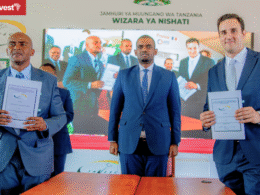



Tanzania President Samia Suluhu Hassan called on African leaders to accelerate infrastructure delivery through public-private partnerships (PPPs) as Tanzania signed five infrastructure agreements at Africa50’s Infra for Africa Forum in Dar es Salaam on 5 August 2026.
The agreements cover electricity transmission, natural gas supply to local industry and expanded kidney dialysis care, alongside USD 70 million in new capital commitments to Africa50 from three development finance institutions.
The agreements were signed on the opening day of the two-day Infra for Africa Forum and General Shareholders Meeting, which brought together policymakers, development finance institutions, investors and private sector leaders as Africa50 marked its 10th anniversary.

Three of the agreements involve the Government of Tanzania directly.
Africa50 and Tanzania’s Ministry of Health agreed to expand access to dialysis and renal care across the country, extending specialist treatment to kidney disease patients and supporting Tanzania’s universal healthcare coverage goals.
Africa50 and the Tanzania Electric Supply Company (TANESCO) agreed to formalize collaboration on electricity transmission public-private partnerships (PPPs), scaling up a transmission line PPP model that Africa50 previously pioneered in Kenya.
Africa50, the Tanzania Petroleum Development Corporation (TPDC) and TAQA Arabia signed a pilot project agreement to develop Tanzania’s first small-scale LNG project and supply Tanzania’s natural gas directly to local industries, allowing the country to use more of its domestic gas output and reduce reliance on imported fuels.
Two further agreements expanded Africa50’s own capital base rather than involving the Tanzanian government directly.

In regard to new capital commitments, British International Investment (BII), the United Kingdom’s development finance institution, committed USD 20 million to the Africa50 Infrastructure Acceleration Fund (IAF) as part of a wider strategic partnership on infrastructure investment across Africa.
The Italian Climate Fund committed USD 40 million alongside USD 10 million from Proparco, the private sector financing arm of the French Development Agency group (AFD), injecting a combined USD 50 million into Africa50 Project Development (APD) to develop strategic green infrastructure projects on the continent.
Delegates at the forum put Africa’s annual infrastructure financing gap at between USD 68 billion and USD 100 billion, against a requirement of between USD 130 billion and USD 170 billion per year.
Participants attributed the continental financing gap partly to constrained public finances, noting that average government revenue across Africa stands at approximately 14% of GDP, compared with a recommended minimum threshold of 25%.
In response, Africa50 announced a strategic shift from financing individual projects toward portfolio-based investing, balance sheet optimization, and asset recycling, designed to unlock larger volumes of institutional capital.
In her opening remarks, President Hassan stated: “Africa has never lacked visions. Through the Agenda 2063, the African Continental Free Trade Area and our national development plans, we have set ambitious goals for socioeconomic transformation of our societies. Our priority now has pivoted towards delivery, and I insist, delivery.”
She added: “It goes without saying that our people measure progress not by the declarations we make but by the visible outcomes, such as roads, reliable energy, efficient ports and railways, digital connectivity, and infrastructure that creates jobs, attracts investment and improves lives. Governments alone cannot finance Africa’s infrastructure ambitions. We must strengthen partnerships that bring together public resources, the private sector, development financial institutions, and local and international business.“
Kenya’s Deputy President, Professor Kithure Kindiki, stated: “Consistency, continuity and stability is a very key enabler of these wonderful objectives around infrastructure. As we build a democratic Africa, we must build a wealthy Africa at the same time, and the two outcomes are not mutually exclusive.”
Kindiki added: “We need to develop technical capacity at the local level in our countries. This will reduce dependence on foreign expertise, lower project costs and build long-term national ownership of our projects.”
The Group Chief Executive Officer of Africa50, Alain Ebobissé, stated: “The United Republic of Tanzania is a fitting place to celebrate the 10th anniversary of Africa50’s operations and to chart the course for the decade ahead.”
He added: “Together we will use the Infra for Africa platform to advance partnerships, projects and investment, and indeed to send a very powerful message to the world that Africa’s infrastructure offers a very compelling investment opportunity.”
He also stated: “Africa50 plans to launch a large-scale midstream gas infrastructure investment platform. This platform will unlock Africa’s domestic gas resources, expand reliable base-load power and support Africa’s industrialization, providing energy for manufacturing, fertilizer production, mineral beneficiation, digital infrastructure and data centers across the continent.”
Separate discussions during the forum focused on the role of natural gas in supporting industrialization and reducing Africa’s dependence on raw commodity exports, with delegates noting that the continent accounts for only 1.6% of globally traded industrial goods despite holding significant natural gas resources.
Mozambique presented its Master Plan for Electricity covering 2028 to 2045 and its Energy Transition Strategy, adopted in 2023, both targeting universal electricity access by 2030.
The country also outlined a Sovereign Wealth Fund framework under which 40% of energy revenues are allocated to the fund while 60% are directed to the national budget to support industrialization.
Mozambique is targeting liquefied natural gas (LNG) production capacity of 38 million metric tons annually by 2028, compared with current production of 3.4 million metric tons.
Mozambique’s Minister of Finance, Carla Louveira, stated: “The true wealth of our resources lies not only in their extraction but above all in our capacity to add value, to create jobs, develop skills, drive innovation and achieve the structural transformation of our economy.”
Louveira added: “Our main priority is to achieve what we have already defined in our strategy, and the commitment that the government has already made is to ensure the right environment and sustainability of the LNG project, to achieve legal stability and a safe environment for companies to operate.”
Nigeria presented its “Gas to Prosperity” strategy, aimed at increasing domestic gas utilization for electricity generation, fertilizer production and clean cooking.
The country also outlined plans to transition five million households from charcoal and firewood to liquefied petroleum gas (LPG) by 2030, while advancing a regional Atlantic gas pipeline linking Nigeria to Morocco through 12 countries.
Nigeria’s Minister of State for Petroleum Resources, Dr. Ekperikpe Ekpo, stated: “Today, looking at Nigeria, President Bola Tinubu has taken a position that we need to develop gas utilization within the country, and when this is done you are sure of power generation, industrialization, food security with reference to fertilizer production, clean cooking and transportation.”
Ekpo added: “Under the direction of President Bola Tinubu, we had to move five million homes from utilization of charcoal and other heavy emission sources to clean cooking by 2030, and we are on track.”
Tanzania highlighted its own progress in expanding clean cooking access, which increased from 6% before 2021 to 28% in 2026, while LPG imports rose from 290,000 metric tons annually to 459,000 metric tons in 2025.
Participants noted that approximately 70% of Tanzanian households still rely on charcoal, prompting calls for regional pipeline infrastructure linking Tanzania with Kenya, Uganda and the Democratic Republic of the Congo to strengthen regional gas markets.
Tanzania’s Minister for Energy, Deogratias John Ndejembi, stated: “Today here in Tanzania, seven out of 10 households still use charcoal and other sources of energy for cooking, so there is still room for work.”
Ndejembi added: “As Africans, we should not work in silos. We should collaborate and form infrastructure projects that are bankable, scalable and that provide access to one another as a continent.”
Discussions also referenced Tanzania’s Development Vision 2050, which targets the private sector contributing 70% of the country’s economy.
Zanzibar announced plans to increase investment in its blue economy and port public-private partnership projects from USD 150 million to USD 450 million over the next three years.
Delegates also highlighted progress on the Ethiopia-Kenya-Tanzania transmission line, which has a capacity of 2,000 MW and is currently transmitting approximately 800 MW of electricity from Ethiopia into Kenya and Tanzania.
Separate sessions covered digital infrastructure and artificial intelligence (AI), with presentations indicating that Africa could generate up to USD 1 trillion in additional GDP over the next decade through targeted AI investment.
Participants highlighted infrastructure gaps limiting digital transformation, including the need for at least 100 million additional smartphones to improve internet access, despite investment in subsea cable systems such as Equiano and Umoja.
Delegates identified cross-border fibre deployment barriers, taxes on semiconductors and AI hardware, unreliable electricity supply for data centers, and fragmented regulation as the main constraints on digital infrastructure development.
Financial fragmentation was also identified as an obstacle to infrastructure financing, with Africa’s 54 countries operating across 42 currencies and more than 40 central banks, increasing the cost and complexity of cross-border payments.
The Secretary General of the African Continental Free Trade Area (AfCFTA), Wamkele Mene, stated: “In the current global context of fiscal constraints and reduced overseas development assistance, the question is how do we mobilize domestic capital, African capital, over USD 3 trillion that’s available, and channel it towards infrastructure projects on the continent.”
Mene added: “A market of 1.4 billion people with a combined GDP of USD 3.4 trillion is a very significant domestic market, but we have to overcome the fragmentation that has persisted for many years by creating a single market.”
The Chief Executive Officer of British International Investment, Leslie Maasdorp, stated: “600 million people not having access to power is the single biggest binding constraint on why we have such low internet penetration and low digital access on the continent.”
Maasdorp added that development finance institutions are increasingly moving away from siloed individual models toward greater collaboration and a deeper, more systemic approach to their business.
About Africa50
Africa50 is a pan-African infrastructure investment and asset management platform established by African governments, the African Development Bank (AfDB) and the Central Bank of West African States to develop, finance and invest in bankable infrastructure projects across the continent.
During its first decade, Africa50 invested in 36 infrastructure projects across 34 African countries, supporting projects with a combined value exceeding USD 9 billion.
The institution currently manages USD 1.2 billion in assets across 38 shareholders.
Its Infrastructure Acceleration Fund has mobilized USD 320 million from 26 institutional investors, including 23 African investors, making it one of the largest domestic capital mobilization initiatives for African infrastructure to date.
Africa50 has set a target to expand its assets under management to USD 5 billion in equity capital, with the objective of catalyzing approximately USD 30 billion in private infrastructure investment across Africa through portfolio-based financing models and greater participation by African institutional investors.
Main keyword phrase: Tanzania infrastructure PPP agreements
SEO Title: Tanzania President Calls for Faster Infrastructure Delivery Via PPPs as Country Signs Five Agreements on Power Transmission, Gas and Health
Slug: africa50-agreements-kidney-care-power-transmission-gas
SEO Meta Description: Samia
SEO Excerpt:
Want to know more about Energy in Tanzania? Our free overview of the Tanzania Business and Investment Guide 2026 covers Energy, plus key sectors and investment opportunities. The complete 141-page edition includes policies, taxation, key regulations, full macroeconomic data, and sources, and is also available at no cost upon completion of a short form.
Download Free OverviewGet the Full Edition for Free