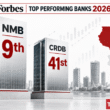

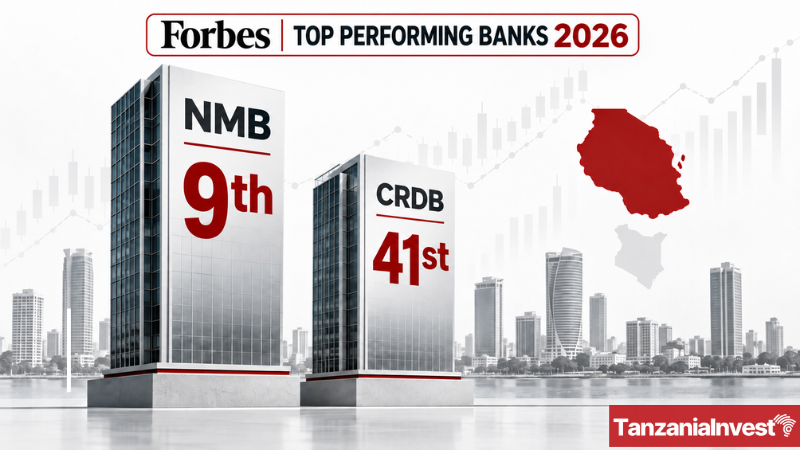
NMB Bank Plc (DSE: NMB) ranked 9th and CRDB Bank Plc (DSE: CRDB) 41st in their asset tier in the inaugural Forbes Top Performing Banks 2026 ranking, placing both Tanzanian lenders ahead of every Kenyan bank in the same bracket.
The ranking was published on 9 September 2026 by Forbes in partnership with market research firm Statista, and covers 500 banks drawn from 89 countries.
Unlike the long-running Forbes World’s Best Banks list, which is built on customer surveys, this ranking is based on audited financial data obtained from providers including the S&P Capital IQ platform, desk research and direct submissions from banks.

To qualify, institutions had to be licensed deposit-taking banks with total assets exceeding USD 3 billion, publish audited financial statements, and provide at least three consecutive years of financial data.
Scores weighted profitability at 30%, capital and funding resilience at 25%, asset quality and efficiency at 25%, and growth and earnings quality at 20%.
Banks were segmented into six tiers by asset size before scoring, so that each institution was measured against peers of comparable scale rather than against the global banking system as a whole.
NMB and CRDB were both assessed in Tier 6, the small-bank tier covering institutions with total assets of between USD 3 billion and USD 10 billion.
Within that same tier, Kenya’s Co-operative Bank placed 120th and Stanbic Holdings 138th, while Rawbank of the Democratic Republic of Congo came in at 145th.

NMB closed 2025 with profit after tax of TZS 760 billion, up 17.5%, on total assets of TZS 17.6 trillion, a 28% increase, with the non-performing loan ratio down to 2.5% from 2.9% a year earlier.
The bank then reported profit after tax of TZS 405.8 billion for the first half of 2026 and total assets of TZS 18.44 trillion as at 30 June 2026.
CRDB lifted half-year profit after tax by 20% to TZS 416.9 billion, with total assets expanding 33.9% year-on-year to TZS 26.40 trillion, the largest balance sheet in the Tanzanian market.
The Managing Director and Chief Executive Officer of NMB Bank, Ruth Zaipuna, said the placement reflected years of transformation at the bank and demonstrated that Tanzania’s banking industry is able to compete at international level.
Zaipuna linked the result to the disciplined execution of the bank’s strategy rather than to a single year of earnings, noting that the assessment window covers three consecutive years of financial data.
CRDB and NMB in Tanzania’s Banking Sector
Tanzania’s banking sector recorded profit after tax of TZS 1.38 trillion in the first half of 2026, up 13% year-on-year, on total assets of TZS 91.3 trillion across 41 banks and financial institutions, according to the H1 2026 banking sector performance review.
CRDB and NMB together held 49.1% of sector assets in that period while generating 59.6% of total sector profit after tax, a concentration of earnings that has widened as smaller institutions posted losses.
CRDB Bank was established in 1996 and controls roughly 28% of banking assets, 30% of loans and 27% of deposits in Tanzania, with subsidiaries in Burundi and the Democratic Republic of Congo and a representative office in Dubai opened to channel trade and capital flows between East Africa, the Middle East and Asia.
Under Group Chief Executive Officer Abdulmajid Nsekela, appointed in 2018, the bank’s asset base has grown from around TZS 5 trillion to more than TZS 26 trillion.
NMB Bank was created in 1997 out of the break-up of the former National Bank of Commerce and operates the widest retail and government payments franchise in the country, with more than 6 million customer accounts.
Both counters are the most heavily traded shares on the Dar es Salaam Stock Exchange (DSE), and African Business magazine’s Top East African Companies 2026 survey placed CRDB third and NMB fourth regionally, each with a market capitalisation of USD 2.7 billion, ahead of Kenya’s Equity Group and KCB Group.
Want to know more about Banking in Tanzania? Our free overview of the Tanzania Business and Investment Guide 2026 covers Banking, plus key sectors and investment opportunities. The complete 141-page edition includes policies, taxation, key regulations, full macroeconomic data, and sources, and is also available at no cost upon completion of a short form.
Download Free OverviewGet the Full Edition for Free