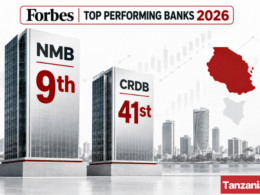



Tanzania’s banking sector recorded profit after tax of TZS 1.38 trillion in H1 2026, up 13% from H1 2025, according to the Tanzania Banking Sector Performance Report for H1 2026, published in August 2026 by AML Finance Limited and authored by the Managing Director, Reginald Massawe.
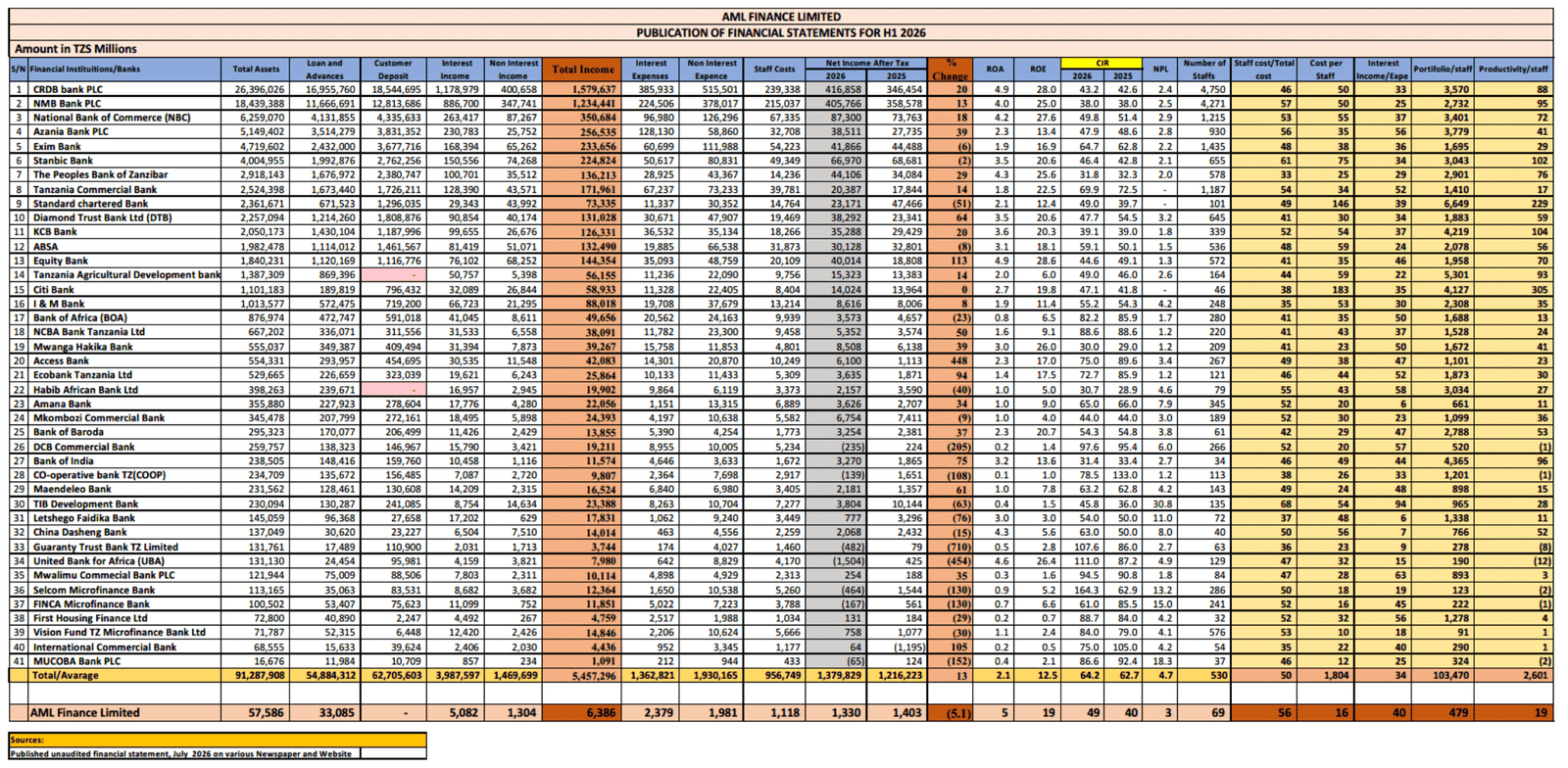
The analysis is based on published unaudited financial statements as at 30 June 2026, covering 41 banks and financial institutions.
Performance Overview
Profit after tax (PAT) reached TZS 1.38 trillion in H1 2026, up 13% from H1 2025.

Total income reached TZS 5.46 trillion in H1 2026, comprising TZS 3.99 trillion in interest income and TZS 1.47 trillion in non-interest income.
Total banking sector assets stand at TZS 91.3 trillion, with combined loans and advances of TZS 54.9 trillion and customer deposits of TZS 62.7 trillion.
This compares with Q1 2026 sector assets of TZS 84.6 trillion, reported in the previous AML Finance analysis, indicating continued balance-sheet expansion.
Loans represented approximately 60% of assets, within the conventional commercial-bank range of 50-70%, while the loan-to-deposit ratio of 87.5% points to increasingly effective conversion of deposits into productive credit.
The sector’s average return on assets (ROA) stood at 2.1%, return on equity (ROE) at 12.5% and non-performing loans (NPL) ratio at 4.7%, while the average cost-to-income ratio (CIR) stood at 64.2%.

Private-sector credit rose from 18.7% to 23.2% of GDP between April 2025 and April 2026, a pace Massawe frames within Tanzania’s Vision 2050 ambition to build a USD 1 trillion economy.
Concentration
Eleven institutions with assets above TZS 2 trillion controlled 84.4% of sector assets and generated 88.3% of PAT.
CRDB and NMB alone held 49.1% of assets but produced 59.6% of PAT, demonstrating superior earnings conversion among the largest banks.
CIR rose from 44.2% for large banks to 87.8% for micro or specialised institutions, while PAT per employee fell from TZS 75.7 million to TZS 1.3 million across the same size tiers.
Seven institutions in the two smallest size tiers reported losses in H1 2026, compared with none among large and medium banks.
Profitability and Returns
CRDB’s PAT grew 20% to TZS 416.9 billion in H1 2026, with assets reaching TZS 26.40 trillion.
NMB recorded PAT of TZS 405.8 billion, up 13%, with assets of TZS 18.44 trillion.
NBC’s PAT rose 18% to TZS 87.3 billion, with assets of TZS 6.26 trillion.
Equity Tanzania recorded the strongest profit growth in the sector at 113%, while DTB profit rose 64%.
Standard Chartered profit declined 51%, ABSA fell 8% and BOA dropped 23% in H1 2026.
Between H1 2020 and H1 2026, CRDB’s assets grew from TZS 7.00 trillion to TZS 26.40 trillion while its CIR improved from 70% to 43.2%.
Over the same period, NMB’s assets rose from TZS 7.12 trillion to TZS 18.44 trillion while its CIR fell from 59% to 38.0%, and NBC’s assets expanded from TZS 1.94 trillion to TZS 6.26 trillion while its CIR improved from 86% to 49.8%.
Momentum continued between Q1 and H1 2026, with CRDB’s assets rising from TZS 23.9 trillion to TZS 26.4 trillion, NMB’s from TZS 17.9 trillion to TZS 18.4 trillion, and NBC’s from TZS 5.6 trillion to TZS 6.3 trillion.
Ownership and Market Structure
In December 2025, 13 locally-owned commercial banks controlled 68.6% of assets, 71.9% of loans and 67.3% of deposits, despite competing with 22 foreign-owned banks.
Their share of loans and deposits increased from 70.1% and 64.7% in 2024 to 71.9% and 67.3% in 2025.
Standard Chartered transferred its consumer, private and business banking portfolio to Access Bank in June 2025, while retaining corporate and investment banking.
African Business Magazine’s 2026 ranking placed CRDB and NMB above Equity and KCB by market capitalization, although the Kenyan groups retain larger consolidated balance sheets and regional franchises.
In 1995, Julius Nyerere questioned the fairness of pitting young Tanzanian banks against much larger Western institutions, likening it to “a heavyweight and a featherweight in the same ring.”
International Capital Access
NMB’s USD 73 million Jamii Sustainability Bond was admitted to the London Stock Exchange in May 2024.
In July 2026, the International Finance Corporation (IFC) listed the first offshore Tanzanian-shilling bond in London, raising TZS 262.5 billion for a long-term local-currency facility to NMB.
Twenty per cent of the facility is dedicated to women-owned micro, small and medium enterprises (MSMEs), with an estimated 13,000-20,000 jobs expected to be supported.
Outlook to 2031 and 2036
Starting from H1 2026 assets of TZS 91.3 trillion, AML Finance frames three growth paths for the sector.
At an 11% compound annual growth rate (CAGR), broadly aligned with nominal GDP, assets would reach approximately TZS 153.8 trillion by 2031 and TZS 259.2 trillion by 2036.
A 14% financial-deepening scenario would produce TZS 175.8 trillion and TZS 338.4 trillion, while a 17% transformation scenario would produce TZS 200.1 trillion and TZS 438.8 trillion.
If loans remain near 60% of assets, the transformation path would support approximately TZS 120 trillion in lending by 2031 and TZS 263 trillion by 2036.
Reported H1 assets rose from TZS 49.2 trillion in 2023 to TZS 91.3 trillion in 2026, a pace Massawe says should not be extrapolated mechanically given post-pandemic recovery and changes in reporting coverage.
Massawe identifies capital consumption, expensive funding, margin compression, government crowding-out, maturity mismatches, cyber risk and delayed NPL formation as the principal threats to the transformation path.
He further points to the Bank of Tanzania’s ten-year leadership tenure ceiling as a central factor for succession and governance risk across the sector’s largest banks.
Bank of Tanzania’s Bank CEO Tenure Regulations
The Bank of Tanzania (BOT) introduced the Banking and Financial Institutions (Corporate Governance) Regulations in November 2021, capping the tenure of bank chief executives and board members at ten consecutive years.
Executives who reach the limit must stand down for a moratorium period before becoming eligible for reappointment, and the regulations also bar elected officials from serving on bank boards.
BOT has stated the rules are intended to strengthen succession planning and reduce dependence on individual leaders, while some industry figures, including former Prime Minister Frederick Sumaye, have argued for exemptions for the best-performing bank chief executives.
The rules apply across Tanzania’s banking sector, including CRDB and NMB, whose current leadership took office within the 2018-2020 window covered by AML Finance’s analysis.
Tanzania Banks Performance H1, 2026
Want to know more about Banking in Tanzania? Our free overview of the Tanzania Business and Investment Guide 2026 covers Banking, plus key sectors and investment opportunities. The complete 141-page edition includes policies, taxation, key regulations, full macroeconomic data, and sources, and is also available at no cost upon completion of a short form.
Download Free OverviewGet the Full Edition for Free