

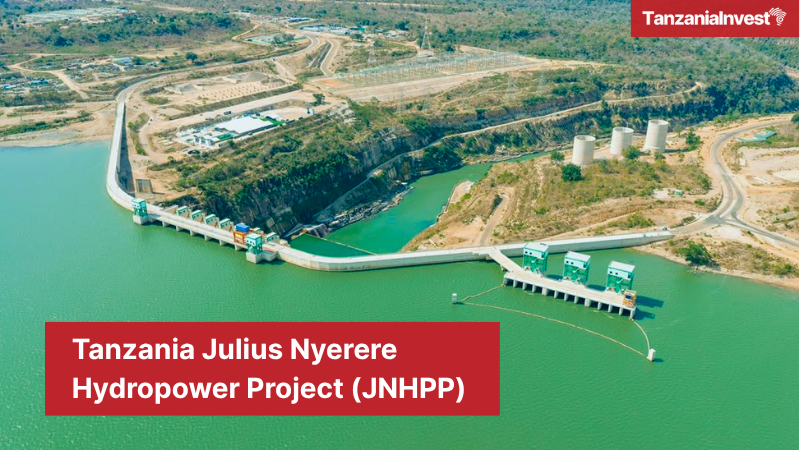
Tanzania´s President Samia Suluhu Hassan officially inaugurated the 2,115-megawatt Julius Nyerere Hydropower Project (JNHPP) on 22 August 2026.
The inauguration took place at the project site in Rufiji District, Coast Region, where nine generating units, each with a capacity of 235 megawatts, make up the plant’s total installed capacity.
The ceremony was attended by Vice President, Ambassador Dr. Emmanuel Nchimbi, Prime Minister Dr. Mwigulu Nchemba, Egyptian Prime Minister Moustafa Madbouly and Energy Minister Deogratius Ndejembi, among other officials.

The project cost approximately TZS 7.452 trillion (USD 3.35 billion), funded entirely through domestic government resources without external financing.
Construction began in June 2019 and was completed in March 2025, carried out by an Egyptian consortium of Arab Contractors and Elsewedy Electric (EGX: SWDY).
With this addition to the country’s power generation capacity, Tanzania recorded an electricity surplus of 2,375 megawatts after installed capacity reached 4,646 megawatts against peak demand of 2,271 megawatts.
Ndejembi commented: “We recognise that increasing generation capacity alone is not enough. We must have a network capable of receiving and transmitting all this power to the various parts of our country.”
He said the government had completed the 400 kilovolt Chalinze to Dodoma transmission line, which now delivers JNHPP-generated power more reliably to the capital.

Ndejembi pointed to the line’s immediate effect on the national grid’s peak load.
“Just last week, the peak electricity consumption in our country was 2,130 megawatts. But right after switching on that Chalinze to Dodoma line, we have now reached a peak of 2,280 megawatts, and this is within just three days,” Ndejembi said.
The government is also constructing a transmission line from Chalinze through Mkuranga to Kinyerezi to strengthen power distribution in the Coast Region and its industrial areas.
The Tanzania-Zambia Interconnector (TAZA) line, running more than 617 kilometres from Iringa through Mbeya to Tunduma and Sumbawanga, has reached approximately 98% completion and will connect the Rukwa Region to the national grid.
Construction is also under way on the Songea to Tunduru, Masasi and Mahumbika line, with the contractor already mobilised on site to improve power reliability in the Lindi and Mtwara regions.
The government is expanding the Ibadakuli substation in Shinyanga Region to upgrade the Dodoma-Singida-Tabora-Shinyanga line from 220 kilovolts to 400 kilovolts, a step intended to increase transmission capacity toward Geita, the Lake Zone and the planned Tanzania-Uganda Interconnector.
Ndejembi said the additional generation capacity strengthens Tanzania’s position to connect with Africa’s wider electricity market through regional grid interconnection initiatives.
The government has signed an agreement to sell electricity to Zambia, according to Ndejembi.
Tanzania also has an arrangement with Kenya to trade electricity based on each country’s needs, and the government is holding talks with other neighbouring countries to enable further cross-border power trade.
Installed generation capacity is expected to reach 8,000 megawatts by 2030 through a mix of hydropower, natural gas, solar, wind and geothermal sources, according to Ndejembi.
The idea of harnessing the Rufiji River at Stiegler’s Gorge dates back to a German colonial-era survey in the early twentieth century, and was revived after independence when Tanzania’s first president, Julius Nyerere, commissioned feasibility studies in the 1960s.
The Japan External Trade Organization supported early feasibility work in that decade that proposed a 620 megawatts plant, and Norway’s development agency, NORAD, produced detailed feasibility and engineering designs for the site through the 1970s and 1980s.
Funding constraints and shifting national priorities repeatedly stalled the project over the following decades until the government revived it as a strategic priority, renamed it from Stiegler’s Gorge to the Julius Nyerere Hydropower Project, and the Tanzania Electric Supply Company (TANESCO) signed the EPC contract with the Egyptian consortium in December 2018.
Tanzania Power Production and Distribution and Vision 2050
The completion of JNHPP is tied to Tanzania’s National Development Vision 2050, which designates energy as one of five strategic enablers of the country’s economic transformation and sets a target of positioning Tanzania as a net electricity exporter by 2050.
The Vision sets a longer-term target of 70,000 megawatts of installed generation capacity by 2050, alongside the government’s Mission 300 initiative to achieve full national electricity access by 2030.
Tanzania’s installed generation capacity stood at 4,522.54 megawatts as of March 2026, rising to 4,646 megawatts by the JNHPP inauguration in August 2026, of which hydropower accounted for 60.30% (2,727.31 megawatts), natural gas 28.40% (1,284.58 megawatts), oil 5.80%, biomass 3.00%, solar 1.44%, coal 1.00% and wind 0.05%.
Tanzania joined the Eastern Africa Power Pool (EAPP), which links 11 countries including Kenya, Uganda, Rwanda, Burundi, Ethiopia and Egypt, in March 2010, and is also a member of the Southern African Power Pool (SAPP) through its national utility, alongside Zambia, Zimbabwe, South Africa and nine other Southern African Development Community (SADC) countries.
Tanzania has historically been one of only a handful of SAPP member countries without a physical transmission connection to the rest of the pool, a gap regional power sector officials have described as the critical missing link between the eastern and southern African grids.
Completion of the TAZA interconnector is expected to close that gap, physically joining SAPP and EAPP into a combined market spanning more than 20 countries and allowing power to flow in both directions between eastern and southern Africa.
Tanzania already exchanges smaller volumes of power with neighbouring countries, importing 47 megawatts from Uganda to supply the Kagera region and 20 megawatts from Zambia to supply the Rukwa region, and drawing 27 megawatts from the 80 megawatts Rusumo Falls hydropower project it shares with Rwanda and Burundi.
Want to know more about Energy in Tanzania? Our free overview of the Tanzania Business and Investment Guide 2026 covers Energy, plus key sectors and investment opportunities. The complete 141-page edition includes policies, taxation, key regulations, full macroeconomic data, and sources, and is also available at no cost upon completion of a short form.
Download Free OverviewGet the Full Edition for Free