
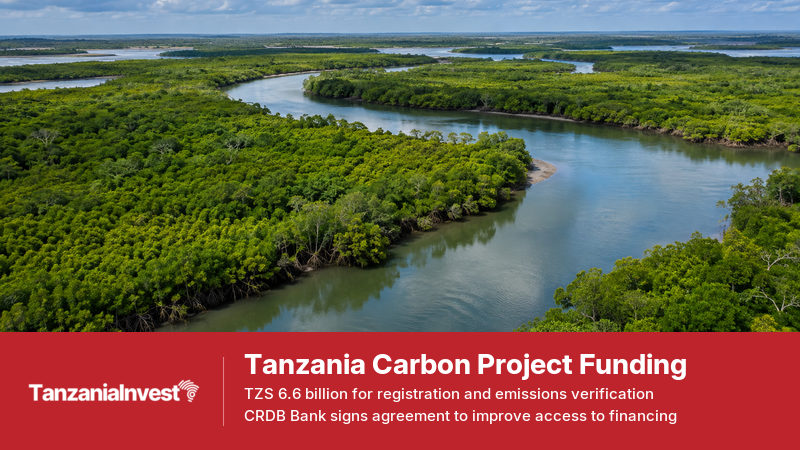
The Tanzanian government has earmarked TZS 6.6 billion for the National Carbon Monitoring Centre (NCMC) to improve its carbon project registry and train specialists to measure, report, and verify greenhouse gas emission reductions.
Richard Muyungi, Permanent Secretary in the Vice President’s Office, announced the funding on 12 November 2026 at the 31st United Nations Climate Change Conference (COP31) in Antalya, Türkiye.
The following day, NCMC and CRDB Bank (DSE: CRDB) signed a memorandum of understanding to help eligible carbon project developers access financing in Tanzania.

CRDB Bank Group CEO Abdulmajid Nsekela said the agreement would help attract investment in carbon projects that deliver economic and social benefits, while NCMC Executive Director Kathryn Kigaraba said it would help developers raise financing locally.
Environment Minister Hamad Masauni urged CRDB Bank to develop new ways for carbon project developers and other market participants to raise capital, adding that developers who secure financing must still comply with the Environmental Management Act and the 2022 carbon trading regulations, as amended in 2023, and obtain the required approvals before starting work.
Carbon Credits in Tanzania
One carbon credit represents one metric tonne of carbon dioxide equivalent reduced or removed, and developers can sell credits from projects such as mangrove restoration, renewable energy and cleaner cooking once the results have been independently verified and the credits issued.
Tanzanian businesses can buy carbon credits voluntarily to compensate for part of their emissions.
In mainland Tanzania, the environment minister approves carbon projects and NCMC registers them, while the carbon trading regulations set out how emissions reductions are verified and how proceeds from credit sales are shared.
By July 2026, NCMC had registered 117 carbon projects, and the government had approved new projects expected to generate credits representing 4.2 million tonnes of carbon dioxide equivalent for sale internationally, according to a parliamentary budget committee report.
Foreign companies can buy Tanzanian credits directly from developers or through intermediaries on the voluntary market, where programmes such as Verra and Gold Standard set rules for issuing credits.
Airlines can buy eligible credits to meet international aviation offsetting obligations, while Article 6 of the Paris Agreement provides for a separate UN-supervised crediting mechanism and requires Tanzania to authorise transfers intended to count toward another country’s climate target.
Want to know more about Energy in Tanzania? Our free overview of the Tanzania Business and Investment Guide 2026 covers Energy, plus key sectors and investment opportunities. The complete 141-page edition includes policies, taxation, key regulations, full macroeconomic data, and sources, and is also available at no cost upon completion of a short form.
Download Free OverviewGet the Full Edition for Free