


The Central Bank of Tanzania (BOT) has recently issued its Monetary Policy Statement, Mid-Year Review 2023/24 for submission to the Parliament.
This statement evaluates both global and domestic economic conditions, outlines the progress in implementing monetary policy, and discusses outcomes observed during the first half of 2023/24.
Additionally, it provides an outlook for the global and domestic economies, along with the anticipated direction of monetary policy for the second half of 2023/24 to achieve policy objectives.

Tanzania GDP Growth in 2023
Despite encountering multiple external shocks, the economy exhibited satisfactory performance.
Mainland Tanzania’s GDP growth averaged 5.3% from January to September 2023, driven primarily by agriculture, financial and insurance sectors, as well as mining and quarrying activities.
The growth was further supported by ongoing improvements in the business environment, propelled by reforms, policies, and increased public investment in infrastructure.
Noteworthy sectors experiencing rapid growth include financial and insurance services, information and communication, and manufacturing.
Based on this performance and leading economic indicators, GDP growth for 2023 is estimated to be around 5%.

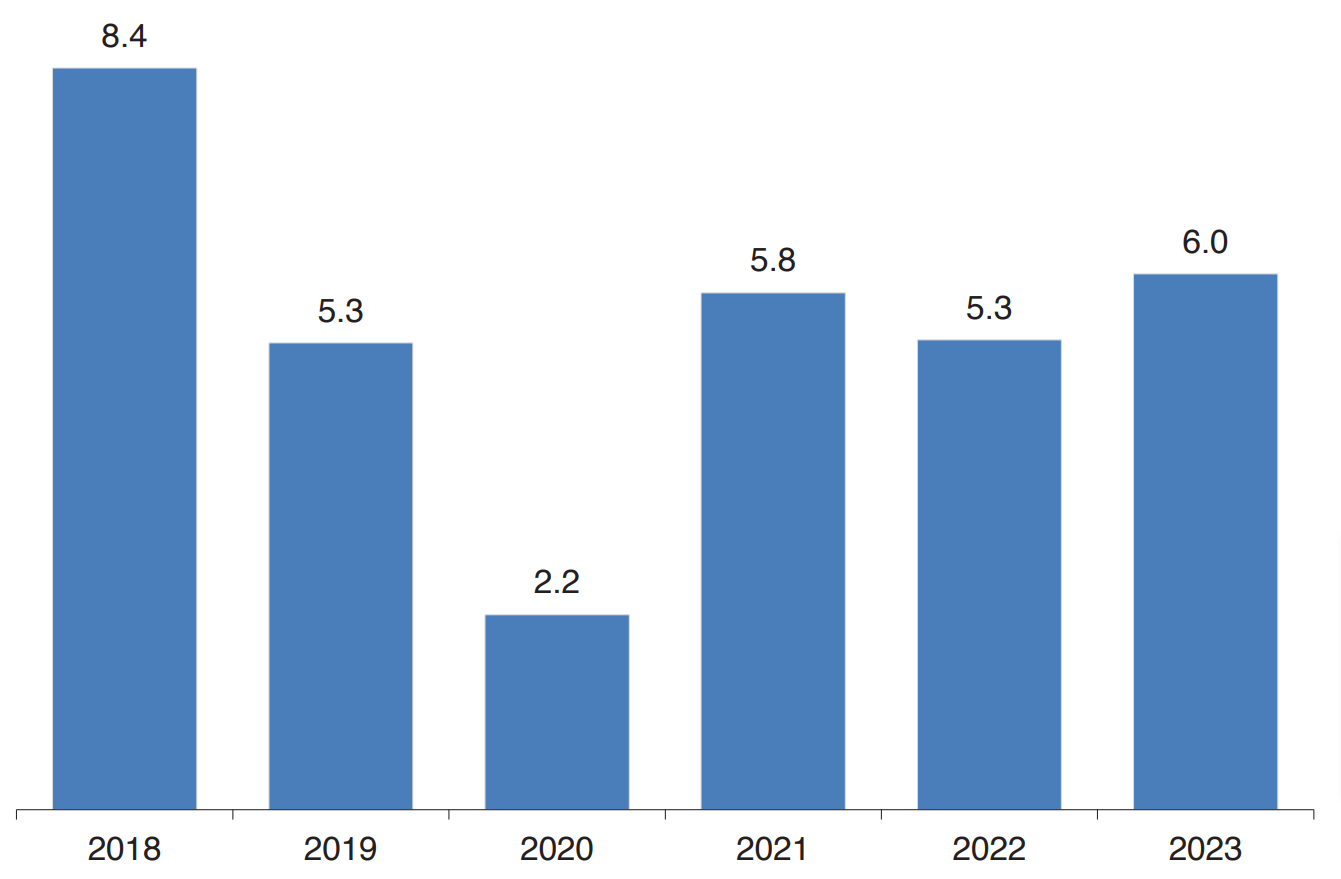
In Zanzibar, the economy grew by 6% in the first 3 quarters of 2023, led by the accommodation and food services, construction, and manufacturing sectors. It is estimated that the economy expanded at a rate of around 7% in 2023.
Zanzibar GDP Growth Rate (%), 2018-2013
Tanzania GDP Growth in 2024
The domestic economy is forecasted to continue its recovery, with GDP growth in Mainland Tanzania projected at around 5.2% in the second half of 2023/24 and 5.5% in 2024.
Favorable rainfall patterns are expected to positively contribute to output growth, alleviating concerns regarding power outages.
Moreover, there is anticipation of increased electricity generation from the Julius Nyerere Hydro Power Plant and other sources during the latter half of 2023/24. However, geopolitical tensions pose a significant downward risk to the growth outlook.
In Zanzibar, the economy is forecasted to grow robustly at 7.4% in 2024. This growth is attributed to the improving business environment, public investment, and successful implementation of policies and reforms. Support from infrastructure projects, rising tourism, and expansion in manufacturing activities further contribute to the positive outlook.
Want to know more about the Economy in Tanzania? Our free overview of the Tanzania Business and Investment Guide 2026 covers the Economy, plus key sectors and investment opportunities. The complete 141-page edition includes policies, taxation, key regulations, full macroeconomic data, and sources, and is also available at no cost upon completion of a short form.
Download Free OverviewGet the Full Edition for Free