

Tourist Arrivals to Tanzania Increase by 20% in 2024 to Reach Record 2.6 Million, Italy Leads Among Non-African Markets

Tanzania received 2,662,219 tourists in 2024, marking a 20% annual increase, according to the National Bureau of Statistics. Kenya led African arrivals, while Italy topped non-African markets.
Tanzania Tourist Arrivals 2015-2024

Tanzania recorded a 20% increase in international tourist arrivals in 2024, reaching 2,662,219 visitors compared to 2,217,287 in 2023, according to the National Bureau of Statistics (NBS) in its High Frequency Data of April 2025.

The data also indicates that tourist arrivals in the first three months of 2025 reached 446,380, representing a 1.17% year-on-year increase compared to the same period in 2024.

Kenya remained the leading source of arrivals, with 51,501 visitors in the period January-March 2025, accounting for 9.78% of the total.

Tanzania Investment Guide 2026 Free Edition

Outside of Africa, the top source market was Italy, with 33,482 arrivals (6.36%), followed by France with 30,652 (5.82%), the USA with 28,440 (5.40%), Germany with 25,008 (4.75%), and Poland with 20,720 (3.94%).

Other key non-African source countries included China with 17,622 arrivals (3.35%), the UK with 16,311 (3.10%), India with 13,541 (2.57%), the Netherlands with 11,395 (2.16%), and the Czech Republic with 7,862 (1.49%).

Tourism constitutes a crucial contributor to the Tanzanian economy, contributing approximately 17% to GDP and 25% to total export earnings, and providing almost 1.6 million direct and indirect jobs.

The government of Tanzania has implemented various initiatives to promote tourism, including marketing campaigns, infrastructure development, and investment incentives.

The country is known for its wildlife safaris, Mount Kilimanjaro, Zanzibar beaches, and national parks such as the Serengeti and the Ngorongoro Crater.

TanzaniaInvest Capital Markets Report Banner

Want to know more about Tourism in Tanzania? Our free overview of the Tanzania Business and Investment Guide 2026 covers Tourism, plus key sectors and investment opportunities. The complete 141-page edition includes policies, taxation, key regulations, full macroeconomic data, and sources, and is also available at no cost upon completion of a short form.

Download Free OverviewGet the Full Edition for Free

Free Newsletter

Get our monthly update on business and investment in Tanzania.

Related Posts
Tanzania Tanga 17 PPP Investment Projects
Read More

17 PPP Projects Open in Tanga to Investors in Transport, Trade, Tourism, Livestock, Agriculture, and Mining

Seventeen Tanga PPP projects with title deeds are open to private investors in transport, trade, tourism, livestock, agriculture, and mining, led by the 595,785-square-metre Pongwe Dry Port. Councils can approve projects below USD 20 million without the national PPP Board, and the government can co-finance capital costs through viability gap funding.
Tanzania TANAPA revenue arrivals 2025-2026
Read More

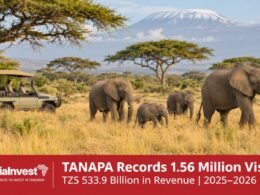
Tanzania Records 1,559,441 Visitors to its National Parks as Revenue Reaches TZS 533.9 Billion; Allocates 130 Investment Sites for New Lodges and Camps

The Tanzania National Parks Authority (TANAPA) recorded 1,559,441 visitors and TZS 533.9 billion (± USD 201.5 million) in revenue in 2025-2026, up from 788,940 visitors and TZS 174.7 billion in 2021-2022. To meet growing demand, TANAPA has allocated 130 investment sites for new lodges and camps, mainly in the Southern, Eastern and Western tourism circuits, after bed capacity rose from 575 in 2021 to 1,294 in 2026.
Tanzania Khamis Mussa Omar World Bank Anna Bjerde
Read More

Tanzania and World Bank Map Central Corridor Investment Opportunities in Agriculture, Logistics, Mining, and Tourism

Tanzania and the World Bank are mapping Central Corridor investment opportunities in agriculture, mining, tourism, transport, and logistics, with a possible extension to Rwanda, while UNDP prepares investor-ready projects for a June 2027 investment conference and seeks Asian Infrastructure Investment Bank financing. The World Bank named job creation its top priority and discussed shifting small business lending from collateral to cash-flow assessment, while Tanzania pursues a 40% value addition target through agriculture, livestock, and minerals.