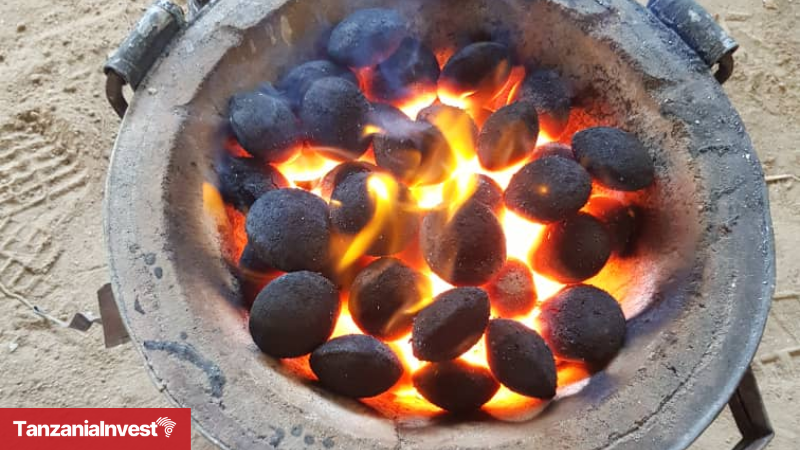
New TZS 4.5 Billion Plant in Geita to Produce Rafiki Briquettes for Clean Cooking Energy

A clean cooking energy plant worth TZS 4.5 billion will be built in Geita Region to produce Rafiki Briquettes, funded by the Rural Energy Agency (REA) and the State Mining Corporation (STAMICO). The plant will be the fifth of its kind and supports the government’s goal of achieving 80% clean cooking energy access by 2034.
Tanzania Clean Cooking Rafiki Briquettes

The Rural Energy Agency (REA) and the State Mining Corporation (STAMICO) signed a TZS 4.5 billion agreement on 22 July 2025 to establish a new plant for the production of alternative cooking energy, specifically Rafiki Briquettes, in Geita Region.

Rafiki Briquettes are smokeless coal briquettes made as an alternative source of energy for domestic purposes. It involves the use of coal dust and other subordinate materials.

Under the agreement, REA will contribute TZS 3 billion for the purchase of machinery, while STAMICO will cover the remaining TZS 1.5 billion for land acquisition, factory construction, and machinery installation.

Tanzania Investment Guide 2026 Free Edition

The contract was signed by REA Director General Eng. Hassan Saidy and STAMICO Managing Director Dr. Venance Mwasse at REA’s office in Dar es Salaam.

The new plant will become STAMICO’s fifth major facility for producing Rafiki Briquettes.
Existing plants are already operating in Kisarawe (Pwani Region) and Kiwira (Songwe Region), while two more are nearing completion in Dodoma and Tabora.

Eng. Saidy noted that REA has been tasked with ensuring that 80% of Tanzanians access clean cooking energy by 2034.

He explained that the contract with STAMICO is part of REA’s broader strategy to increase clean energy production and distribution, especially in rural areas, in line with the directive of President Samia Suluhu Hassan.

He added that the agency is also implementing projects for distributing improved cookstoves, electric stoves, 6kg and 15kg LPG cylinders, and piped natural gas in Lindi and Pwani, as well as building clean energy infrastructure in public institutions.

Tanzania Investment Guide 2026 Full Edition

Dr. Mwasse thanked the government for REA’s support and reiterated STAMICO’s commitment to eliminating the use of unsafe cooking energy nationwide by 2034.

He said the clean energy agenda, championed by President Samia, aims to empower women by transitioning away from hazardous energy sources.

He also noted that Rafiki Briquettes are already in use across all 129 prison facilities in Tanzania, as well as units of the Tanzania People’s Defence Force (JWTZ), the National Service (JKT), training institutions, primary and secondary schools, hotels, restaurants, and food vendors.

Dr. Mwasse confirmed that STAMICO will maintain the equipment to ensure uninterrupted service delivery.

Want to know more about Energy in Tanzania? Our free overview of the Tanzania Business and Investment Guide 2026 covers Energy, plus key sectors and investment opportunities. The complete 141-page edition includes policies, taxation, key regulations, full macroeconomic data, and sources.

Download Free OverviewGet the Full Guide
Related Posts
Eastern Africa Power Pool (EAPP) 2026 Council of Ministers Meeting
Read More

Eastern Africa Power Pool Ministers Agree to Accelerate Regional Electricity Market

Eastern Africa Power Pool (EAPP) member states have agreed to speed up the implementation of a regional electricity market aimed at expanding cross-border electricity trade and strengthening energy security. Tanzania said the initiative will support industrial growth, attract investment, and improve the reliability of electricity supply across the region.
Dangote Ruto Oil Refinery Pledge Kenya
Read More

Dangote Picks Kenya Over Tanzania for USD 19 Billion East Africa Oil Refinery

Dangote Industries has confirmed Kenya as the site for its planned 700,000 bpd East African oil refinery, ending months of speculation over rival location Tanzania. The KSH 2.5 trillion (approximately USD 19.3 billion) project will be built at Lamu Island, take around 30 months to construct, and supply fuel to Kenya, Uganda, Tanzania, and South Sudan.
Tanzania ASSESSMENT OF ECONOMIC IMPACTS ON TANZANIA ARISING FROM THE GULF CRISIS
Read More

Tanzania Gulf Crisis Report Rates Energy, Food, Transport, Tourism and Budget at High Risk

A May 2026 rapid assessment by Tanzania's National Planning Commission and UNDP rates energy, food, transport, tourism and the Government budget at high risk from the Gulf crisis, which raised Dar es Salaam fuel prices by up to 69% between January and May 2026. The report flags a possible TZS 153.7 billion monthly customs revenue shortfall and fuel subsidy needs rising to TZS 1,384.2 billion by July, alongside buffers including a 124% food self-sufficiency ratio, USD 6.3 billion in reserves and 57 trillion cubic feet of gas.
Tanzania-Rwanda energy cooperation agreement 2026 Hassan Kagame
Read More

Tanzania and Rwanda Sign Energy Cooperation Agreement Covering Power Trade, Oil, Gas and LNG

Tanzania and Rwanda signed a bilateral energy cooperation agreement covering cross-border electricity trade, joint power infrastructure development, and petroleum product distribution. The deal also extends to oil and gas exploration, LNG project opportunities, and the use of artificial intelligence in the energy sector, building on the existing 80 MW Rusumo interconnection, which has synchronized the grids of Tanzania, Rwanda, and Burundi since March 2024.