

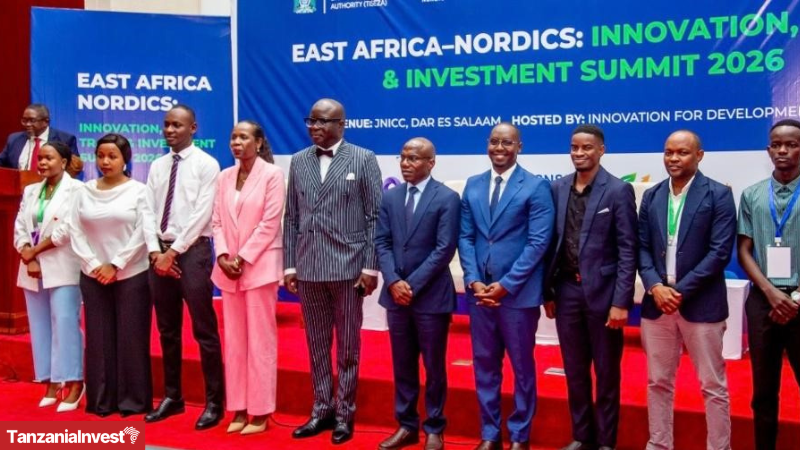
On 25th –26th February 2026, Tanzania’s Innovation for Development (I4D) hosted the East Africa Nordic Investment Summit in Dar es Salaam, bringing together government leaders, Nordic partners, investors, financial institutions, and entrepreneurs to strengthen digital transformation and structured industrial investment.
The two-day summit focused on aligning digital systems, capital structuring, and policy frameworks to accelerate Tanzania’s industrialization agenda and expand cross-border trade between East Africa and Nordic countries.
The first day of the summit centered on digital transformation as a foundation for investment mobilization and economic competitiveness.

Opening the summit, Tanzania’s Deputy Minister of Planning and Investment, Pius Chaya, said digital transformation must be viewed as an economic transformation rather than a purely technological shift.
The Minister said, “Digital transformation serves as the backbone of the investment mobilization. It strengthens governance, improves service delivery, and supports enterprise growth across key sectors including agriculture, manufacturing, and trade”.
He added that Tanzania is targeting a USD 1 trillion economy by 2050, with the private sector expected to contribute 70% of GDP growth, emphasizing the need for coordinated public-private collaboration.
On his part, the Director General of Tanzania’s ICT Commission, Dr. Nkundwe Mwasaga, outlined Tanzania’s digital transformation pillars, including digital skills, cybersecurity, digital communication services, digital public infrastructure, and innovation ecosystems.
He highlighted the growth of smartphone penetration and the establishment of digital public infrastructure systems, including digital ID and interoperable payment systems, as critical enablers of investor confidence.

Representing the private sector, the Director of Grant Thornton, Muntazir Fazel, said that the digital economy has become the foundation of competitiveness and sustainable growth.
Day 1 also featured three panels discussing digital infrastructure, regulatory efficiency, structured capital pathways, and cross-border investment between East Africa and global markets.
The second day focused on Special Economic Zones (SEZs), export competitiveness, and practical pathways for youth participation in industrial development.
Speaking at the event, the Director of Special Economic Zones at the Tanzania Investment and Special Economic Zones Authority (TISEZA), Anna Rimo, outlined the role of SEZs in promoting manufacturing, logistics, trade, and services.
She explained that investors operating within Special Economic Zones benefit from fiscal incentives, including tax relief for up to 10 years, VAT exemptions on goods and services directly linked to production, and import duty exemptions on capital goods.
Rimo highlighted strategic SEZ projects, including Nala in Dodoma, Kwala in Kibaha, Buswagi in Shinyanga, the Benjamin William Mkapa Export Processing Zone, and the Bagamoyo Special Economic Zone, which forms part of a flagship development area of approximately 9,800 hectares.
She emphasized that SEZs create opportunities not only for large-scale investors but also for youth in logistics, warehousing, packaging, catering, quality testing laboratories, and digital services.
A panel discussion addressed structured agricultural value chains and export readiness, stressing the importance of productivity, quality control, and traceability to meet international market standards.
Entrepreneurs shared experiences in value addition, branding, and compliance with international certification standards to access premium export markets.
Financial institutions outlined the requirements for youth and SMEs to access structured capital, emphasizing tax compliance, financial records, documented business plans, and verified off-take contracts as key criteria for financing.
The summit also witnessed the launch of the Tanzania Youth Agri-Export Hub, an initiative designed to increase exports of youth-led agribusinesses to the United Kingdom market.
The hub aims to equip young agro-entrepreneurs with export-readiness support, including compliance guidance, quality assurance, branding, traceability systems, and market linkage with UK buyers.
About Innovation for Development (I4D)
Innovation for Development (I4D) is a Tanzanian technology and innovation company building digital platforms and trade systems that enable investment, exports, and inclusive economic growth.
The Organization is licensed as an Investors’ Service Provider (ISP) by the Tanzania Investment and Special Economic Zones Authority (TISEZA), building platforms that connect producers, startups, and SMEs with regional and international markets.
I4D centers on translating innovation into structured investment, scalable enterprises, and measurable development impact in Tanzania and across East Africa.
Want to know more about Industry in Tanzania? Our free overview of the Tanzania Business and Investment Guide 2026 covers Industry, plus key sectors and investment opportunities. The complete 141-page edition includes policies, taxation, key regulations, full macroeconomic data, and sources, and is also available at no cost upon completion of a short form.
Download Free OverviewGet the Full Edition for Free