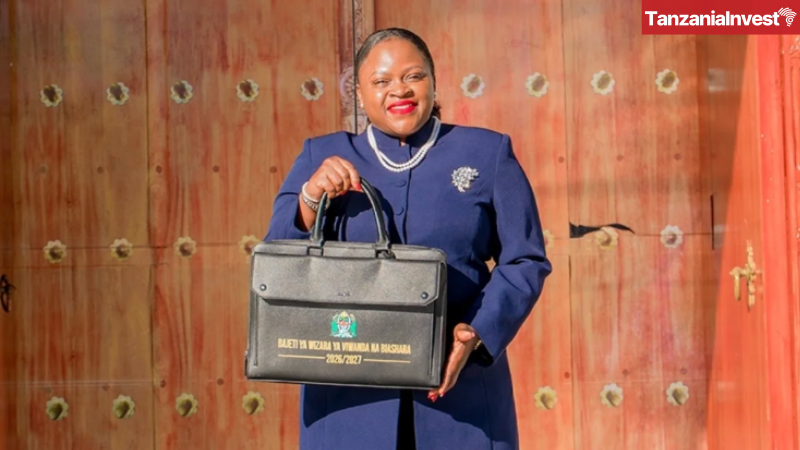
Tanzania’s Ministry of Industry and Trade has tabled a TZS 137.81 billion budget for the 2026/27 financial year, funding the Liganga-Mchuchuma iron and coal project, expanded access to the African Continental Free Trade Area (AfCFTA), and innovation and business hubs for youth.
The budget was presented to the National Assembly by Minister of Industry and Trade Judith Salvio Kapinga on 22 May 2026 in Dodoma.
The 2026/27 allocation marks an increase of about 1.5% from the TZS 135.79 billion approved for 2025/26.
The budget funds seven strategic priorities, with the entire development envelope financed from domestic sources.
Tanzania Industry and Trade Budget 2026/27 Structure
The Ministry has requested Parliament to approve TZS 137,812,633,000 for Vote 44 for the 2026/27 financial year.
Recurrent expenditure accounts for TZS 104,122,530,000 (75.6%), of which TZS 78,049,345,000 covers salaries and TZS 26,073,185,000 covers other operational charges.
Development expenditure accounts for TZS 33,690,103,000 (24.4%), financed entirely from domestic sources with no external component, against TZS 41.89 billion approved in 2025/26 of which TZS 14.02 billion was expected from foreign sources.
By April 2026, the Ministry had received TZS 95.63 billion of the 2025/26 budget, equivalent to 70.43% of the approved allocation, with recurrent funded at 79.45% and the domestic development component at 75.45%.
The shift to fully domestic development financing reflects the wind-down of donor-funded industrial programmes and a fiscal commitment by Treasury to finance the Ministry’s flagship projects internally.
Tanzania Industry and Trade Performance to April 2026
The industry sector contributed 5.9% to GDP in 2025, down from 6.8% in 2024, while the trade sector contributed 8.6%, unchanged from 2024.
Despite the lower GDP share, industry sector growth accelerated to 5.2% in 2025 from 4.9% in 2024, and trade sector growth rose to 5.1% from 4.9% over the same period.
The cement industry produced 10.3 million tonnes by April 2026 against a domestic demand of 8.5 million tonnes, with the surplus exported to Malawi, Zambia, the Democratic Republic of the Congo, Rwanda and Burundi.
Tanzania has 15 cement plants with installed capacity of 13.6 million tonnes a year, supporting 6,020 direct jobs and 20,280 indirect jobs.
A new cement plant by WIH Holding Limited in Kigoma, with installed capacity of 1.9 million tonnes a year, produced 1.5 million tonnes by April 2026 and created 800 direct and 3,050 indirect jobs.
The roofing sheets industry produced 350,000 tonnes of coloured sheets and 500,000 tonnes of white sheets by April 2026, with installed capacity of 410,000 and 700,000 tonnes a year respectively across five major producers.
The edible oils industry operates 1,604 plants with installed capacity of 2,527,739 tonnes a year, producing 302,000 tonnes against a national demand of 700,000 tonnes, with the 430,000-tonne shortfall met by imports.
The sugar industry operates seven plants and the steel industry continues to depend heavily on imports, with the Government targeting domestic substitution through the Liganga-Mchuchuma and Maganga Matitu projects.
By April 2026, 40 Tanzanian companies had traded under AfCFTA using a total of 500 Certificates of Origin, supporting the entry of Tanzanian goods into preferential trade markets across Africa.
Industry and Trade Priorities for 2026/27
The 2026/27 budget supports seven strategic priorities.
- continuing the implementation of flagship and strategic industrial projects;
- strengthening industrial production capacity by developing industrial clusters and estates for small and medium enterprises;
- driving industrial and trade development through innovation, technology, education, and skills;
- improving access to finance and capital for entrepreneurs and industrialists;
- improving the business environment and stimulating private sector growth;
- expanding market access for goods and services produced in Tanzania;
- establishing innovation and business hubs for youth.
The priorities are aligned with the Fourth National Five-Year Development Plan 2026/27-2030/31, the ruling party manifesto for the 2025 general election, the Ministry’s Medium Term Strategic Plan, and the Tanzania Development Vision 2050.
The Ministry has placed particular emphasis on the establishment of Innovation and Business Hubs for youth, citing the projection that digital trade will overtake goods trade in global commerce, and the need to position Tanzanian youth entrepreneurs to capture this market.
Strategic Flagship Industrial Projects
The Government has concluded negotiations with Chinese state-owned Shudao Investment Group Company Limited (SDIG) for the implementation of the Liganga iron and Mchuchuma coal integrated project.
SDIG acquired the project from the previous investor Sichuan Hongda Group Company Limited (SHG) and will deliver it in partnership with the National Development Corporation (NDC).
Joint Venture Agreements and Shareholders Agreements are expected to be signed in the first half of the 2026/27 financial year, with construction expected to be completed within three years.
The project is expected to save Tanzania USD 1.22 billion in foreign exchange annually, equivalent to TZS 3.2 trillion, by substituting steel product imports which currently rank as the second largest foreign exchange use after petroleum.
The Government and the investor have prepared a joint financial model projecting Government revenue from taxes and royalties over 25 years of USD 1.99 trillion, with project revenue drawn from electricity, coal, steel products, titanium, vanadium and aluminium sulphate.
The project is expected to create 6,500 direct jobs and 26,000 indirect jobs.
The Magadi Soda project in the Engaruka basin of Monduli district has paid compensation of TZS 5.82 billion, covering 98.7% of the 513 of 594 affected residents identified, with the Government Negotiation Team continuing to negotiate a joint venture contract with the winning bidder, in a project expected to save more than USD 121 million in annual foreign exchange.
The Maganga Matitu iron project, a joint venture between the Treasury Registrar and Fujian Hexingwang Industry Tanzania Co. Ltd, has paid TZS 4.196 billion in compensation to 380 of 385 affected residents, with plant equipment now arriving on site.
The Maganga Matitu iron deposit is estimated at 101 million tonnes and is intended to supply raw material to the domestic roofing sheets and steel industries.
Other strategic projects funded for 2026/27 include the Katewaka coal project, the rehabilitation of the Kilimanjaro Machine Tools Company (KMTC), and production of biological products at the Tanzania Biotech Products Limited (TBPL) plant.
Industrial Clusters and Small and Medium Enterprise Development
The TAMCO industrial cluster in Kibaha, Pwani region, hosts 14 factories across vehicle assembly, pharmaceuticals, medical devices, packaging and other production lines, of which 12 are operating, having created 853 jobs. New investors preparing to set up at TAMCO include Hyundai Automobile Manufacturing (vehicle assembly), Goodlife Investment Tanzania (electric vehicle assembly) and Sanda Max Group Limited (livestock feed).
The Ministry, working through the Small Industries Development Organization (SIDO), the Centre for Agricultural Mechanization and Rural Technology (CAMARTEC) and the Tanzania Engineering and Manufacturing Design Organization (TEMDO), will establish an industrial cluster in one district in each Mainland region.
The Ministry will facilitate access to markets and finance or credit for 3,000 entrepreneurs and deliver training and skills development to 21,200 entrepreneurs in 2026/27.
A demonstration factory for palm oil processing will be established in Kigoma to develop the domestic edible oils value chain.
The Tanzania Industrial Research and Development Organization (TIRDO) will establish a National Industrial Information Management System (NIIMS), conduct value chain research for rare minerals in Kagera (Kyerwa), Singida (Iramba) and Dodoma (Mpwapwa), build a demonstration factory for electronic equipment using locally sourced raw materials, and install a biogas plant in Dar es Salaam to convert waste at the Mabibo, Ilala Boma and Temeke Sterio markets into liquefied petroleum gas (LPG).
Trade and AfCFTA Implementation
The Ministry will coordinate negotiations and the implementation of bilateral, regional, and international trade agreements, including the African Continental Free Trade Area (AfCFTA), the East African Community (EAC), the Southern African Development Community (SADC) and the EAC-SADC-COMESA Tripartite Free Trade Area.
The Ministry will also continue work under the World Trade Organization (WTO) framework and on Tanzania’s National AfCFTA Implementation Strategy to expand the export of Tanzanian goods and services to African markets.
The Ministry will strengthen trade facilitation committees to resolve cross-border trade bottlenecks, expand the use of AfCFTA Certificates of Origin, and continue work to improve Tanzania’s ranking on the Ease of Doing Business indicators.
The Ministry will also establish the Innovation and Business Hubs for youth, providing physical workspaces and support for young entrepreneurs to develop digital businesses with regional and international market potential.
Want to know more about Industry in Tanzania? Our free overview of the Tanzania Business and Investment Guide 2026 covers Industry, plus key sectors and investment opportunities. The complete 141-page edition includes policies, taxation, key regulations, full macroeconomic data, and sources.
Download Free OverviewGet the Full Guide