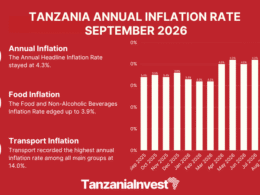



Tanzania’s annual headline inflation held steady at 3.2% in March 2026, unchanged from February, according to data released on April 8, 2026, by the National Bureau of Statistics (NBS).
The figure is measured by the National Consumer Price Index (NCPI), which tracks price changes across a fixed basket of 383 goods and services collected from households in all 26 regions of mainland Tanzania and serves as a key indicator for investors and businesses monitoring the cost environment in the country.
The overall NCPI rose from 119.27 in March 2025 to 123.04 in March 2026, reflecting a measured pace of price increases across the economy.

The annual Headline Inflation Rate remained within a narrow band of 3.2% to 3.6% throughout the 12-month period from March 2025 to March 2026, indicating broad macroeconomic price stability.
On a monthly basis, the NCPI increased from 122.01 in February 2026 to 123.04 in March 2026, a rise of 0.8%.
Table of Contents
- Food and Non-Alcoholic Beverages
- Non-Food Inflation
- Transport
- Housing, Water, Electricity, Gas and Other Fuels
- Clothing and Footwear
- Restaurants and Accommodation Services
- Furnishings, Household Equipment and Routine Household Maintenance
- Personal Care, Social Protection and Miscellaneous Goods and Services
- Alcoholic Beverages and Tobacco
- Health
- Education Services
- Information and Communication
- Recreation, Sport and Culture
- Insurance and Financial Services
- Energy, Fuel, and Non-Food Items
- Core and Supplementary Indices
Food and Non-Alcoholic Beverages
Food and Non-Alcoholic Beverages inflation—the category with the highest weight in the basket at 28.2%—eased to 5.5% year-on-year in March 2026, down from 5.7% recorded in February 2026.
On a monthly basis, food prices rose by 1.8% between February and March 2026, driven by price increases across a broad range of items.
Food items recording the largest monthly price increases included fresh cassava (8.2%), Irish potatoes (5.1%), sweet potatoes (4.5%), dried sardines (4.3%), fruits (3.8%), and vegetables (3.8%).

Other food categories posting monthly price gains included rice (2.6%), finger millet grains (2.3%), cooking bananas (2.3%), sorghum flour (2.2%), sorghum grains (2.0%), dried lentils (1.9%), dried beans (1.7%), maize grains (1.3%), bread and bakery products (1.3%), cassava flour (2.5%), maize flour (1.0%), fresh fish (2.4%), wheat grains (0.8%), groundnuts (0.5%), raw milk of cattle (0.6%), dried peas (0.3%), and beef (0.4%).
Non-Food Inflation
The inflation rate for all items excluding food and non-alcoholic beverages remained unchanged at 2.1% in March 2026, as recorded in February 2026.
The following categories contributed to non-food price movements during the month.
Transport
Transport recorded the second-highest annual inflation rate among all main groups at 4.2%, with a weight of 14.1% in the NCPI basket.
Its monthly index rose from 123.55 in February 2026 to 124.22 in March 2026, a monthly increase of 0.5%.
Housing, Water, Electricity, Gas and Other Fuels
The Housing, Water, Electricity, Gas and Other Fuels category—the third-largest component of the basket with a weight of 15.1%—recorded annual inflation of 1.6%, with its index rising to 119.82 in March 2026 from 117.97 in March 2025, and a monthly increase of 0.7%.
Clothing and Footwear
Clothing and Footwear recorded annual inflation of 1.3%, with its index rising to 115.99 in March 2026 from 114.49 in March 2025, and a monthly increase of 0.5%.
Monthly price increases in this category were driven by clothing materials (0.9%), garments for men (1.2%), garments for women (0.4%), and footwear for men and women (0.2%).
Restaurants and Accommodation Services
Restaurants and Accommodation Services recorded annual inflation of 2.1%, with its index rising to 119.07 in March 2026 from 116.67 in March 2025, and a monthly increase of 0.4%, driven by food and beverage serving services.
Furnishings, Household Equipment and Routine Household Maintenance
Furnishings, Household Equipment and Routine Household Maintenance recorded annual inflation of 2.3%, with its index rising to 117.82 in March 2026 from 115.13 in March 2025, and a monthly increase of 0.1%, with household furniture up 0.1% and household appliances up 0.2%.
Personal Care, Social Protection and Miscellaneous Goods and Services
Personal Care, Social Protection and Miscellaneous Goods and Services recorded annual inflation of 3.3%, with its index rising to 121.88 in March 2026 from 117.97 in March 2025, and a monthly increase of 0.3%.
Alcoholic Beverages and Tobacco
Alcoholic Beverages and Tobacco recorded annual inflation of 2.1%, with its index rising to 114.41 in March 2026 from 112.05 in March 2025, and a monthly increase of 0.1%.
Health
Health recorded annual inflation of 1.1%, with its index rising to 110.35 in March 2026 from 109.13 in March 2025, and a monthly increase of 0.4%.
Education Services
Education Services recorded annual inflation of 0.9%, with its index rising to 113.22 in March 2026 from 112.16 in March 2025, and a monthly increase of 0.6%.
Information and Communication
Information and Communication recorded annual inflation of 1.0%, with its index rising to 107.20 in March 2026 from 106.13 in March 2025, with no monthly change recorded in March 2026.
Recreation, Sport and Culture
Recreation, Sport and Culture recorded the lowest annual inflation among all main groups at 0.6%, with its index rising to 111.65 in March 2026 from 110.97 in March 2025, and a monthly increase of 0.1%.
Insurance and Financial Services
Insurance and Financial Services recorded the lowest annual inflation among all categories at 0.3%, with its index rising to 102.57 in March 2026 from 102.29 in March 2025, and a monthly increase of 0.1%.
Energy, Fuel, and Non-Food Items
Among non-food items contributing to monthly price increases, diesel recorded the largest gain at 4.7%, followed by charcoal (4.1%), petrol (2.5%), and kerosene (2.2%).
Products and materials for the maintenance of the dwelling rose by 0.3% on a monthly basis.
The Energy, Fuel and Utilities Index rose by 2.1% year-on-year and by 2.1% month-on-month in March 2026, reflecting sustained upward pressure from fuel prices.
Core and Supplementary Indices
The Core Inflation Rate—which excludes volatile items such as unprocessed food, energy, and utilities, except maize flour—edged up to 2.2% in March 2026, from 2.1% in February 2026.
The Core Index covers 297 items representing 73.9% of the total NCPI weight and provides policymakers with a more stable measure of underlying price trends.
The Non-Core Index, which captures the more volatile components of the basket, stood at 5.6% year-on-year in March 2026, with a monthly increase of 2.3%.
The Goods Index recorded annual inflation of 3.6%, while the Services Index rose by 2.4% year-on-year.
The Education Services and Products Ancillary to Education Index recorded annual inflation of 0.7%, while the All Items Less Food and Non-Alcoholic Beverages Index rose by 2.1% year-on-year.
The next NCPI release, covering April 2026, is scheduled for May 8, 2026.
Want to know more about the Economy in Tanzania? Our free overview of the Tanzania Business and Investment Guide 2026 covers the Economy, plus key sectors and investment opportunities. The complete 141-page edition includes policies, taxation, key regulations, full macroeconomic data, and sources, and is also available at no cost upon completion of a short form.
Download Free OverviewGet the Full Edition for Free