



The Bank of Tanzania (BOT) released its Monthly Economic Review for July 2026, covering key macroeconomic indicators for the year ending June 2026, with Tanzania’s exports of goods and services rising 17.2% to USD 19,923.6 million on gold, manufactured goods and tourism.
Credit to the private sector accelerated to 28.1% growth from 23.2% a month earlier, with lending to trade expanding 59.5% and to transport and communication 46.4%.
Headline inflation eased to 4.0% in June 2026, although the Monetary Policy Committee (MPC) subsequently raised the Central Bank Rate (CBR) to 6.25% from 5.75% for the third quarter of 2026.

Real GDP in Mainland Tanzania grew 6.0% in the first quarter of 2026 against 4.3% a year earlier, while gross official reserves reached USD 5,673.5 million, covering 4.4 months of imports.
Table of Contents
Inflation
Headline annual inflation eased to 4.0% in June 2026 from 4.2% in May 2026, remaining above the 3.3% of June 2025 but inside the national target range of 3% to 5%.
Core inflation, which excludes unprocessed food and energy, rose to 3.7% from 3.4% in May 2026 and 1.9% a year earlier, on higher transport and personal care costs.
Core inflation contributed 2.7 percentage points to the headline rate, its largest contribution in two years, which the Bank read as evidence of second-round effects from the energy shock.
Food inflation slowed to 4.1% from 5.6% in May 2026 and 7.3% a year earlier, as the harvest stabilised wholesale prices of maize, rice and beans.

Energy, fuel and utilities inflation climbed to 6.3% from 5.0% and 2.1% a year earlier, while transport was the fastest-rising basket category at 13.6% against 11.9% in May 2026.
Monetary Policy
The MPC held the CBR at 5.75% for the quarter ending June 2026 and narrowed the interest rate corridor to 150 basis points either side of the policy rate, a band of 4.25% to 7.25%.
At its meeting on 2 July 2026, the MPC raised the CBR to 6.25% for the third quarter, citing core inflation’s rise from 2.2% in March 2026 to 3.7% in June 2026.
The 7-day interbank cash market (IBCM) rate averaged 5.98% in June 2026, close to the policy rate, with the Bank injecting funds through reverse repo operations where liquidity distribution was uneven.
Extended broad money supply (M3) grew 25.5% in the year to June 2026, up from 25.2% in May 2026, while reserve money expanded 32.7%.
Trade recorded the strongest sectoral credit growth at 59.5%, ahead of transport and communication at 46.4%, agriculture at 39.9% and personal loans at 34.4%, while manufacturing lagged at 0.9%.
Interest Rates
The overall lending rate eased to 15.20% in June 2026 from 15.32% in May 2026, while the negotiated rate for prime customers edged up to 11.93% from 11.90%.
The overall time deposit rate rose to 8.60% from 8.43%, and the spread between one-year lending and one-year deposit rates widened to 5.66 percentage points from 5.22 percentage points.
Financial Markets
Government Securities
The Bank held two Treasury bill auctions with a combined tender size of TZS 552.1 billion (approximately USD 209.6 million), attracting bids of TZS 1,295.9 billion (approximately USD 492.0 million).
Accepted bids reached TZS 597.1 billion (approximately USD 226.7 million), above the amount offered, and the overall weighted average yield edged up to 4.83% from 4.74% in May 2026.
Auctions of 10-year and 25-year Treasury bonds carried a combined tender size of TZS 387.6 billion (approximately USD 147.2 million) and drew bids of TZS 1,539.6 billion (approximately USD 584.6 million).
Of those, TZS 269.8 billion (approximately USD 102.4 million) was accepted, with the 10-year yield to maturity rising 0.99 percentage points to 10.39% and the 25-year easing to 11.89%.
Interbank Cash Market
Turnover rose to TZS 2,508.7 billion (approximately USD 952.5 million) from TZS 1,732.7 billion, with 7-day tenors at 56.8% of volume and the overall rate easing to 6.0% from 6.14%.
Interbank Foreign Exchange Market
Turnover in the Interbank Foreign Exchange Market (IFEM) increased to USD 193.3 million from USD 119.3 million in May 2026, with the Bank making a net sale of USD 28.5 million.
The shilling averaged TZS 2,633.73 per US dollar against TZS 2,616.88 in May 2026, depreciating 0.08% year-on-year compared with 0.21% in the year to June 2025.
Government Budgetary Operations
Total government revenue reached TZS 3,259.4 billion (approximately USD 1.24 billion) in May 2026, exceeding target by 0.5%, with central government collections of TZS 3,152.4 billion representing 96.7% of the total.
Tax revenue came in at TZS 2,749.96 billion (approximately USD 1.04 billion), 5.2% above target, with income tax collections exceeding their monthly target by 32.9%.
Non-tax revenue of TZS 402.5 billion (approximately USD 152.8 million) fell short of its TZS 494.7 billion target, while total expenditure stood at TZS 4,018.4 billion (approximately USD 1.53 billion).
Debt Developments
The national debt stock stood at USD 50,595.8 million at end-June 2026, broadly unchanged on the previous month, with external debt accounting for 70.4%.
External Debt
External debt, public and private, edged up 0.1% to USD 35,606.1 million, of which 83.1% was public debt and the remainder private sector borrowing.
Loans disbursed during June 2026 amounted to USD 379.8 million, mainly to the central government, while debt service payments totalled USD 249.2 million, including USD 184.9 million in principal.
Multilateral institutions remained the largest creditor group at 59.3%, followed by commercial lenders at 34.4%, and the US dollar accounted for 66.2% of the currency composition.
Domestic Debt
Government domestic debt rose marginally to TZS 39,325.8 billion (approximately USD 14.93 billion), with the overdraft facility at the Bank the largest non-securitised component at TZS 6,011.4 billion, or 15.3%.
The Government mobilised TZS 468 billion (approximately USD 177.7 million) through securities in June 2026, while domestic debt service reached TZS 1,551.5 billion (approximately USD 589.1 million), including TZS 1,264.4 billion in principal.
External Sector Performance
Current Account
The current account deficit widened 7.0% to USD 2,303.9 million in the year ending June 2026, from USD 2,153.4 million a year earlier, as imports outpaced export growth.
The goods account deficit widened to USD 5,657.7 million from USD 4,580.0 million, while the services surplus improved to USD 4,765.6 million from USD 3,951.4 million.
Exports
Exports of goods and services grew 17.2% to USD 19,923.6 million, with goods exports up 19.2% to USD 11,782.7 million from USD 9,885.9 million a year earlier.
Gold remained the leading export at USD 5,522.9 million, up 36.4% from USD 4,049.1 million, supported by international prices averaging USD 4,228 per troy ounce in June 2026.
Manufactured goods exports rose 46.3% to USD 2,162.2 million on regional demand for iron and steel products, glassware and textiles, while tobacco gained 28.6% to USD 604.9 million.
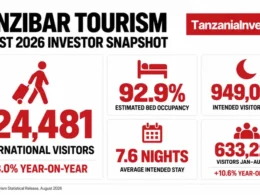
Service receipts grew 14.4% to USD 8,140.9 million, with travel earnings of USD 4,405.5 million supported by a 4.5% rise in international tourist arrivals to 2,291,479.
Transport receipts climbed 27.3% to USD 3,230.9 million on higher freight earnings from rising transit cargo volumes through the country’s corridors.
Imports
Imports of goods and services increased 18.1% to USD 20,815.7 million, with goods imports up 20.6% to USD 17,440.4 million on industrial supplies, petroleum products and capital goods.
Refined white petroleum products, at 16.2% of the total goods import bill, rose 19.5% to USD 2,826.9 million from USD 2,365.4 million on elevated global oil prices.
Service payments increased 6.7% to USD 3,375.3 million on higher freight costs, while the primary income deficit narrowed 11.8% to USD 1,773.2 million on lower interest payments to non-residents.
Foreign Exchange Reserves
Gross official foreign exchange reserves stood at USD 5,673.5 million at end-June 2026, sufficient to cover 4.4 months of projected imports of goods and services.
The position exceeded the national benchmark of four months and was underpinned by gold export earnings and the Bank’s domestic gold purchase programme.
Want to know more about Tourism in Tanzania? Our free overview of the Tanzania Business and Investment Guide 2026 covers Tourism, plus key sectors and investment opportunities. The complete 141-page edition includes policies, taxation, key regulations, full macroeconomic data, and sources, and is also available at no cost upon completion of a short form.
Download Free OverviewGet the Full Edition for Free