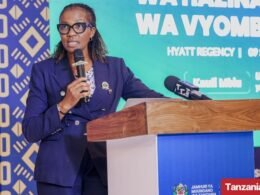


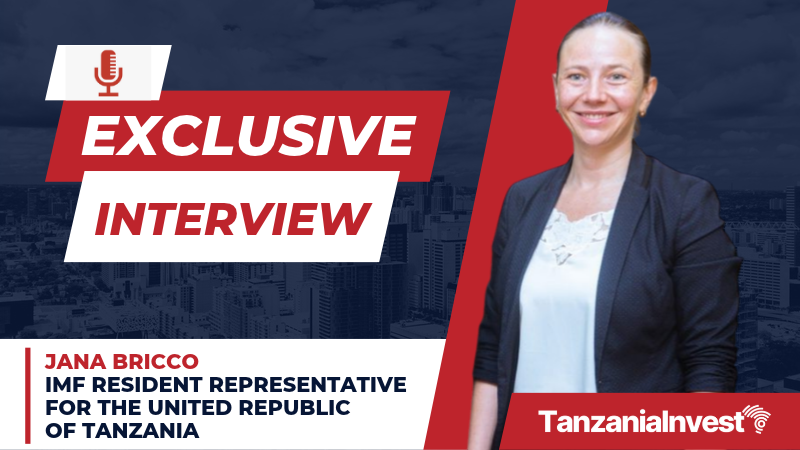
In this exclusive interview with TanzaniaInvest, Jana Bricco, the new Resident Representative of the International Monetary Fund (IMF) in Tanzania, discusses the country’s economic outlook, business environment reforms and the next phase of relations between Tanzania and the IMF.
Bricco was appointed to represent the IMF in Tanzania in March 2026 and took up the position in August 2026, succeeding Sebastian Acevedo, at the same time that Tanzania entered a new phase of engagement with the Fund following the completion of the Extended Credit Facility (ECF) and Resilience and Sustainability Facility (RSF) arrangements.
The interview examines Tanzania’s growth outlook and risks, fiscal management, private-sector development and access to finance, as well as the reforms the IMF considers necessary to improve tax predictability, reduce regulatory obstacles, increase private investment and support job creation.

Bricco also discusses climate resilience, foreign-exchange reserves and the Bank of Tanzania’s gold purchase programme, and explains how the IMF’s engagement with Tanzania is changing now that the country has completed the ECF and RSF programmes.
This interview is a must-read for investors, business leaders, policymakers and anyone seeking to understand the IMF’s assessment of Tanzania’s economy, the reforms it considers priorities and the future of the country’s relationship with the Fund.
Macroeconomic Overview
TanzaniaInvest: On July 10, 2026, the IMF Executive Board completed the sixth and seventh reviews under Tanzania’s Extended Credit Facility (ECF) arrangement, and the third and fourth reviews under the Resilience and Sustainability Facility (RSF) arrangement, reporting that GDP growth reached 5.9% in 2025, with inflation contained at 4.0% year-on-year in June 2026, and that accelerated reform implementation remains critical to sustain that growth. Which sectors are leading growth, and what do you see as the biggest risk to sustaining it this year?
Jana Bricco: Tanzania’s growth is being supported by sectors that matter directly for people’s lives—agriculture, transport, finance, industry, and services. Looking ahead, mining, agriculture, and tourism will remain especially important for jobs and growth.
“Tanzania’s growth is being supported by agriculture, transport, finance, industry, and services. Looking ahead, mining, agriculture, and tourism will remain especially important for jobs and growth.”
The main risk is that several shocks could come together at once: renewed social tensions at home, higher import costs or travel disruptions from tensions in the Middle East, and lower aid inflows. That could put pressure on confidence, prices, and the exchange rate.

So the priority is to protect macroeconomic stability while pushing ahead with reforms that help the economy become more productive, diversified, resilient, and job-rich.
Fiscal Performance
The reviews found that Tanzania recorded significant fiscal overspending in the first quarter of FY2025/26, before meeting the end-December primary balance target, and that the end-December quantitative performance criterion on net domestic assets was missed, with the authorities requesting a waiver. What caused the fiscal overspending, and what steps are being taken to prevent it from recurring?
The overspending was concentrated in the first quarter of the fiscal year and reflected front-loaded, unbudgeted election-related expenditure, including on defence and police. The authorities subsequently tightened expenditure control, while tax revenue performed strongly.
The lesson is that budget discipline and stronger commitment controls must be maintained throughout the year.
“Budget discipline and stronger commitment controls must be maintained throughout the year.”
This is an area where the IMF has longstanding expertise from working with many member countries, and where Tanzania could benefit from making fuller use of IMF capacity development in public financial management—especially commitment controls, cash management, and timely fiscal reporting.
Business Environment Reforms
The reviews said accelerated reforms to strengthen the business environment are critical to creating jobs for Tanzania’s growing population. Concretely, which reforms does the IMF consider most urgent, and when should investors expect to see them?
The most urgent reforms are the practical ones that make life easier for businesses—especially small and medium-sized firms. That means simpler and fewer regulatory obstacles and costs; a tax system that is more predictable and transparent; faster VAT refunds; and better consultation with the private sector before major changes are made.
Access to finance is also very important. Many Tanzanian businesses have ideas and ambition, but they need affordable credit to invest, grow, and create jobs. Reforms that improve credit information, land rights, insolvency procedures, and capital markets can help.
“The most urgent reforms are the practical ones that make life easier for businesses—especially small and medium-sized firms […] Access to finance is also very important. Many Tanzanian businesses have ideas and ambition, but they need affordable credit.”
The new secured transactions framework is a welcome step because it can help smaller firms use movable assets as collateral. Infrastructure reliability, governance, and regional integration are also essential.
And of course, growth is ultimately about people. Investing in education, health, nutrition, and skills will help Tanzania’s growing population drive—and benefit from—the country’s economic progress.
So the key message is: move from plans to implementation now. Clear responsibilities, timelines, and regular reporting on results will help build confidence. And the IMF is ready to support Tanzania with policy advice and capacity development.
Climate Resilience and Balance of Payments
The RSF arrangement was designed to support reforms that reduce prospective balance of payments risks and enhance economic resilience to climate change. What are the main balance of payments risks the IMF is monitoring for Tanzania right now?
The immediate risks come from higher import costs and weaker foreign-currency inflows. Tanzania imports most of its refined fuel, so a prolonged rise in oil prices caused by the war in the Middle East would increase the import bill and production costs.
Higher fertilizer prices could also affect agriculture and food prices. Disruptions to shipping and air travel could weaken trade and tourism. Tourism could also be weakened by renewed social unrest.
“The immediate risks come from higher import costs […] The appropriate response is to maintain a flexible exchange rate, adequate reserve buffers, prudent fiscal and monetary policies, and continued efforts to diversify exports and attract stable private investment.”
Gold exports have provided an important buffer, but this also creates exposure if gold prices were to fall sharply. Further reductions in external aid or tighter global financing conditions could add pressure on the shilling and reserves.
Against these shocks, the appropriate response is to maintain a flexible exchange rate, adequate reserve buffers, prudent fiscal and monetary policies, and continued efforts to diversify exports and attract stable private investment.
Separately, what climate resilience gaps remain the most urgent to address?
Tanzania has made important progress under the RSF, including by strengthening the framework for climate governance, disaster-risk management and land-use planning, introducing vulnerability maps, expanding the social registry, and improving the monitoring of climate risks in the financial system.
Building on this progress, climate considerations need to be embedded consistently across budgets, public investment plans, and sector strategies, while early-warning systems, disaster preparedness, and shock-responsive social protection should continue to be strengthened.
The most urgent remaining gaps relate to energy-sector reforms, as well as the broader challenge of implementation and financing.
Continued work is needed to align the power system master plan with Tanzania’s climate objectives, and to put the sector on a financially sustainable footing, supported by a cost-reflective tariff framework that protects poor and vulnerable households.
“Continued work is needed to align the power system master plan with Tanzania’s climate objectives and to put the sector on a financially sustainable footing.”
These reforms are important not only for climate resilience, but also for energy security, which depends on private investment, to support long-term growth.
A key priority going forward is mobilizing additional financial resources to enhance Tanzania’s long-term climate resilience.
The Climate Finance Roundtable planned for October 5 will bring together the authorities, development partners, and private investors to identify viable investment opportunities as well as priority reforms that can help unlock additional climate finance, particularly from the private sector.
Medium-term Outlook
The reviews projected medium-term GDP growth of around 6.2%, assuming a strong outlook for mining, agriculture, and tourism, while noting that downside risks have increased. What needs to go right for that 6.2% projection to hold, and what are the specific downside risks that could derail it?
For growth of around 6.0% over the medium term to be sustained, Tanzania must maintain low and stable inflation, preserve fiscal and debt sustainability, keep the exchange rate flexible, and accelerate reforms that support private investment, productivity and job creation.
“For growth of around 6.0% over the medium term to be sustained, Tanzania must maintain low and stable inflation, preserve fiscal and debt sustainability, keep the exchange rate flexible, and accelerate reforms that support private investment, productivity and job creation.”
As noted before, reliable infrastructure, better access to finance, more supportive regulatory and tax environments, and greater investment in education and health are central to this outlook.
The downside risks are both external and domestic. We already talked about external risk factors. Domestically, delays in reforms, weaker investor confidence, social tensions, climate shocks, or renewed foreign-exchange market and inflation pressures could derail growth.
The Next Phase
In August, at your arrival in Tanzania, you met with Finance Minister Ambassador Khamis Mussa Omar, to discuss private-sector growth, inflation, and the next phase of cooperation with the IMF following completion of the ECF and RSF programmes. What were the main outcomes of your meeting with Ambassador Omar, and what specific fiscal commitments, if any, did the government make for the post-programme period?
My discussion with the Minister focused on how to preserve the strong macroeconomic foundations Tanzania has built while advancing the next phase of its development agenda. We discussed the importance of private-sector-led growth, maintaining fiscal prudence and debt sustainability, and ensuring that Tanzania’s reform momentum continues beyond the ECF and RSF arrangements, which came to an end at the beginning of July.
We also discussed the growing challenges posed by climate change, including the risks associated with the upcoming El Niño period, which could potentially bring severe flooding and significant economic and social costs. We also discussed how the IMF can best support the authorities through policy dialogue and capacity development.
The fiscal commitments relevant for the post-program period are those set out publicly by the authorities. They include stronger domestic revenue mobilization, better tax administration, more efficient public investment, and maintaining fiscal prudence over the medium term.
“[With the Minister of Finance] we also discussed the importance of improving spending efficiency and creating additional fiscal space to address the pressing challenges of rapid population growth, especially with regard to human capital development.”
We also discussed the importance of improving spending efficiency and creating additional fiscal space to address the pressing challenges of rapid population growth, especially with regard to human capital development.
You also met with Bank of Tanzania (BoT) Governor Emmanuel Tutuba, who briefed you on measures to stabilize the shilling, including a gold purchase programme to build foreign exchange reserves. What is your assessment of the gold purchase reserve-building strategy?
Building reserves is a sound objective. Adequate reserves help Tanzania manage external shocks and support confidence, and domestically purchased gold can contribute to that objective.
We welcome that BoT has reached its target holdings of domestically purchased gold and plans to sell some of its gold to increase the foreign-exchange share of reserves. This will help diversify reserve holdings, preserve liquidity, and reduce the risk that gold price fluctuations affect reserve adequacy.
Does the IMF expect Tanzania to require another financing arrangement in the future, or will the relationship now focus primarily on surveillance, policy advice and technical assistance?
The authorities have not requested a new IMF financing arrangement. Growth is solid, inflation is under control, reserves are adequate, and debt remains sustainable. For now, the relationship will focus on policy dialogue and capacity development in areas where the IMF can add value, such as revenue mobilization, public financial management, financial sector development, statistics, and climate resilience.
Our policy advice will be geared in particular at helping Tanzania tap its significant potential and turn macroeconomic stability into stronger private-sector growth, more jobs, higher productivity, and faster poverty reduction.
“Our policy advice will be geared toward helping Tanzania tap its significant potential and turn macroeconomic stability into stronger private-sector growth, more jobs, higher productivity, and faster poverty reduction.”
Of course, the IMF would be ready to support Tanzania if conditions were to change and the authorities determined that a new Fund arrangement would help support the implementation of their economic program.
What message would you like to convey to Tanzania’s policymakers, businesses and investors about the country’s economic outlook and priorities for the years ahead?
For policymakers, that means staying disciplined on stability while moving faster on practical reforms: making it easier to do business, improving tax predictability, expanding access to finance, investing well in infrastructure and people, and reducing barriers to trade and investment.
For businesses and investors, Tanzania offers important opportunities—in agriculture, mining, tourism, energy, manufacturing, and as a regional hub for trade and investment. Again, realizing that potential will depend on steady progress in reforms, governance, infrastructure, and climate resilience.
“Tanzania offers important opportunities in agriculture, mining, tourism, energy, manufacturing, and as a regional hub for trade and investment.”
So the message is: Tanzania’s outlook is positive, its potential is strong, but the priority now is implementation. The faster reforms move from plans to results, the sooner growth can translate into jobs, confidence, and better opportunities for Tanzanians.
Want to know more about the Economy in Tanzania? Our free overview of the Tanzania Business and Investment Guide 2026 covers the Economy, plus key sectors and investment opportunities. The complete 141-page edition includes policies, taxation, key regulations, full macroeconomic data, and sources, and is also available at no cost upon completion of a short form.
Download Free OverviewGet the Full Edition for Free