




EACOP
EACOP is one of Tanzania's flagship infrastructure projects, designed to anchor the country as a critical hub in the regional energy supply chain.
Once operational, the pipeline will position Tanzania as a key crude oil transit and export corridor for the East African region, generating transit revenues and unlocking logistics-related investment opportunities.
The project is expected to be completed by July 2026.
Project Overview and Route
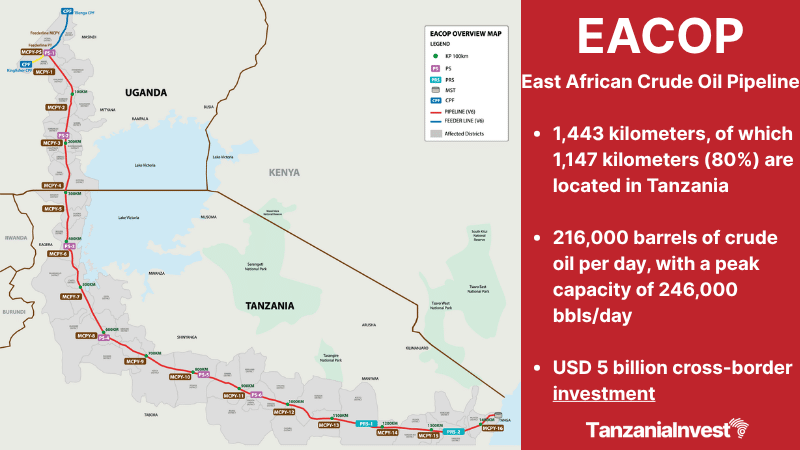
EACOP is a cross-border export pipeline transporting crude oil from Uganda's Lake Albert oilfields to the Port of Tanga in Tanzania for global export.
The pipeline spans a total length of 1,443 kilometers, of which 1,147 kilometers (80%) are located in Tanzania.
It is designed to transport up to 216,000 barrels of crude oil per day, with a peak capacity of 246,000 bbls/day.
The project includes associated infrastructure such as pumping stations, storage facilities, and a marine export terminal at Tanga.
Investment Size and Shareholding
The project represents an investment of approximately USD 5 billion aimed at enhancing Government revenue, improving logistics, facilitating skills and technology transfer, and strengthening the trade corridor between Uganda and Tanzania.
TotalEnergies, 62%
UNOC (Uganda), 15%
TPDC (Tanzania), 15%
CNOOC (China), 8%
The shareholders comprise TotalEnergies (62%), Uganda National Oil Company Limited (UNOC, 15%), Tanzania Petroleum Development Corporation (TPDC, 15%), and China's CNOOC (8%).
This ownership structure underscores the project's strategic significance as a multilateral energy venture linking East Africa with global capital markets.
Strategic Importance for Tanzania
EACOP forms a central pillar of Tanzania's infrastructure program supporting trade logistics and industrial growth.
By transporting crude oil from Uganda's Lake Albert region to Tanga Port, the pipeline establishes Tanzania as a critical link in the regional energy supply chain.
The project is expected to generate transit revenues, attract logistics-related investment, and reinforce Tanga as a strategic export node.
Fitch projects Tanzania's real GDP growth to remain strong at 6% in 2026 and 2027, supported by strong infrastructure investment in flagship projects including the EACOP pipeline and the SGR railway.
Integrated ICT and Connectivity Benefits
Beyond crude oil transport, EACOP integrates advanced fiber-optic cables that can increase the capacity of local operators.
This component supports wider and faster internet connectivity in both Uganda and Tanzania, embedding a digital infrastructure layer into the energy corridor.
The pipeline therefore delivers both energy transit and ICT enablement, multiplying its developmental footprint along the route.
Power Supply and Project Alignment
EACOP is recognized as one of Tanzania's strategic projects requiring a reliable power supply, alongside the Standard Gauge Railway (SGR) and the Liquefied Natural Gas (LNG) Project.
Government energy targets include providing dedicated and reliable power to these strategic projects to ensure uninterrupted operations.
This alignment integrates EACOP into the country's broader energy planning, including renewables expansion and grid reliability commitments.
Investment Opportunities
Once operational by July 2026, EACOP will position Tanzania as a key crude oil transit and export corridor for the East African region, opening multiple investment avenues.
Logistics-related opportunities include port services at Tanga, storage facility operations, marine export terminal services, and pumping station support contracts.
Ancillary opportunities arise in fiber-optic and ICT services leveraging the pipeline's integrated digital infrastructure, expanding internet connectivity along the corridor.
Skills and technology transfer associated with the USD 5 billion investment also creates demand for local engineering, procurement, and construction (EPC) services, technical training providers, and specialized petroleum-sector suppliers.
Transit revenues and logistics flows along the trade corridor between Uganda and Tanzania further support investment in warehousing, freight handling, and corridor infrastructure development.
Last Update: May 2026
References
- https://tazama.co.zm/ (Guide reference #94)
- https://www.ewura.go.tz/pages/petroleum-infrastructure (Guide reference #95)
- https://www.ewura.go.tz/uploads/documents/en-1744207225-Natural%20Gas%20Sub-Sector%20Performance%20Report%20FY%202023-24%20%E2%80%A2pdf.pdf (Guide reference #96)
- https://www.nishati.go.tz/uploads/documents/en-1754048957-National%20Renewable%20Energy%20Strategy%202024%E2%80%932034.pdf (Guide reference #99)
- https://www.nishati.go.tz/uploads/documents/en-1754049550-National%20Renewable%20Energy%20Strategy%202024%E2%80%932034.pdf (Guide reference #102)
