On 17th October 2024, the International Monetary Fund (IMF) announced a staff-level agreement with Tanzanian authorities regarding the fourth review under the Extended Credit Facility (ECF) and the first review under the Resilience and Sustainability Facility (RSF).
Subject to approval from the IMF Executive Board, the agreement will facilitate the release of SDR 198.61 million (approximately US$ 265.78 million), raising the total IMF financial support under the ECF to SDR 568.84 million (around US$ 758.11 million) and SDR 85.24 million (about US$ 114.07 million) under the RSF.
This follows discussions held by a staff team from the IMF led by the IMF mission chief for Tanzania Charalambos Tsangarides with Tanzania’s Minister of Finance, Dr. Mwigulu Nchemba, Bank of Tanzania Governor (BoT), Mr. Emmanuel Tutuba, other senior officials, development partners, and private sector representatives, in October, in Dodoma and Dar es Salaam.

After the mission, Tsangarides highlighted: “I am pleased to announce that the IMF team and the Tanzanian authorities have reached a staff-level agreement on the policies needed to complete the fourth review under Tanzania’s ECF-supported program and the first review of the RSF arrangement. The IMF’s Executive Board will discuss these requests in the coming weeks.”
“Supported by the RSF, the authorities are implementing their climate reform agenda to address climate policy challenges and enhance the resilience and sustainability of the Tanzanian economy. Efforts are underway to clearly define the institutional framework for climate change-related policies and strengthen public investment management in line with climate impacts and risks. Progress on the implementation of the RSF reforms continues, and the authorities are mobilizing technical and financial assistance from development partners,” added Tsangarides.
For his part, Sebastian Acevedo, the IMF resident representative for Tanzania, discussed the staff-level agreement during a recent CNBC Africa interview.
He highlighted Tanzania’s strong economic performance, noting a positive growth outlook and effective management of inflation, which has remained around 3%.
Acevedo emphasized the need for further flexibility in Tanzania’s foreign exchange market to alleviate liquidity concerns and allow the exchange rate to reflect market forces. While acknowledging recent improvements in the interbank market, he indicated that more could be done to enhance access to foreign currency for firms.

He stressed that “Tanzania’s economic performance so far has been very good under the IMF-supported program. The outlook for the economy is positive, with growth picking up this year, up from last year. And the track record of the Tanzanian authorities in implementing the reforms under the program has been very good so far.”
This staff-level agreement follows the IMF and the World Bank’s (WB) announcement made on 13th October 2024, declaring Tanzania as the second country, after Madagascar, to benefit from the Climate Resilience Partnership Framework to address climate change and the adverse effects of environmental degradation.
The IMF will support the establishment of climate-resilient public investment regulations and reporting, while the WB will focus on helping implement projects in sectors that will strengthen Tanzania’s ability to cope with climate change, such as energy, water, social protection, and agriculture.
The institutions will also assist in improving and implementing Tanzania’s disaster risk management policy, including funding systems to address these risks and strengthening the social safety net to cope with climate-related disasters.
Additionally, the IMF and the WB will support policies to improve water resource management, expand planning and management of sustainable land use in rural areas, manage climate risks in the economy and finance sectors, and provide technical and financial assistance, including involving the private sector.
Tanzania Economy and IMF
According to the IMF, the Tanzanian economy is showing signs of strong momentum in 2024, with economic activity projected to grow by approximately 5.4% in the first half of the year, following a growth rate of 5.1% in 2023.
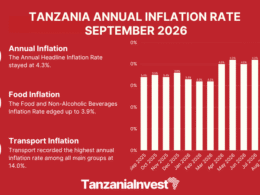
Inflation remained stable at 3.1% year-on-year as of September, well within the Bank of Tanzania’s target range, and the current account deficit improved decreasing to about 3.1% of GDP for FY2023/24 from 6.5% the previous year.
IMF involvement in Tanzania’s economic transformation and programs has evolved in three phases: liberalization, 1986–95; macroeconomic stabilization and structural reform, 1996–2006; and consolidation of reforms and policy support since 2006.
As IMF’s financing has become less critical for Tanzania, the fund provides policy advice to the country via its Policy Support Instrument (PSI), designed for low-income countries that do not want—or need— IMF’s financial assistance, a tool that provides advice and support without a borrowing arrangement.
In May 2024, upon the approval of the IMF executive board, Tanzania was set to receive approximately US$ 150 million under the third review of the ECF and requested access to US$ 789.6 million from the RSF.
Want to know more about the Economy in Tanzania? Our free overview of the Tanzania Business and Investment Guide 2026 covers the Economy, plus key sectors and investment opportunities. The complete 141-page edition includes policies, taxation, key regulations, full macroeconomic data, and sources, and is also available at no cost upon completion of a short form.
Download Free OverviewGet the Full Edition for Free